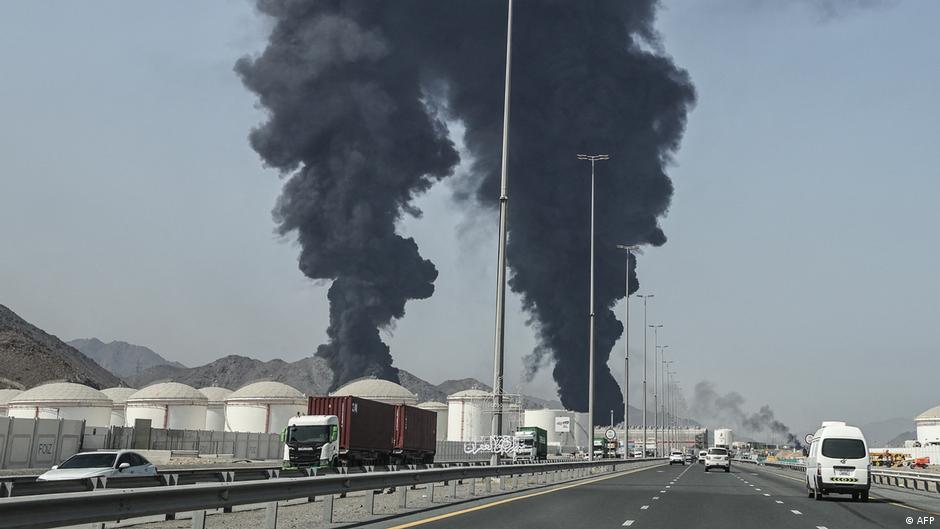
Since the start of the Iran war, Gulf states have taken possession of thousands of Iranian missiles and drones, with Tehran targeting targets including US military bases and civilian energy infrastructure.
On Monday, Kuwait said its air defenses were defending against missile and drone attacks after the US said it had targeted radar and drone sites in southern Iran.
Because of their proximity to Iran and coordination with Washington, Gulf Cooperation Council (GCC) countries are particularly vulnerable when tensions rise.
In the unlikely event that the war, still ruled by the Islamic Republic, brings a negotiated end to the war, the long-term question for the region will be how the GCC countries and Tehran can proceed.
Gulf Arab countries have told Washington that simply ending the war is not enough and have stressed that Iran’s ability to threaten the region with missiles and drones must be curtailed.
Babak Dorbeki, a London-based political analyst and former official at Iran’s Center for Strategic Research, said, “If Iran and the United States reach an agreement, and Iran abandons its state of hostility with the West, it will have to take significant diplomatic and economic steps to improve its regional conditions and relations with its neighbors.”
Dorbachy told DW that from Tehran’s perspective, the GCC countries it has targeted in the current war are not “neutral actors,” but they have played some role in pressure campaigns against Iran, whether hosting US troops, providing military assistance or indirectly supporting military action.
Dorbachy said that in the short term Iran’s neighbors are likely to view Tehran with deeper suspicion and more caution. This will have implications not only for diplomacy, but also for trade routes, regional infrastructure and future transport and energy corridors.
Gulf countries want regional stability
In late April, leaders of the GCC countries met for the first time in Saudi Arabia to coordinate a response to Iranian attacks. Between the start of the war on 28 February and the declaration of a ceasefire on 8 April, Iran launched more than 4,000 missiles and drones at targets in the GCC, most of which were intercepted.
Although the frequency of Iranian attacks has decreased, the Gulf states’ economies and infrastructure are still in a vulnerable state amid regional instability. During the GCC talks in April, Qatar’s Foreign Ministry warned against the possibility of a “frozen conflict” that could heat up “every time there is a political reason”.
The United Arab Emirates (UAE) said Iran must stop attacking neighboring states if diplomacy is to move forward, while Saudi Arabia warned Tehran not to target the kingdom or other Gulf states.
Tehran has alienated some countries that have extended a helping hand in the past during conflicts with the US and Israel.
The UAE, along with non-GCC countries Iraq and Turkey, played a key role in trade, finance and re-export channels, which gave Iran a breathing space amid international sanctions.
Rivalry existed, especially in the oil and gas markets, but a working balance still emerged. If Gulf states increasingly coordinate their distrust of Tehran, the consequences could extend beyond politics to trade, logistics and long-term regional development.
need for geography
Paris-based political analyst Reza Alijani told DW that the physical proximity of Iran and its Gulf neighbors will force some degree of adjustment.
“Geography will always be more powerful than politics. These countries will always be neighbours,” he said.
Alijani said, however, that there is a clear distinction between rebuilding relations and rebuilding trust, the most likely outcome of which is not genuine reconciliation but a strategic reduction in open hostilities.
Shared interests, particularly in energy exports, trade and regional stability, could ultimately push both sides toward a limited engagement, he said.
But this does not necessarily mean an end to hostilities. It may simply mean a cooler, more carefully managed rivalry.
Iran’s projection of power in the Middle East
The Islamic Republic has built much of its regional influence on missiles, drones, and proxy militias. That model was designed to deter stronger adversaries and expand Iran’s leverage without direct conventional confrontation.
After the current war, and the overall collapse of Iranian proxies such as Hezbollah and Shia militias in Iraq, Arab states are likely to place greater emphasis on integrated defense, economic coordination, and alternative energy and trade corridors that reduce the risk of Iranian pressure.
Dorbacki said mutual suspicion of Tehran itself could become a driver of closer commercial cooperation between Arab states and their allies, which could further isolate Iran from emerging trade corridors, transportation links and future energy infrastructure.
However, no regional system could be completely stable, while Iran remained permanently outside it.
Real normalization of relations will require serious changes in Tehran’s regional policy, a less confrontational relationship with the West, and a sustained effort to reassure neighbors that Iran is willing to pursue stability rather than seek leverage through fear. At the moment, hostilities are still ongoing and the Iranian regime remains in power with the same policies.
Edited by: Wesley Rahn