
Bitcoin ETFs had the largest run of capital outflows since their launch.
The largest buyer of bitcoin, Strategy, made its first sale in 4 years.
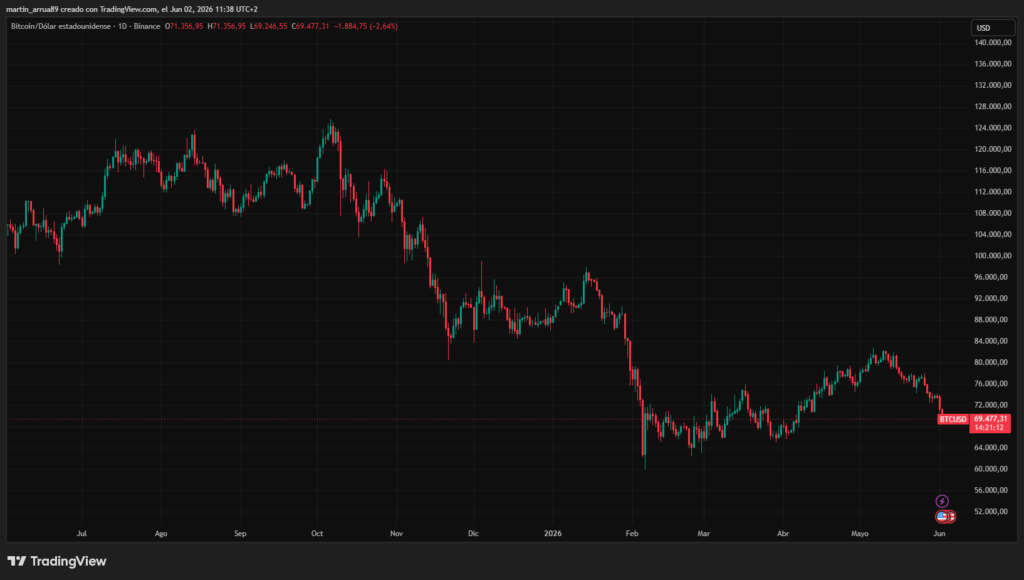
Bitcoin (BTC) lost the $70,000 level on June 2, 2026 and deepened the correction that began in recent days.
At the time of publication of this note, The digital asset is trading near $69,80044% below its all-time high (ATH) of $126,000.
The fall occurs in a context marked by growing risk aversion in global markets. On the one hand, tensions between the United States and Iran continue. On the other hand, Russia launched one of the largest air strikes in recent months on Ukraine.
According to reported Reuters, Russian forces fired 656 drones and 73 missiles into Ukrainian territory overnight, mainly over kyiv. Local authorities reported at least 11 dead and more than 100 injured. The Russian Defense Ministry confirmed having carried out a “massive attack” against Ukrainian defense industry facilities.
At the same time, Iran suspended indirect exchanges of messages with the United Statesa decision that complicates diplomatic efforts to reduce tensions in the Middle East.
For the markets, these events have implications that go beyond the military level. The conflict keeps the Strait of Hormuz, one of the most important routes for global oil transportation, affected.

And this not only increases the risk of disruptions in global energy supplies, but inflation fears are also growing. For these reasons, they are reduced expectations of interest rate cuts by central bankswhich generates downward pressure on assets considered risky, such as bitcoin and cryptocurrencies.
Strategy sells bitcoin again
In the midst of this scenario, The market also processed Strategy’s first bitcoin sale since 2022.
The company chaired by Michael Saylor informed the United States Securities and Exchange Commission (SEC) that between May 26 and 31, it sold 32 BTC for approximately $2.5 million.
Although the operation represents a minimal fraction of its holdings, the news generated concern among some investors because it is the main corporate buyer of bitcoin.
Strategy currently holds 843,706 BTC in treasury, making it the publicly traded company with the most BTC in the world.
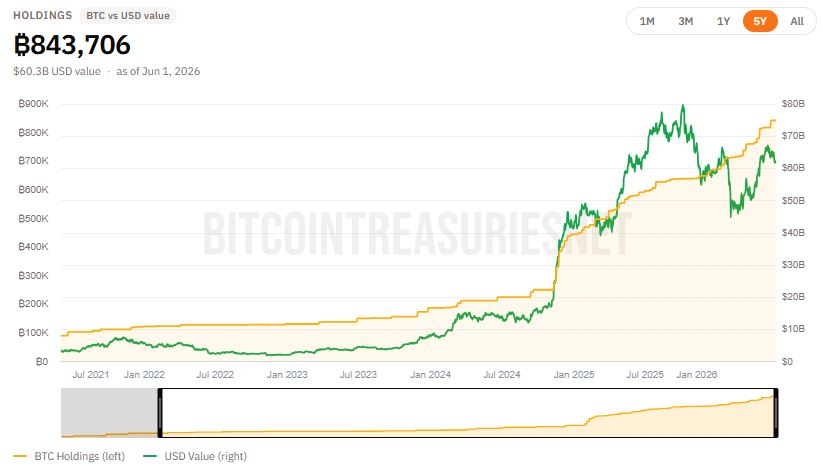
Although this is a small sale compared to the bitcoin that Strategy maintains in treasury, The movement occurs in a context of fragility for bitcoin and that is why it had an impact on the market.
The concern is not only about the BTC sold, but also about the precedent it sets. If Strategy, with the financial backing and capital structure it has built over the last few years, begins to sell part of its BTC to cover obligations, The question that arises is what margin other companies with less financial muscle have in the face of a longer bearish scenario.
ETFs record their worst streak since launch
The bearish pressure is also reflected in US spot bitcoin exchange-traded funds (ETFs). As CriptoNoticias has reported, these financial instruments have accumulated 11 consecutive days in the red, the longest negative streak since its launch, in January 2024.
Yesterday, June 1, $483.8 million was withdrawn from these ETFs. Most of that figure corresponded to BlackRock’s IBIT, which recorded outflows of $440.3 million. The only exception was Morgan Stanley’s MSBT, which raised $6.14 million.
From May 15 to June 1, ETFs recorded outflows of more than $3.45 billion.
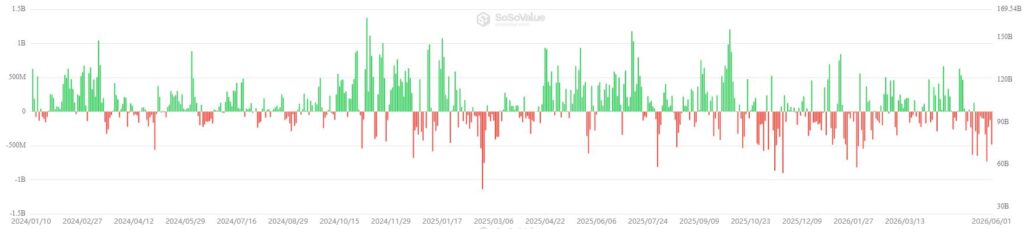
Due to its operation, The performance of these financial products has a direct impact on the price of BTC. This happens because, when capital enters these funds, the managers must buy BTC in the market. Conversely, when shortfalls occur, managers may be forced to sell part of their holdings to return money to investors.
This accumulation of news has a full impact on bitcoin, which now needs a signal capable of cutting the short-term downward trend.
A possible catalyst would be the end of the conflict between the United States and Iran, along with the reopening of the Strait of Hormuz and the normalization of oil transportation. Until that happens, The market will continue to operate under pressure.