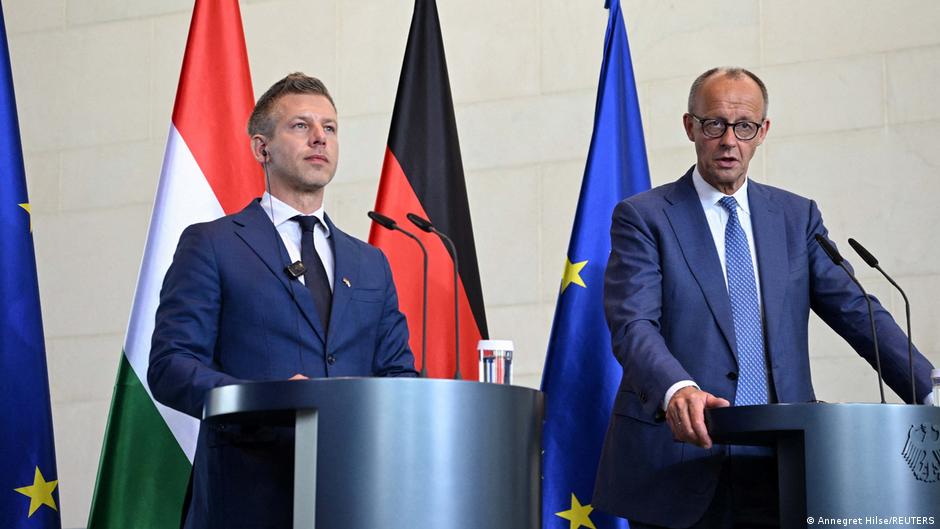
German Chancellor Friedrich Merz on Tuesday pledged full support to Hungary’s new Prime Minister Peter Magyar to bring the country back into mainstream Europe.
Merz praised the Magyars during the Hungarian Prime Minister’s inaugural visit to Berlin, calling their election victory over Viktor Orban inspirational for Europe and vowing to help ensure a successful new start.
What did Merz and Magyar say about Hungary and the EU?
Welcoming Hungary’s new leader, Merz said that the Magyars are “the great beacon of hope of our times” for many Hungarians.
“They have given them a clear mandate,” he said. Merz said, “Democracy and the rule of law are once again strong in Hungary. We have confidence in him to take Hungary back to the center of Europe.”
Magyar promised that Hungary would act as an “honest and reliable partner” within Europe. He said disagreements were inevitable but stressed that Budapest would not use a veto “in principle” and said, “I believe in dialogue.”
Orbán had spent years using Hungary’s veto power to block major EU decisions, most recently delaying the approval of a €90 billion loan for Ukraine.
Magyar’s conservative Tisza party decisively defeated Orbán’s nationalist Fidesz in the April election, winning a two-thirds majority and promising sweeping systemic reforms.
What did the Magyars say about Ukraine?
However, Magyar has indicated only a partial change in Ukraine policy. In Berlin, he reaffirmed that Hungary will not send arms or troops to Ukraine, a stance praised by Moscow.
He also plans to block the start of EU accession negotiations with Ukraine until the rights of Hungarian ethnic minorities there are guaranteed, especially with regard to Hungarian language education.
According to Hungarian estimates, 100,000 ethnic Hungarians live in the western Ukrainian region of Transcarpathia.
Still, Magyar said he hopes to find success soon. He said technical talks could end this week and if so, he would be ready to meet with Ukrainian President Volodymyr Zelensky next week to open “a new chapter” in bilateral relations.
Merz said this should happen as soon as possible.
“We understand that Budapest wants to resolve bilateral issues first, such as the rights of the Hungarian minority in Ukraine,” Merz said at the meeting in Berlin.
“However, this should not come at the expense of European support, nor should it prevent us from our aim to formally launch accession negotiations with Ukraine, starting with the first chapter.”
Edited by: Wesley Rahn