
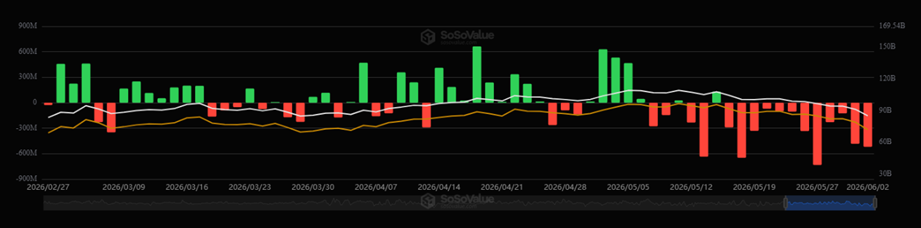
The bitcoin (BTC) spot ETF market in the United States extended its negative streak to at least 12 consecutive days of net outflows, in data updated as of June 3, 2026, in a context of sustained selling pressure and weakening institutional flows.
The movement has led to accumulated withdrawals close to USD 4 billionwhich constitutes the longest period of exits since the launch of these products in January 2024, in parallel with a correction in the price of bitcoin and a general adjustment in the risk appetite in the market.
A single day within the sequence, June 2, recorded outflows of around USD 733 millionprolonging a trend that began to intensify at the end of May and that, according to different market data aggregates, continues without clear signs of reversal.
Likewise, assets under management of bitcoin ETFs have fallen from about $106 billion at the start of the streak to about $85 billion today, which implies a reduction close to 20%. This drop does not respond only to negative flows, but also to the depreciation of the price of bitcoin during the period, which reduces the dollar value of holdings, in addition to the additional pressure derived from net outflows.
The pressure has been concentrated on the main vehicles on the market. The iShares Bitcoin Trust (IBIT), from BlackRock, leads the outflows with approximately USD 2,939 million in accumulated withdrawals during the period, while the Fidelity Wise Origin Bitcoin Fund (FBTC) registers outflows close to USD 403 million, reinforcing the concentration of the negative flow in the funds with the largest market share.
It is worth noting that the movement occurs in parallel to a correction in the price of bitcoin, which after being rejected in the USD 82,000 area, fell approximately 15% in the last monthcurrently moving in a range close to USD 65,000.
A market under pressure and divided opinions
The interpretation of the phenomenon divides the market. On the one hand, flow data providers such as SoSoValue They consider that the streak reflects a change in institutional appetite after months of inflows during 2025which would suggest a cooling phase of the cycle and tactical reduction of exposure, as reported by CriptoNoticias.
On the other hand, analysts focused on the microstructure of the bitcoin market maintain that the movement responds mainly to a profit-taking phase after the strong previous appreciation of the asset, in which institutional investors would have gradually reduced exposure without necessarily implying a structural change in trend.
Along these lines, some analysts such as Eric Balchunasfrom Bloomberg Intelligence, have pointed out that this type of exit is usually fit with rebalancing and profit taking after periods of strong increases, rather than with a loss of conviction in the asset.
It is worth noting that, despite recent pressure, bitcoin ETFs continue to represent a significant portion of the asset’s circulating supply and maintain positive cumulative net flows since their approval, indicating that the institutional adoption process has not been reversedalthough it does show greater sensitivity to liquidity conditions.
For now, the episode reinforces a trend already visible in recent months: the price of bitcoin is increasingly conditioned by institutional flows channeled through ETFs and by the global liquidity cycle. In this scenario, the evolution of the next few days will be key to determining whether the market enters a stabilization phase after the correction or if an environment of prolonged pressure on institutional demand consolidates.