
Justin Drake, co-author of the Google paper, confirmed that the US prevented the method used from being revealed.
For Ledger’s CTO, public post-quantum migration schedules no longer reflect reality.
The United States government prevented Google from publishing the complete systems used in its paper published last March on Bitcoin and the quantum threat, as confirmed by Justin Drake, one of the main developers of the Ethereum Foundation (EF) and co-author of the study, in a publication on X this June 1.
According to Drake, that omission was not Google’s choice:
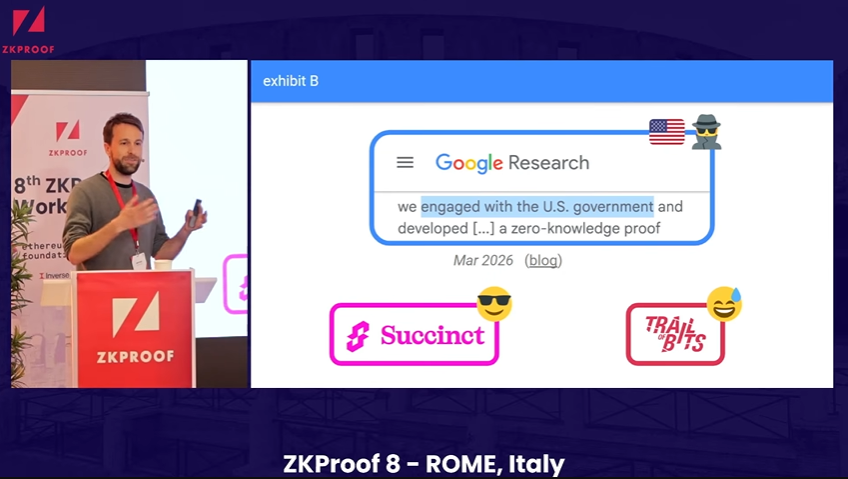
Instead of following the standard academic process, the optimizations were kept secret, hidden behind a zero-knowledge proof. Google’s blog post mentions that they ‘collaborated with the US government.’
Justin Drake, developer of the Ethereum ecosystem and co-author of the Google Quantum AI paper.
Drake claimed to have witnessed the context surrounding that decision and claimed to be limited in its ability to reveal more details, but he described what happened as “academic censorship.”.
The Ethereum Foundation collaborator did not specify which government agency intervened or what arguments were invoked to justify the block. The most direct inference is that the US government considered that publishing the complete circuits was equivalent to delivering an attack manual to strategic adversaries.
Regarding the threat status, Drake, in his publication, reiterated his estimate of a 50% probability that a quantum computer could break the cryptography used in networks like Bitcoin and Ethereum before 2032, and by 10% before 2030.
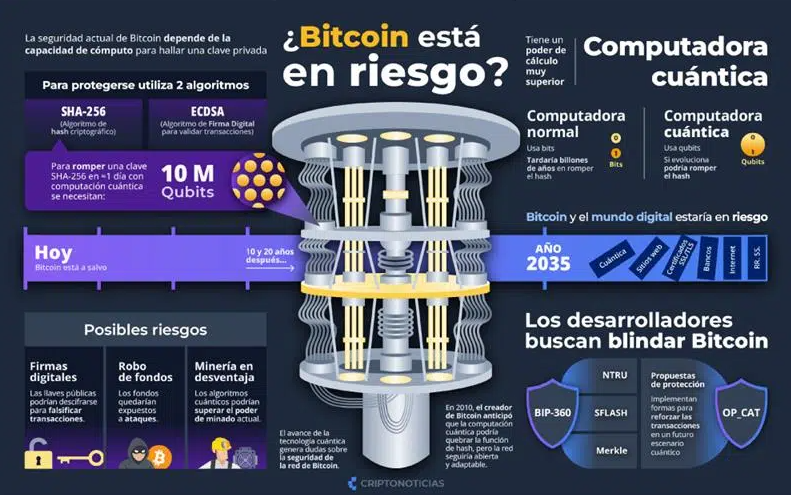
As CriptoNoticias reported, the paper of the Google team indicated that a quantum computer could compromise Bitcoin cryptography in less than 9 minutes with less than 500,000 physical qubits (20 times fewer resources than thought), but Google Quantum AI did not reveal the circuits that would make that attack possible. Instead, Google researchers published a zero-knowledge proof instead (ZK) that verified the existence of those circuits without showing them.
However, this past June 1, researcher André Schrottenloher reconstructed and published the quantum systems that Google Quantum AI kept in reserve and claimed to have achieved more efficient results than those reported by Google.
Ledger’s CTO referred to the US government’s impediment.
Charles Guillemet, chief technology officer at Ledger, reflected on what Drake pointed out:
Google did not choose to keep the circuits private. The US government blocked its publication. The blog put it diplomatically (‘we engaged with the US government’). You have to call it what it is: diplomatic cover for a publication block.
Charles Guillemet, CTO of Ledger.
The executive maintained that cryptographer Scott Aaronson had warned about that threshold (the moment when researchers who estimate the resources to break cryptosystems in use would stop publishing) and that that moment has already occurred: «The actor imposing silence is not Google’s public relations team. “It is a government.”
Guillemet also does not position recent developments as an immediate breaking point for Bitcoin: «There is still no quantum computer capable of executing these circuits». What did change, according to the executive, is the credibility of the institutional deadlines:
What has changed is the honesty of every public post-quantum migration timeline. The public record is now demonstrably thinner than reality: by classification at one end, by AI-powered re-derivation at the other.
Charles Guillemet, CTO of Ledger.
With this, Guillemet points out that real knowledge about the quantum threat exceeds what appears in public documents in two directions. On the one hand, Governments classify results that researchers cannot publish; On the other hand, artificial intelligence agents reconstitute from the outside what was attempted to be hidden.
What governments are willing to classify, Guillemet concluded, today more precisely defines the real risk that quantum computing poses to Bitcoin cryptography than what researchers are allowed to publish.