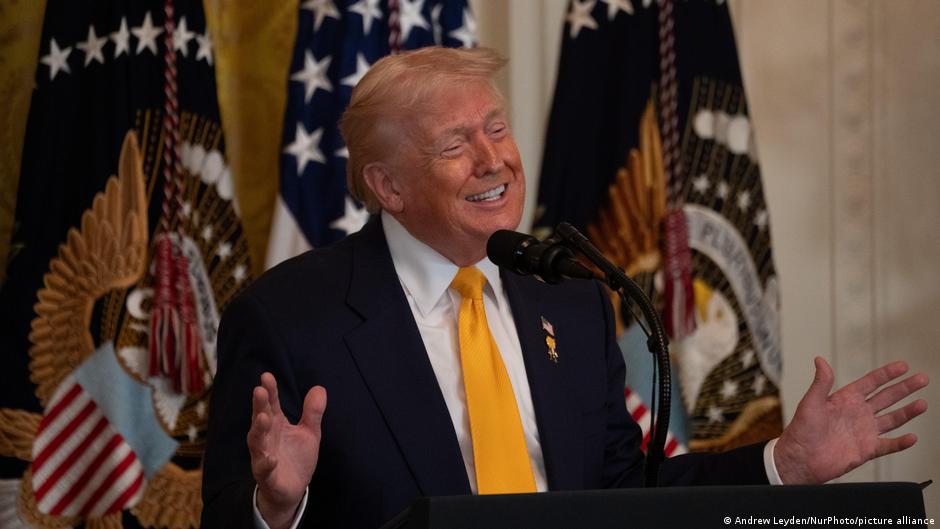
US President Donald Trump’s administration is proposing to impose additional tariffs of 10% or more on its trading partners after investigating countries that import goods allegedly made with forced labor.
In a report released on Wednesday, the US Trade Representative (USTR) said it found that 60 economies had failed to “enact and effectively enforce restrictions on imports of goods produced with forced labour”, calling it a “burden” to US commerce.
USTR Ambassador Jamieson Greer said in the document, “This creates a dynamic where American workers are forced to compete globally on an uneven playing field. We will no longer tolerate this inequity.”
The tariff proposal is currently open for public comment and review and therefore is not in immediate effect.
The new tariffs under US trade law could help Trump sidestep a Supreme Court ruling in February that said his tariffs were largely illegal.
Which countries will face additional US tariffs?
An additional 10% tariff will be imposed on imports from Canada, Mexico, Taiwan, Pakistan, the UK and EU countries. These are countries that, according to Washington’s investigation, ban forced labor imports, that have made commitments on forced labor or have partially halted the import of forced labor goods.
An additional 12.5% tariff will be imposed on 45 others, including China, India, Japan, South Korea, Brazil and Switzerland. The statement said these are countries that have failed to impose and effectively ban imports of forced labour.
“Each of our trading partners must do more to ensure that trade does not encourage and perpetuate forced labor globally,” Greer said.
USTR said it opened 60 investigations into forced labor in March.
USTR said the alleged failure to prohibit imports made with forced labor was “subjecting U.S. producers to unfair competition” in both export markets and the U.S. market.
The trade regulation body will hold a hearing on the proposed tariffs on July 7.
Is there still more conversation to be had?
This latest wave of tariffs is likely to upset many US trading partners who have been negotiating lower tariffs for more than a year.
Just two weeks ago, the EU approved a trade deal with Washington to limit tariffs on most EU exports to 15%. That consensus was hard-fought, with some member states initially threatening to block the deal.
Meanwhile, a US delegation is currently in New Delhi to finalize a trade deal after Washington imposed the highest tariffs on India last year. India’s Commerce Minister Piyush Goyal told local media on Monday that key details of the deal had already been finalized.
The final set of tariffs, partly on India’s imports of Russian oil, significantly strained diplomatic ties between the two strategic powers. US Secretary of State Marco Rubio spent four days in India in May in an apparent attempt to smooth diplomatic ties.
Trump recently visited China where he discussed expanding market access for American goods with Chinese President Xi Jinping.
The new tariffs may create stress in work.
Don’t let algorithms hide news. If you rely on our team for reliable reporting, please take a moment Select us as your favorite source on Google by clicking here and pressing the “Star” or “Favorite” buttonThat’s why you’ll always see our verified news first.