Wuerr Caixi’s weight has increased over the past 37 years and her graying hair no longer appears above her eyes in the style that impressed her as a student at Beijing Normal University in 1989, but some things haven’t changed.
For example, he is still on the list of student dissidents whom the Chinese government identified as the ringleaders of the Tiananmen Square protests in those difficult days when democracy seemed a possibility for China.
Now, 58 and living in Taipei, Kaixi is equally outspoken about the Chinese government, which has made it clear that he will never be granted amnesty and may never return home.
Speaking in Tokyo on Wednesday, a day before the anniversary of the brutal suppression of the protests, Caixi said, “What I am trying to convey to the world is the simple fact that China is not only a threat to peaceful dissidents in China, but also a direct threat to the entire civilization of mankind.”
For too long, countries have looked the other way as Beijing repressed internal dissent, including by ethnic minorities such as Tibetans and Uighurs, and hoped to encourage China to become a responsible member of global society through engagement.
Other governments put trade and economic opportunities above human rights, he said, but countries appear to have realized their mistake.
“America has had a pro-China policy, which is appeasement,” he said. “America led and the rest of the world followed.”
In search of democracy
He said, “China was allowed to join the WTO and the global trading system because it was hoped that this would lead to the creation of a civil society that would eventually lead to democracy.”
That hasn’t happened yet, he said, but at least President Donald Trump is looking at the situation from a different perspective, from the perspective of a businessman who is willing to apply leverage.
“It seems that Japan, the United States and every other country have misunderstood China,” he told DW. “They think that China is led by ideology, nationalism or communism, but this is wrong. The Chinese Communist Party is a criminal group motivated by profit.”
And while Chinese leaders “talk about rejuvenation” and how taking control of Taiwan would benefit the country — and the public, driven by propaganda, awakens to the party’s goals — Caixi said, the reality is quite different.
He said, “They don’t care about rejuvenating China; they only care about adding another zero to their bank balance.” “They are nothing but common thieves.”
And he cautions other governments, including Germany, to be wary of investments that sound like good business propositions but are ultimately aimed at enriching and empowering the Chinese leadership.
Earning both fame and enmity
Caixi points out that China is now Hamburg’s largest trading partner, with state-owned Cosco Shipping Ports now holding about a 25% stake in the Tollerott container terminal. Chinese logistics and rail freight companies also maintain distribution centers in the port city, linking shipping with Beijing’s “Belt and Road” network on land.
He said Germany is “increasingly waking up” to the challenges posed by the activities of Chinese companies within its borders.
Wuerr Kaixi, a member of the Uyghur minority from China’s far west, was in her first year studying education administration at one of the country’s top universities when the Tiananmen unrest began in 1989.
The students initially wanted to mark the death of former party general secretary Hu Yaobang on April 15, who favored political liberalization and economic reforms. Protests escalated, with posters ridiculing Communist Party leaders appearing across the city and crowds gathering in Tiananmen Square.
Disorganized and unfocused, they were looking for a leader who was there when Wuerr Kaixi moved forward. As protests escalated in April and May, students felt that the government was unsure how to respond and meet their demands. Many people including Kaixi went on hunger strike.
Surprisingly, Premier Li Peng agreed to speak with the students in person, but during the opening remarks being shown live on national television, Caixi interrupted Li Peng and said both sides needed to focus on the major issues troubling China. The intervention brought Caixi instant fame among reform advocates—but not sympathy for the regime.
action
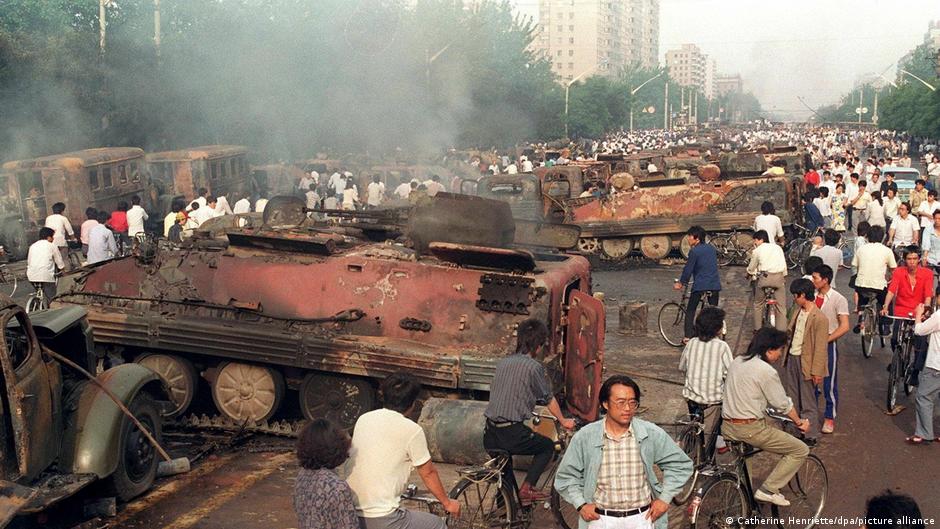
When the action occurred on the night of June 3–4, 1989, it was sudden, with thousands of troops storming Tiananmen Square with tanks and armored personnel carriers and firing live rounds. China has never released the full death toll, but rights groups and witnesses say the figure could be in the thousands.
After appearing on the government’s “most wanted” list, Caixi was persuaded to flee to Hong Kong and then to Paris. He completed his studies in Paris and Harvard University before moving to Taipei in 1996 and becoming a Taiwanese citizen three years later.
Today, he is president of the Taiwan Association for Democracy in China and serves on human rights committees.
Today, China is a “bully” against which the rest of the world needs to stand up, he said, adding that political pressure on other governments and failure to resist the regime’s policies of territorial grab from weaker neighbors will encourage Beijing to take more action.
a scary call
Caixi acknowledged that his criticism of the regime had cost him dearly, saying that last year he received the call he had long feared.
“Living in exile is mental and spiritual torture and I have been living that way for 37 years. And no matter how well I tried to prepare, I was still not prepared when I got the call last year that my father had passed away.”
Caixi’s parents were refused permission to travel abroad to see her, and for almost four decades the best they could manage were phone calls and video link meetings.
“Every day I want to return to that land and hug my parents,” he said. “Now, I will never be able to hug my father again but I hope that one day I will be able to hug my mother.”
Edited by: Srinivas Majumdaru