
Orchard’s pause was coordinated by distributing a voluntary binary to major mining pools
There was no control mechanism in the code: the suspension depended on the decision of three actors
On June 2, 2026, the Zcash network suspended transactions in the Orchard pool due to a critical vulnerability in its test circuit. The pause was executed within hours. The mechanism that made it possible generated a technical debate about the real limits of decentralization in proof-of-work networks with concentrated hashrate.
Developer Jacob Gadikian explained the process in X: Zcash Open Development distributed a binary to mining pool operators that disabled Orchard transactions.
According to Gadikian, the miners were not forced to run the new software. Each one evaluated the update and decided adopt it voluntarilymotivated by its interest in preserving the viability of the network. There was, by this reading, no central switch in the code nor a remote deactivation of the pool.
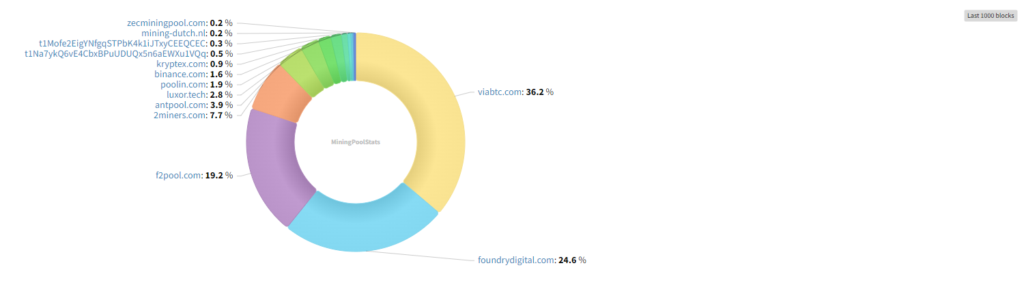
However, the speed of coordination was not independent of network structure. MiningPoolStats data on the last 1,000 blocks shows that three pools—ViaBTC (36%), Foundry Digital (24%) and F2Pool (19%)— They concentrated 79% of the total hashrate at the time of the incident. That distribution was the one that allowed the pause to be executed by simply coordinating three actors.
Analyst CyberSatoshi put forward a reading contrary to Gadikian’s in Censorship resistance means zero pause buttons.
According to CyberSatoshi, calling major pools on the weekend and getting them to stop a layer of the protocol is functionally equivalent to having an administrative control mechanismregardless of whether the miners act voluntarily.
Technical decentralization vs. practical decentralization
The OrangeFren.com account summed up the central point of the debate in three pools control more than 78% of the hashrate. This is not a bug in the code, but from an emergent property of the real distribution of mining power.
Zcash is a proof-of-work network, where miners are the actors who validate and produce blocks. When the hashrate is concentrated in a few operators, the ability to coordinate urgent changes to the protocol—whether to fix a vulnerability or any other intervention—is left in the hands of that small group.
In this case, the voluntariness of the process does not eliminate the fact that the result depended on the decision of three actors.
The incident did not result in any reported losses. and Zcash Open Development confirmed that there is no evidence of exploitation of the vulnerability. But, according to the position that circulated in