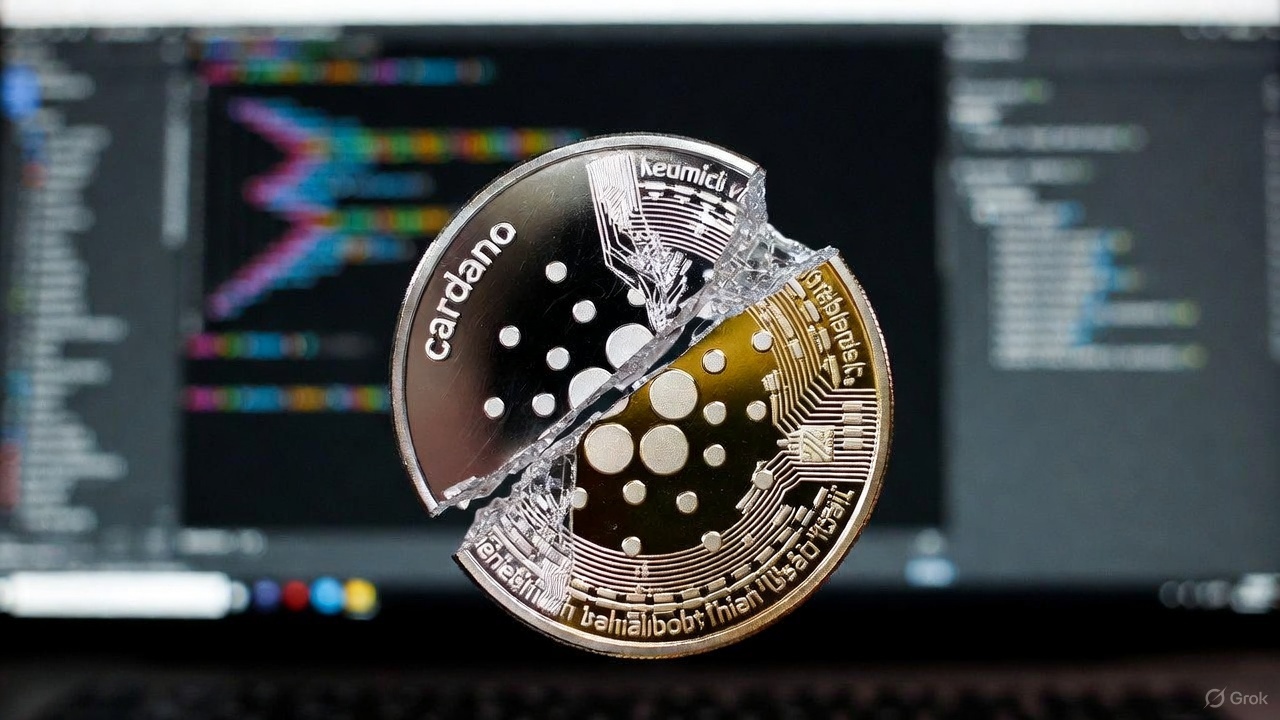
The ADA price breaks the support of $0.15 after accumulating severe losses.
The blocking of treasury funds shows the operational paralysis of the governance model.
The Cardano ecosystem faces an internal reconfiguration after deep discrepancies between its users and its technical leadership come to light. The operational trigger was the cessation of operations of TapTools, the most used data analysis and infrastructure platform within the network.
The firm reported an unsustainable financial imbalance, after registering expenses of $61.4 million compared to income of just $71,000. This closure reignites the debate on the commercial viability of applications developed in the digital asset environment.
The economic impact was immediately reflected in the financial markets. This is visible in the price of ADA, the network’s native token, which is trading below $0.15 for the first time in five years.
The TradingView chart reflects that the asset’s performance shows a slight daily recovery of 0.58%, but consolidates severe losses in broader time frames.
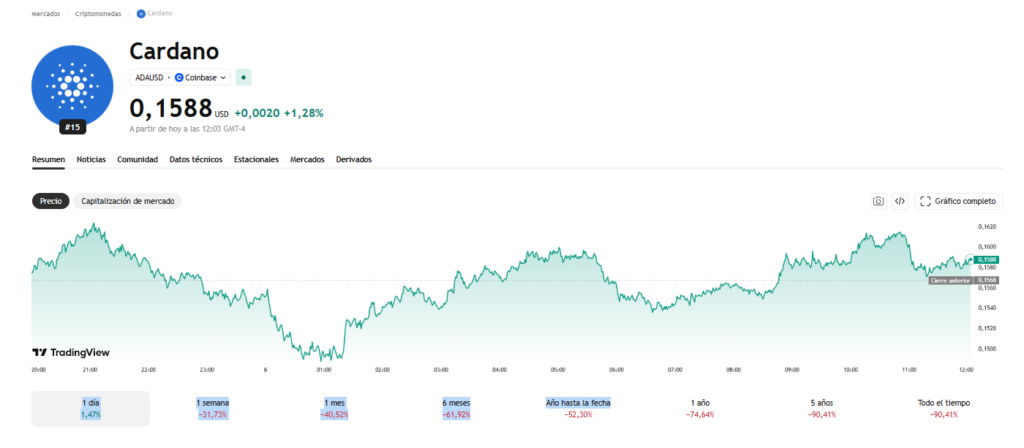
ADA faces a contraction of 32.33% in the last week, a decline of 41.05% in the last month and a collapse of 62.25% over the last six months, which has a negative performance of 52.72% so far this year. This acceleration in losses increases operational difficulties for development teams that depend on the value of the asset to finance their long-term projects.
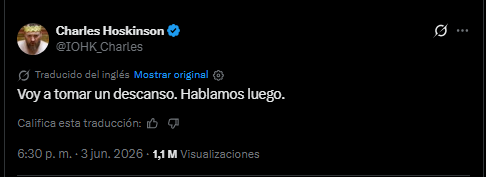
In this context of financial contraction, Charles Hoskinson, founder of the project, announced on June 3, 2026 an indefinite pause in its public communications.
The paradox of governance and the dilemma of consensus
The core of the conflict exposes a structural tension in decentralized governance models. Cardano’s protocol requires a qualified majority of 66% of the community’s votes to authorize the disbursement of funds from its treasury. Under this mechanism, theUsers systematically blocked various financing proposals.
The most emblematic case occurred at the end of May 2026, when the community rejected a request for 7.8 million ADA (about $2 million) to hold the Cardano Summit 2026 in Singapore. The proposal obtained 65.21% votes in favor, but failed because it did not reach the required 66.67%. Hoskinson publicly supported the summit and urged the representatives (DReps) to approve it, but the community blocked him anyway.
In the absence of agreements, Hoskinson even proposed the possibility of launch a new chain independent through a “proof of burn”, a process that would restart the token economy from scratch.
This situation keeps market participants divided. Critical factions, represented by user accounts such as AdaArmyIndia, point out that the project’s strategy prioritize promotioneitherabout the technical execution, highlighting that Treasury funds continue to accumulate without generating tangible returns for investors.
On the contrary, sectors that support current management, such as the user AlesL55581they call for internal cohesion and defend the continuity of the roadmap, which includes developments aimed at decentralized finance and protocols focused on privacy such as Midnight.
The limits of decentralization and the human factor in Cardano
On the critical side, the analyst BtcAndres He called Hoskinson a “scamster who prints money with a click” and stated bluntly: “Bitcoin. Not Cardano.” For its part, from the account cryptoupdate_io A member of the community qualified the confrontation by pointing out that “purism does not save from fraud, but Bitcoin at least has a thick skin. Cardano is promise with a thin skin.”
For market participants, especially individual investors in Spanish-speaking emerging markets, The Cardano case illustrates the practical limits of decentralized governance in Web3 projects. The withdrawal of a central figure shows how decision-making can slow down in times of crisis when it relies heavily on the public influence of the founder, beyond the formal structure of the DAO.
For all this, Cardano’s immediate future depends on its community’s ability to resolve budget paralysis. Without Hoskinson’s daily presence on broadcast channels, the network enters a trial period where voters will have to decide whether to modify the parameters of governance to facilitate the commercial viability of their platforms, or if they maintain the current scheme at the risk of facing a definitive split in their blockchain.