
The agent ecosystem is growing rapidly, but without prior auditing, operational risk increases.
26.1% of skills have vulnerabilities; 5.2% present high risk or malicious behavior.
The technology multinational NVIDIA presented the security analysis tool, SkillSpector, aimed at the “capabilities” of artificial intelligence agents, designed to introduce a layer of prior verification in an ecosystem that until now operated with very low levels of auditing.
The system starts from a simple but critical premise: Before executing an agent skill or capability, it is necessary to reconstruct its full context and subject it to multiple forms of analysis in parallel to assess whether its behavior is safe or potentially risky.
The tool covers 64 types of vulnerabilities in 16 categories, including prompt injection (a specific type of attack against AI models), data exfiltration, privilege escalation, and supply chain risks.
The risk assessment is not binary, but cumulative. Each finding adds points according to its severity: low risks contribute 5 points, medium risks 10, high risks 25 and critical risks 50. The final result is translated into a scale from 0 to 100, where any value greater than 50 activates an automatic block.
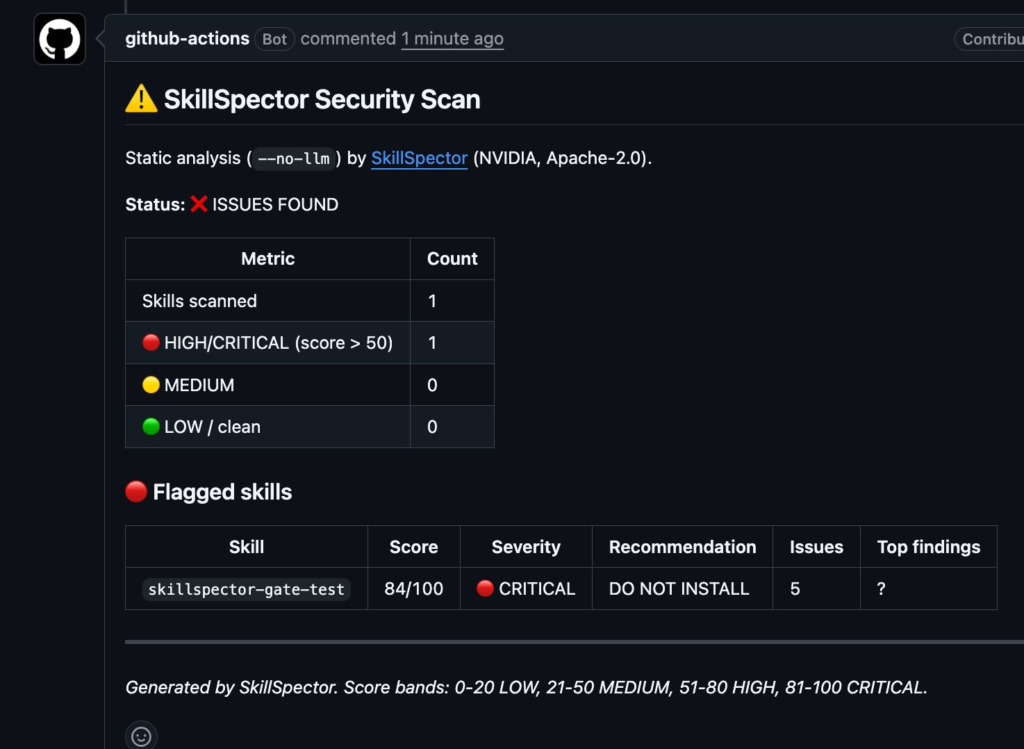
This evaluation system is based on a relevant finding from a ecosystem analysis: approximately 26.1% of the skills evaluated present at least one vulnerabilitywhile 5.2% show high severity patterns that suggest possible malicious behavior. These percentages reinforce the need to move from models based on implicit trust to models where security is systematically verified before execution.
The goal is not only to identify risks, but to integrate them into the development cycle. SkillSpector can operate as part of continuous integration flows using GitHub Actionswhere it analyzes only the changes introduced in each pull request related to skills. In its language model-free mode, the process does not require API keys and focuses on deterministic and reproducible analysis.
AI agents exposed
The main point of tension that SkillSpector exposes is not only technical, but structural. The ecosystem of AI agents has expanded under a model where the installation of skills is rapidmodular and low friction, which facilitates its mass adoption, but at the same time leaves an important gap in terms of standardized prior audit.
This creates a contradiction that is difficult to ignore. On the one hand, the growth of these systems depends directly on their ease of integration and the minimum resistance so that new skills can be incorporated. That flexibility is precisely what accelerates its expansion. However, on the other hand, this same characteristic amplifies operational risk, since the absence of prior verification turns implicit trust into the main security mechanism.
From a reading inspired by bitcoiner values, This scenario is especially relevant because it reflects a system that still relies on trust by default.rather than being built on independent validation mechanisms. In that sense, the natural movement that is beginning to be observed is the transition towards models where execution is not automatic, but conditional on previous verification processes, under a logic of “verify before executing.”
Although SkillSpector is an open source tool, it also introduces another layer of discussion. The infrastructure responsible for carrying out this verification is not completely distributedbut remains largely dependent on large players within the artificial intelligence ecosystem. This opens an additional tension between the idea of openness of the software and the concentration of the control and validation layers, which contrasts with the philosophy of decentralization associated with the Bitcoin model.
From that perspective this fits with a fundamental idea: reduce the dependence on trust in the actors of the system and replace it with mechanisms that allow validation behavior independently. Although the context is different—centralized artificial intelligence systems versus decentralized networks—the conceptual direction is similar: the evolution toward architectures where trust is not presupposed, but rather demonstrated through verification.