
Bitcoin’s recent fall below USD 60,000 once again reignited alerts about the possible end of the current bearish cycle. Although the cryptocurrency managed to partially recover and is trading again near USD 62,000, market behavior continues to show signs of fragility, according to CryptoQuant analysis.
For Julio Moreno, head of research at the firm, one of the most relevant levels to observe is the so-called “realized price”, currently located around USD 53,600. This indicator reflects the average purchase cost of all bitcoins in circulation and, in previous bearish cycles, it has functioned as a key reference to identify support zones or possible temporary bottoms of the market.
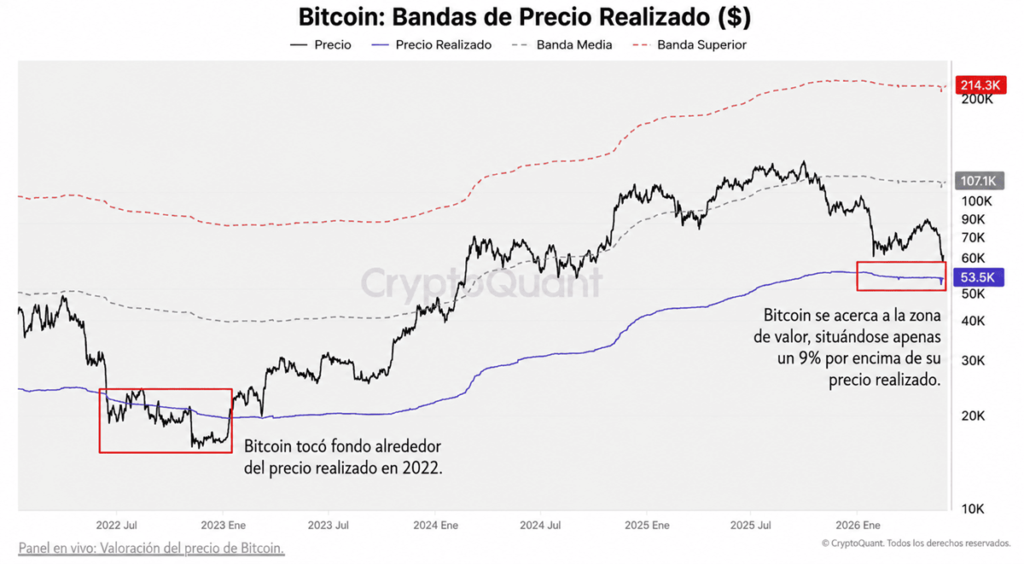
The report clarified that this level should not be interpreted as an exact goal, but rather as a historical reference that in the past has marked important moments within profound corrections. However, he warned that current conditions do not yet confirm that bitcoin has found bottomespecially due to the weakness shown by several demand indicators.
One of the data that worries CryptoQuant the most is the sharp contraction in total bitcoin demand over the last week, which fell by approximately 652,000 BTC. This is the largest weekly drop recorded since January 2022. This decline was driven by the liquidation of long positions in derivatives markets and the increase in spot sales, after the price pierced the psychological level of USD 60,000.
The outlook does not improve when looking at the underlying trend. According to the firm, annual growth in apparent demand is already negative and falling below its moving average at a pace not seen since February 2024. In other words, there are fewer buyers today than a year ago, weakening one of the most important supports for a sustained recovery.
Added to this is the behavior of spot Bitcoin ETFs in the United States, which for much of 2024 and 2025 had been one of the main drivers of institutional demand. However, that momentum has slowed noticeably. Far from absorbing selling pressure, ETFs would be contributing today to increasing the supply available in the marketreflecting a reduction in the exposure of some institutional investors. For the firm, this change represents a relevant sign of cooling in one of the sources of demand most observed by the market.
The apartment would be close, but not confirmed
Although bitcoin accumulates a correction close to 50% since its historical maximum in October 2025, CryptoQuant considers that no real capitulation has yet taken place. In the last 30 days, investors would have materialized losses of 187,000 BTC, a significant figure, but still far from much larger episodes of stress, such as the 400,000 BTC recorded when bitcoin lost USD 60,000 for the first time in February 2026 or the more than 1.2 million BTC during the FTX crisis in 2022.
That detail, the report suggests, has yet to see a massive panic exit, something that historically usually appears near the true lows of bearish cycles. Therefore, although the USD 53,600 level appears as an attractive valuation zone from a historical perspective, there is still no definitive confirmation of the floor.
The big unknown is not only whether bitcoin will reach USD 53,600, but what a fall to that level would mean. If the realized price acts as support again, it could be interpreted as evidence that the market still retains a solid base of investors willing to accumulate in times of weakness.
However, if the asset crosses that threshold without a clear demand reaction, the message would be different: it would reflect that even the average acquisition cost of the network is no longer sufficient to contain the selling pressure. In that scenario, the market would have to face a new stage of uncertainty, while investors look for signs that the bearish cycle has finally found its limit.