The conflict between the US, Israel and Iran has put regional giant Egypt in a diplomatic and strategic dilemma.
Egypt is not only a close ally of the US and the Gulf states – it is a signatory to the 1979 Camp David accords with Israel – but was also on the verge of restoring full diplomatic relations with Iran as early as 2026.
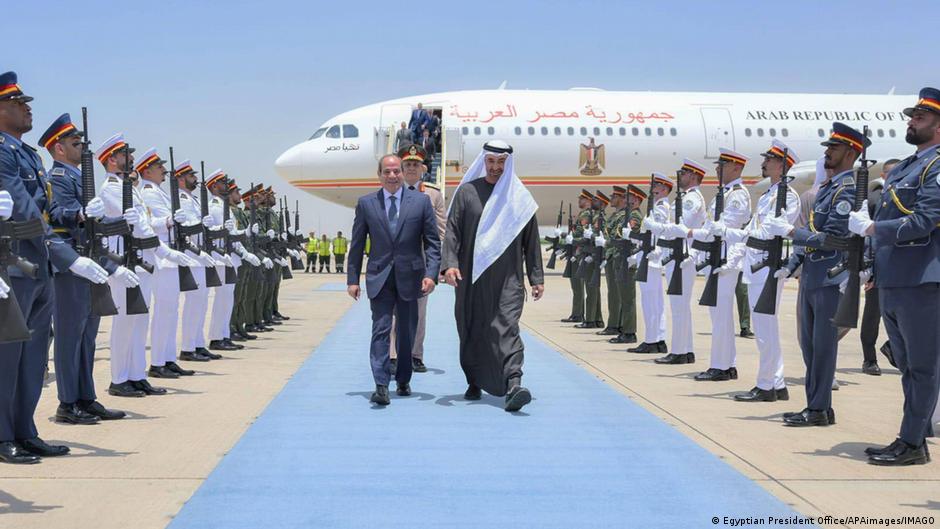
Cairo’s tug-of-war has so far included public Condemnation Iranian attacks on Gulf countries while offering limited military assistance. It has sought to position itself as a mediator between Tehran and Washington, alongside parallel efforts by Pakistan, Turkey and Qatar. President Abdel-Fattah al-Sisi also visited the United Arab Emirates in May.
“Abdel-Fattah el-Sisi sees this conflict primarily as a threat to domestic stability,” Michel Pace, a Middle East analyst and visiting academic at the University of Oxford, told DW. “Egypt’s main objective is to stay out of the Iran war while controlling its economic and security consequences.”
However, this approach has created tension with Egypt’s Gulf partners, who expect support from their allies in the face of Iranian attacks on their territories, interests and assets, Timothy E. Caldas, deputy director of the Washington-based Tahrir Institute for Middle East Policy, told DW.
“There are not-so-subtle statements coming especially from the UAE that indicate frustration and anger toward Egypt,” he said.
For example, Anwar Gargash, foreign policy adviser to the UAE presidency, recently wrote that regional analysts understand the statement was directed at Cairo.
economic dependence
Egypt, the most populous Arab country with about 120 million people, also feels the economic impact of the war with Iran. Traffic through Egypt’s Suez Canal was reduced after the Iran-aligned Houthi militia in Yemen resumed attacks on shipping in the Red Sea and the Bab al-Mandab Strait in support of Iran. A recent analysis by the International Crisis Group found that Suez Canal revenues are set to decline by 38% in the first quarter of 2026.
“The war is damaging an economy that was showing tentative signs of recovery from the difficulties of COVID-19 and the consequences of the wars in Ukraine and Gaza,” the analysis said.
Egypt has managed to reduce the amount owed to oil and gas partners from about $6.1 billion in June 2024 to zero in June 2026, Karim Badawi, Egypt’s minister of petroleum and mineral resources, said on Wednesday.
The report’s authors said the economic recovery after years of crisis was largely driven by Gulf investment. “Saudi Arabia and Kuwait have deposited $5.3 billion and $4 billion respectively into Egypt’s central bank, while the United Arab Emirates has invested $35 billion in the country through a major real estate acquisition and Qatar has committed to investing $29.7 billion in another major property deal,” said Crisis Group. AnalysisSaid. The World Bank, the European Union, and the International Monetary Fund have also helped stabilize Egypt’s economy in recent years.
Now, the scenario seems to be worsening again. Not only have Suez Canal revenues fallen, but tourism has also declined, and energy and food prices have soared.
Furthermore, the Gulf countries themselves are facing significant economic losses and huge costs: damaged buildings and infrastructure must be repaired, weapons replenished, and defense capabilities expanded, Caldas pointed out.
“The availability of financial assistance, even if they were to provide it, may come under pressure, especially given that Egypt will be competing with reconstruction needs in Lebanon, Syria and Gaza,” he said.
diplomatic pressure
Meanwhile, America is also tightening diplomatic screws on Egypt. Reuters reported on May 25 that US President Donald Trump said he had asked Saudi Arabia, Qatar, Pakistan, Egypt, Turkey and Jordan to join the Abraham Accords and normalize relations with Israel as part of his effort to secure support for a potential accord involving Iran.
In 2020 and 2021, the United Arab Emirates, Bahrain, Morocco and Sudan have already normalized relations with Israel under the Abraham Accords. Following Hamas’ attack on Israel on October 7, 2023, and the ensuing war in Gaza, Saudi Arabia made negotiations and the establishment of a path to an independent Palestinian state a prerequisite. Egypt and Jordan signed peace treaties with Israel in 1979 and 1994, respectively.
Caldas sees Trump’s latest attempt at normalization as a desperate attempt to claim some kind of accomplishment in the Iran conflict.
He added, “Egypt is also concerned about the hostile posture of the Israelis in the region, so giving them any kind of additional diplomatic support is almost certainly not something the Egyptian government would want to do at this time.”
Relations between Egypt and Israel have been deteriorating since the Gaza war. Israel has repeatedly said it wants to see millions of Palestinians in Gaza transferred to Egypt.
Moreover, Cairo is also wary of the complete collapse of Iran, Michel Pace warned: “This would strengthen Israel’s regional dominance,” he said, all this limits Cairo’s strategic autonomy and pushes it toward pragmatic diplomacy rather than confrontation.
Crackdown on political dissent
At the same time, Cairo also needs to consider public dissatisfaction, Kaldas said, “In Egyptian public opinion, a large part of the population is on Iran’s side in this war and sees it as the wronged party.”
For Egyptian President Abdel-Fattah el-Sisi this means “not sticking our neck out too much in defense of what is seen by most Egyptians as American-Israeli aggression against Iran.”
However, public signs of dissent will remain prohibited. Since the outbreak of the Gaza War, demonstrations have occasionally been broken up by police and detained participants.
Sarah Leah Whitson, former director of human rights organization DAWN, warned that other conflicts in the Middle East have allowed the Egyptian government to avoid scrutiny of its dismal human rights record.
“Thousands of people have been unjustly imprisoned in sham trials; dozens of journalists and human rights activists have been detained, while thousands more face new charges in mass terrorism cases,” he told DW. “The military’s power has expanded dramatically, with the same powers of arrest and prosecution of civilians as the Justice Ministry.”