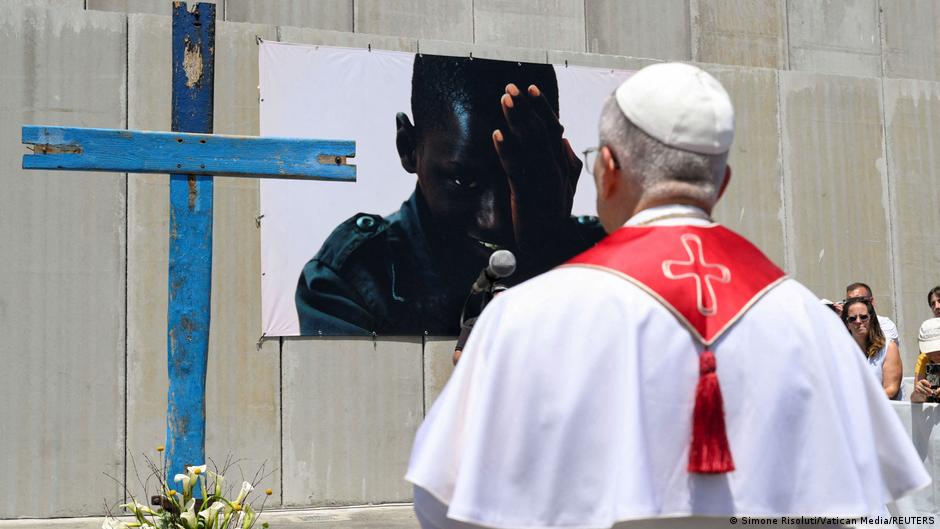
Pope Leo XIV continued his weeklong tour of Spain on Thursday with a visit to a port in the Canary Islands, which has become the epicenter of the massive migration crisis that has hit the islands in recent years.
The Pope visited the port of Arguineguín on the island of Gran Canaria, where he addressed migrants and criticized the international community and leaders, especially those in Europe, over their treatment of migrants.
The visit was in line with the broader theme of his visit to Spain, and satisfied the unfulfilled wish of his predecessor, Pope Francis, who had also taken up the issue of migrants’ rights.
What did Pope Leo say in Gran Canaria?
The Pope laid a wreath at sea to remember the thousands of people who died while attempting to enter Europe, a similar gesture made by Pope Francis during a 2013 visit to Lampedusa in Sicily, another migration flashpoint.
“Let history not blame us for turning the pain of those suffering on our shores into plain sight,” he said. “Today, here on the seashore, everyone who comes asks us what is left of our humanity.”
He urged authorities to improve the security and economic conditions of countries from which migrants migrate and called on transit countries to protect migrants from smugglers and smugglers.
But he was particularly critical of European politicians, where the crackdown on migration has intensified in recent years amid pressure from the far right.
Leo appealed to the continent’s “conscience”, arguing that it could not claim to preserve human dignity while being unconcerned about the Mediterranean Sea and Atlantic becoming “unmarked graves”.
“Human dignity has no passport and its value does not diminish when crossing borders,” the Pope said.
He also directly addressed the migrants gathered around him, where a cross made of wood from shipwrecked boats lay.
“Dear migrants, before saying anything else to you, I want to bow before your dignity,” the Pope said. “You are not just numbers or files. You are people who left behind families and homes. You have dreams that no one has the right to despise.”
Why was Arguinguín called the ‘Dock of Shame’?
Located 1,000 kilometers (620 mi) from mainland Spain, the Canary Islands are effectively closer to Africa than Europe, and have therefore in recent years become a point of arrival for migrants attempting to enter Europe from Africa.
The Arguineguín port was dubbed the “dock of shame” in 2020, as thousands of migrants slept there in the open or under makeshift shelters, living in unsanitary conditions, after a surge in arrivals during the pandemic.
In 2024, a record more than 46,000 people arrived in the archipelago before an agreement between the EU, Spain and several West African governments saw a dramatic drop in arrivals. In the first five months of 2026, more than 3,000 arrivals were recorded.
Records from the International Organization for Migration’s Missing Migrants Project show that about 6,600 people have died on the Atlantic route from West Africa since records began in 2014. Between little information and the phenomenon of “invisible shipwrecks”, the actual figure is thought to be much higher.
Spanish migrant rights group Walking Borders (Caminando Fronteras) estimates there have been more than 25,000 deaths or missing cases among those attempting to reach the Canary Islands since 2020.
On Thursday, a signal was given to change the name of the port of Arguenguin to the “Dock of Hope”.
Edited by: Shawn Sinico