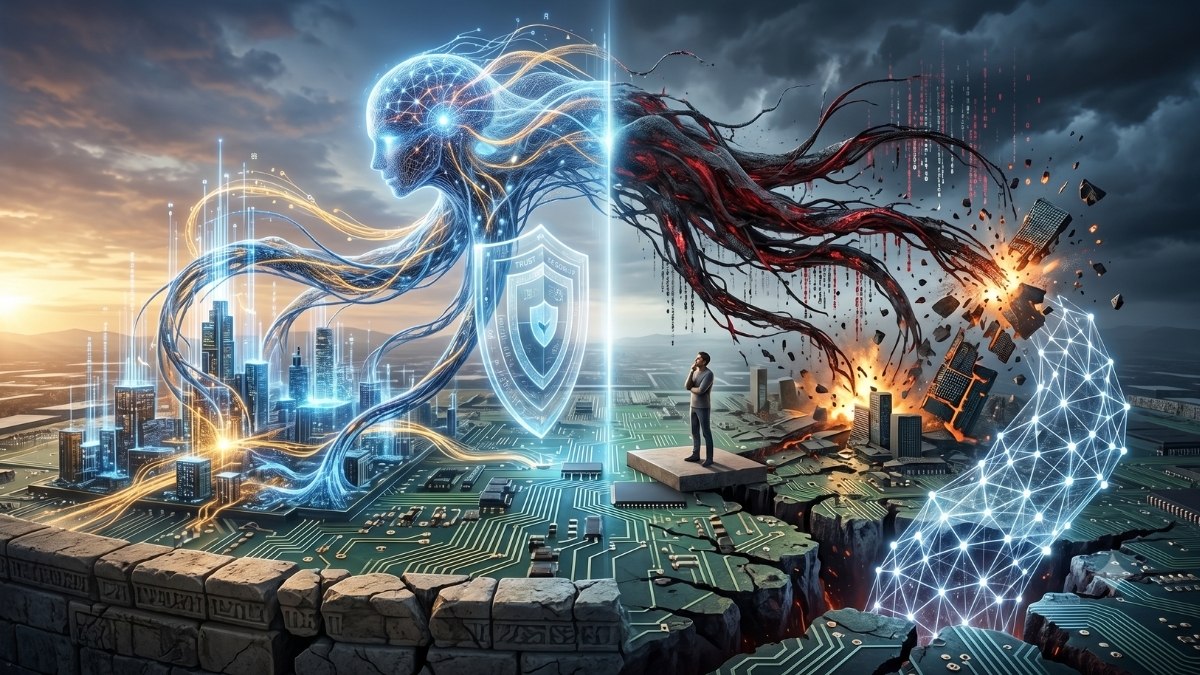
Useful AI agents require private access, external inputs, and the ability to act.
Dai argues that AI is no longer limited by capability, but by trust.
Researcher Wei Dai—different from the eponymous cryptographer author of the b-money protocol cited by Satoshi Nakamoto in the Bitcoin whitepaper—warned this June 11 that agentic artificial intelligence is creating a new class of trust problems in digital systems.
According to Dai, the origin of the problem is not technical but structural: the same properties that make an AI agent useful are those that make it susceptible to exploitation.
The expert published his warning in the context of a clip distributed by 1kx, a venture capital fund specialized in decentralized networks in which he serves as a Research Partner.
In the video, the researcher explains that An AI agent needs three conditions to operate effectively: access to private information, access to untrusted external input, and the ability to act autonomously.
He adds that once these three properties coexist on the same system, there is always the possibility that the agent will be injected using malicious prompts from external inputs. Then I could exfiltrate confidential information or act in a harmful manner within corporate systems.
The researcher, who is the author of more than a dozen academic papers on security and cryptography, gives these three properties the name “lethal trifecta for AI agents”. He attributes the term to researcher Simon Willison.
Dai’s warning comes days after Anthropic launched Claude Fable 5, the first model of the Mythos family available for general use, with mechanisms that block cybersecurity queries as high risk.
The move illustrates the tension Dai describes: the offensive capability of advanced models grows at the same rate as their usefulness.
Trust is a bottleneck
Dai argues that agentic AI no longer limited by your technical capacitybut for trust and security. For the researcher, achieving the full potential of autonomous agents requires new trust infrastructures throughout the technological stack. Although it does not specify in its publication what these infrastructures would be or which actors should develop them.
1kx developed in its thesis “Cost of Trust 2.0”, published in June 2026, the argument that AI is acting as accelerator of problems of digital trust.
According to the firm, Generative AI collapsed the cost of producing fake credentials, voices, counterparts and identitieswhich generated a crisis of authenticity and verifiability.
For its part, agentic AI, the document adds, exposes new surfaces where trust is critical and fragile: autonomous agents require full access to documents, accounts and communication channels to operate effectively.
This is a vision that generates controversy in the sector. While some experts support the idea that autonomous AI agents represent an inevitable structural risk, others argue that the problem is not the technology itself, but the lack of controls and human verification.
Decentralized networks as an answer to the problem
1kx, which was founded in 2018 with the thesis that decentralized networks can reduce trust costs in markets where traditional intermediaries extract rents for being trustworthy, believes that These networks are the only infrastructure capable of solving trust problems that agentic AI generates.
The company, which in 8 years accumulated more than USD 400 million in investment exits through more than 160 companies and protocols, highlights four properties that centralized systems cannot replicate simultaneously and who support that argument:
- Programmable peer-to-peer settlement
- Publicly verifiable status
- Structural neutrality
- Participation without permissions.
The fund maintains that any centralized platform can adopt one of those properties in isolation. But it cannot adopt all four simultaneously without becoming, in effect, a decentralized network.
For 1kx, that combination of properties is precisely what the agentic AI stack requires to operate with trust on a global scale, and represents the next generation of trusted markets that the decentralized ecosystem is positioned to capture.
Although there are critics who question this idea of decentralization as a universal solution, it could underestimate real challenges such as scalability, gas costs in autonomous agents, and already known vulnerabilities in smart contracts.
The immediate challenge is to advance interoperability standards between AI-based agents and decentralized protocols, before mass adoption turns these theoretical risks into real losses.