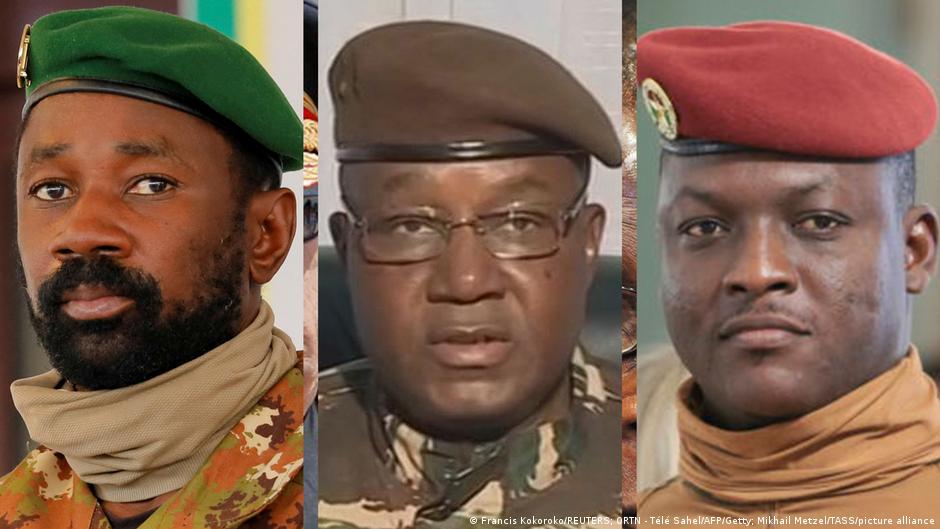
Since the 2020‑2023 coups in Mali, Niger and Burkina Faso, military leaders have imposed sweeping criminal defamation and anti-terrorism laws that enable arbitrariness. detention of journalistsBlogger and activist. He has also ordered the closure of independent radio stations and online platforms.
“It has become more repressive. It is no longer easy to speak about it,” said Ulf Lessing, former director of the Konrad Adenauer Foundation’s Sahel program in Mali. People have become more cautious.
“This is clearly a point of criticism against the government,” he told DW.
In Mali, General Assimi Goita seized power through two military coups in 2020 and 2021 and gradually brought the country under military rule. In 2025, the National Transitional Council passed a draft law securing Goita’s rule for the next five years.
According to Lessing, there was initially some improvement in the volatile security situation in parts of Mali, and farmers were even able to return to their farms. That’s not the case today. Mali still faces the threat of terrorism and jihadist rebels control parts of the country. “I don’t think any government will succeed in recapturing those areas. Even if there are more coups or eventually an elected government,” he sees little chance of bringing peace to the country.
According to Lessing, people in Bamako neither want Sharia law nor Islamists. Despite the threats and repression, there will be plenty of reasons to protest against the government. But people know that if this government goes, the next government will be more Islamist.
“It’s not what people want,” Lessing said.
Silencing dissent in Burkina Faso
The other two countries of the Sahel Alliance (AES), established in 2023 – Burkina Faso and Niger – are also ruled by military rulers with an iron fist. Freedom of expression and democratic aspirations are being severely curtailed.
“In the case of Burkina Faso, I would say that public space no longer exists,” Burkinabé human rights activist Binta Sidibé-Gascon told DW. “Everyone is forced to remain silent and pressured to self-censor. Anyone who dares to speak about the national situation is sent to the front lines.”
Sidibé-Gascon is president of the NGO Observatoire Kisle and a member of the Citizens’ Coalition for the Sahel, a coalition that aims to strengthen civil society in the Sahel. She lives in the diaspora.
Burkinabé President Ibrahim Traoré seized power in a coup in September 2022 and promised the Burkinabé people that he would restore security in the country.
There is very little evidence of this. Sidibé-Gascon said, “All the rights of the Burkinabé have been confiscated and are now in the hands of a single person who makes all the decisions. Civil rights, human rights, property rights – even the right to life. The death penalty has been reinstated. This is a step backward for Burkina Faso.”
Junta leader Traoré’s views on these fundamental democratic rights became clear in early April. “People need to forget about democracy,” Traoré said on national television. “If an African tries to talk to you about democracy, you should run away. Democracy kills.”
Freedom of the press is also strictly restricted in Burkina Faso. According to Reporters Without Borders, Cases of bullying against media persons There has been an increase in recent years, and a dozen journalists have been forced into exile. “The ruling junta has also banned foreign, primarily French, media outlets,” the organization writes. In 2024, at least ten of them, including Jeune Afrique, Deutsche Welle and GuardianSuspended for a specific period or until further notice.
An example of how harshly the military regime is cracking down is the arrest on May 26 of Imam Mohammed Ishaq Kindo, a prominent Sunni religious leader. The imam was said to have criticized a law aimed at regulating religious practices, including public prayer. The arrest sparked rare unrest in the capital, Ouagadougou. Hundreds of supporters demanded Kindo’s release, clashing with police and dozens were arrested.
ruling by spreading fear
For exiled Burkinabé journalist Newton Ahmed Barry, these events are part of a strategy of fear. Barry said, “This is the logic of this junta and its leaders: the more people are afraid, the more they choose their way out of trouble. They create fear and terror to keep everyone under their control and thus rule peacefully.”
Another sign of suppression is a period of three months. Suspension of the General Union of Students of Burkina Faso (UGEB). Its president and several members were arrested. The union had criticized the security situation. The organization is now accused of “glorifying terrorism” and “demoralizing security forces.”
Mahamadou Iddar Alghabid, deputy secretary-general of the Alliance of Sahel Democrats (ADS), sees the allegations as part of a regional trend. “It is absurd to accuse students, unarmed civilians, of glorifying terrorism. But this is a well-known pattern in the Sahel,” he told DW.
In his view, the junta’s “propaganda” initially worked because it presented concepts that African people yearned for: things like sovereignty and what they called the fight against imperialism. “But today, all these promises made to the people of the Sahel – whether they come from Burkina Faso, Niger or Mali – have been proven false.” People in the Sahel are realizing this and are abandoning “the ship of the coup plotters”.
Alghabid stressed that despite the risks – arrests, kidnappings, violence – vocal criticism continues, although mostly from abroad. “We know how big the conflict is before us, because we are facing three military regimes.”
Activists believe that the responsibility lies not only with civil society and the diaspora, but also with the international community. “Burkina Faso’s partners can no longer hide behind the perception that any condemnation of the junta is counterproductive,” says Ilaria Allegrozzi, a Sahel researcher at the rights group Human Rights Watch. “Silence and ambiguity ultimately always legitimize authoritarian excesses.”
This article was originally written in German