
The lethargy of large investors in the Cardano (ADA) cryptocurrency could be coming to an end. Since last June 4, 2026, a sudden awakening of old wallets has been detected that broke a pattern of low activity on the network.
To explain this, the analysis firm Santiment detailed yesterday, June 10, that age metrics on the Cardano network show “unusual behavior.” This indicator evaluates precisely how long funds remain untransferred to users’ addresses.
The data comes from the following chart covering the period May 8 to June 9, 2026, analyzed with 12-hour candles, which shows three simultaneous metrics about the network: the price of ADA, the average age of the invested dollar and the consumed age.
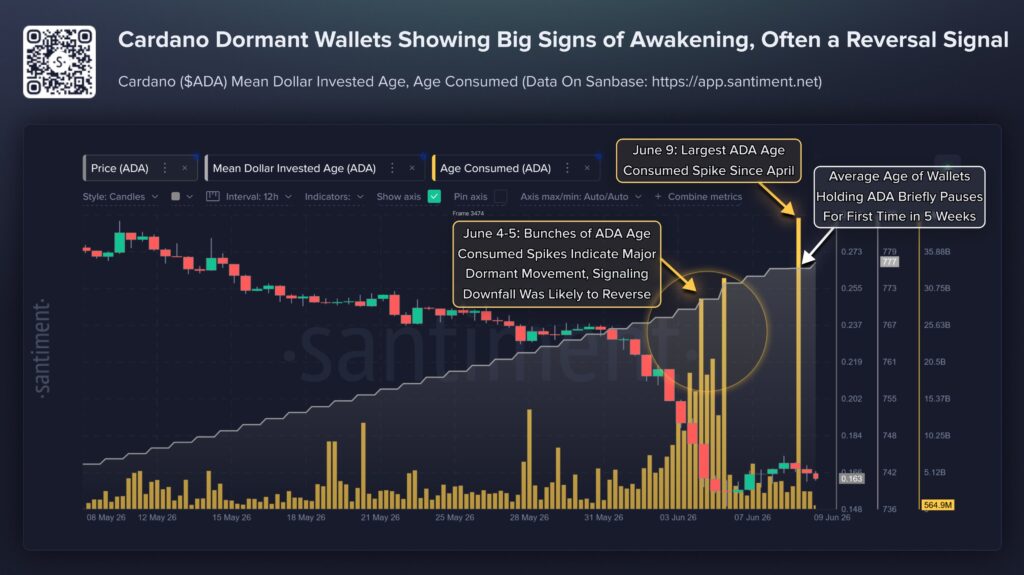
In terms of structure, the combination of an average age of the invested dollar rising steadily while the price falls indicates accumulation without rotation.
Throughout the price drop, the average age of the invested dollar – represented by the white line – rose without interruption from 736 days to reach 777 days. This indicates that capital within Cardano wallets was largely not moving: holders were holding their positions untouched, causing the average age of accumulated cryptocurrencies to increase day after day for five consecutive weeks.
However, this behavior changed radically between June 4 and 5, when the consumed age metric—represented by the vertical gold bars—produced multiple spikes in rapid succession.
These peaks indicate that wallets that had remained inactive for long periods began to move their funds suddenly. In practice, this means that long-term investors decided to abandon inactivity (their passive accumulation strategy) and take action, whether to capitulate (sell at a loss), restructure their portfolios, or take profits before a major decline.
The most significant data on the graph comes on June 9, when the consumed age registered its highest peak since April, reaching a maximum value of 35.880 million ADA-days. This metric measures days per coin; That is, it results from multiplying the amount of ADA moved by its days of inactivity. For example, if 1,000 ADA moves after 100 days of standing still, they generate 100,000 ADA-days.
Under this formula, the spike shows that a massive amount of very old capital was mobilized that day. Although the graph does not allow us to separately decipher whether it was a few wallets with colossal sums or many wallets of moderate age, the combined impact represented the largest awakening of funds on the network in months.
In contrast, that same day the average age of the invested dollar took its first pause in five weeks, stopping at 777 days after its continuous rise. At the close of the day, the consumed age returned to its calm level at 564.9 million ADA-days.
When the accumulation trend is interrupted and coincides with streaks of peaks in the consumed age – as occurred between June 4 and 9 – the historical pattern recorded in the network has tended to appear near key turning points or changes in price direction.
When the explosion of golden bars converges with the fall in prices (which took the price of ADA to $0.163), it is found that cryptocurrencies passed from the hands of old investors to new users at lower priceswhich usually marks a technical floor for a rebound.
Although these signals do not ensure an immediate rise, they firmly confirm that something is changing in the dynamics of the asset.
These maneuvers occur in the midst of a market that faces severe declines. Although ADA experienced a recovery in the last few hours, the cryptocurrency has suffered a 17% contraction in the last week and a 40% decline in the last month. The outlook worsens when observing the collapse of 59% accumulated throughout the last semester.
Internal friction shakes the Cardano community
Prolonged losses are already restricting the operating funds of technology development teams, who are forced to liquidate cryptocurrencies to finance their research.
This financial pressure unleashed internal friction between the community of Cardano users and the project’s technical leadership, as reported by CriptoNoticias.
Faced with the wave of criticism, Cardano’s own founder, Charles Hoskinson, suspended his appearances public on June 3, although it reappeared five days later.
The businessman returned to the ring recognizing the severity of the environment: “the cryptocurrency industry is in an existential crisis. People are wondering if this is already dead.” However, the developer defended the structure of his network arguing operational advantages over competing networks.