
Other analysts project possible alternative supports between $48,000 and $40,000.
The bank’s thesis states that USD 59,000 would be a floor after a liquidation phase amplifies
The British bank Standard Chartered stated on June 12, 2026 that bitcoin (BTC) would have left the crypto winter behind after the fall that took the asset to USD 59,000, a level that it considers the possible bottom of the cycle.
The thesis was presented by the bank’s global head of digital asset research, Geoff Kendrickwho maintains that the 53% correction from the all-time high of USD 126,000 in October 2025 would have marked the point of exhaustion of the bear market.
In his analysis, the current price of bitcoin, close to USD 64,000would be consolidating a base after the episode of greatest selling pressure of the cycle, in a context where ETF flows and global liquidity have come to dominate market dynamics above historical halving patterns.
Kendrick’s thesis is supported by the reading that USD 59,000 would represent a floor reached during a liquidation phase amplified by external factors. In particular, the bank notes that bitcoin ETFs in the United States recorded around USD 5 billion in net outflows since mid-Maywhich would have intensified the downward pressure in an environment of lower liquidity, as seen in the following graph.
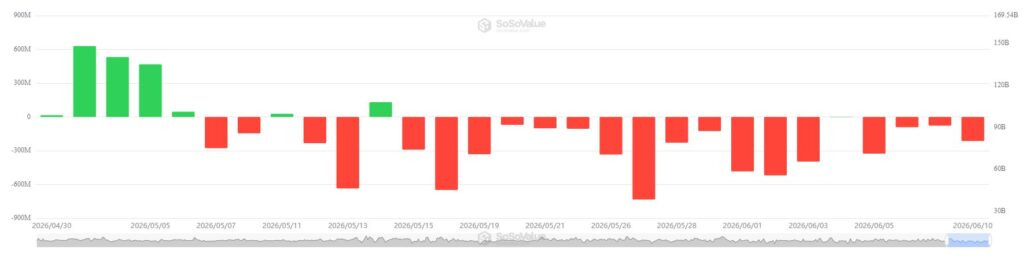
Part of these flows, according to the report, would be linked to a capital rotation towards the SpaceX IPO, valued at approximately USD 1.75 trillion, which would have forced some investors to unwind positions in ETFs to free up liquidity. After this process, the market would have rebounded from the lows to the current area, interpreted by the bank as stabilization after the partial capitulation phase.
The concept of crypto winter, understood as a prolonged period of falls, capital outflows and contraction of institutional liquidity, would be an already concluded phase for Standard Chartered. Under this reading, the market would be entering a different regime, where price evolution depends more on monetary policy, flows to ETFs and institutional allocation than on traditional four-year cycles.
The end of crypto winter: far from being a unanimous vision
The bank’s vision contradicts that of other actors in the sector. Part of the market considers that the level of USD 59,000 does not yet constitute a definitive bottom. Investigations of Galaxy Research project fall scenarios towards USD 40,000–46,000, while André Dragoschfrom Bitwise, estimates that an additional correction close to 20% could still occur, with potential stress areas around $48,000.
Added to this is the vision of the analyst and educator Benjamin Cowenwho maintains that the four-year cycle is still in force and that the true minimum could form towards the end of 2026 in ranges of USD 30,000–40,000.
In parallel, an analysis by CryptoQuant adds a more structural reading on the weakness of demand, as reported by CriptoNoticias. The firm points out that the level of USD 53,600—realized price of the network— could act as a key reference in this cycle, although it warns that total bitcoin demand fell by approximately 652,000 BTC in the last week, the largest contraction since January 2022.
Furthermore, he maintains that ETFs, which were previously a driver of demand, now show weaker performance and would even have begun to contribute to net selling pressure. In this context, CryptoQuant concludes that a clear capitulation has not yet been observedwhich weakens the idea that the market has formed a definitive bottom.
The debate is also intensified by the history from Kendrick himselfwho has maintained significantly bullish projections for bitcoin in previous cycles — including targets of USD 100,000 by 2024 and USD 200,000 by 2025 — which were subsequently adjusted downwards by Standard Chartered based on the actual behavior of ETF flows and institutional demand. This trajectory fuels some of the market’s skepticism about the accuracy of its cycle calls.
In this scenario, Standard Chartered’s thesis is positioned as an optimistic interpretation of the current regime rather than a consensus. If flows into ETFs stabilize and the macroeconomic environment improves, the current level could be consolidated as the base of the next bullish leg with targets towards USD 100,000 in 2026. But if the weakness in demand persists and accumulation indicators do not recover, the supposed end of crypto winter could only become a pause within a broader correction, where the true bottom of the cycle has not yet been defined.