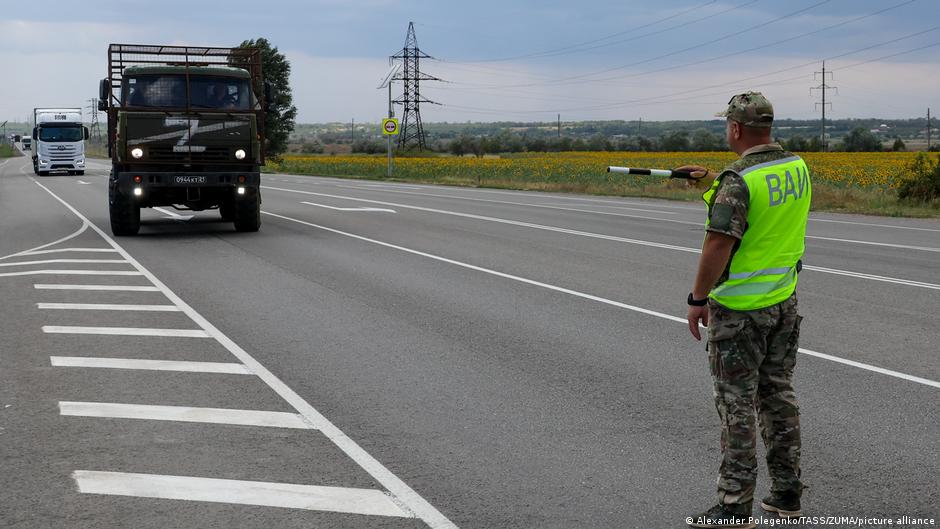
Ukrainian forces are fighting for control of key supply routes for Russian forces into occupied territories of Ukraine. According to Ukrainian military officials, newly developed medium-range weapons are now reaching Russia’s logistics routes beyond the front lines.
Ukrainian drones were reportedly conducting surveillance and strikes in the area around Mariupol. That would mean parts of the land corridor linking the Russian-held Ukrainian territory to the Crimean peninsula, about 160 kilometers (99 miles) away, are now under fire control. As evidence, the Ukrainian military has published several online videos purportedly showing burned Russian military vehicles on the road leading from the occupied territories in southern mainland Ukraine to Crimea.
“During the bloody and protracted war from 2022 to 2026, the creation of a land corridor to Crimea was seen as Moscow’s biggest potential achievement,” Ihor Lutsenko, a Ukrainian army soldier and co-founder of the Air Intelligence Support Center, posted on Facebook.
“But now it is clear that this is a fleeting gain,” he wrote, “in fact, Ukrainian drones are already circling over the corridor, which civilians are no longer allowed to use. Crimea is becoming a foreign territory for Russia. Of course, we will not leave it just like that.”
A turning point in the war in Ukraine?
According to Mykola Belyaskov, an adviser at the Ukrainian National Institute for Strategic Studies, full control over Russian supply routes is still a long way off. “If we had complete control, Russian soldiers in the south would feel differently,” Beleshkov told DW. However, he noted that vulnerability among Russian troops was increasing.
According to Belyaskov, photo and video evidence indicates that Ukrainian attacks have become more effective at medium ranges. “The Russians are now less active, even though their area of operations is much larger and there have been heavy attacks,” he said.
New military technology provides relief for Ukraine
Experts attribute the Ukrainian military’s progress to technological breakthroughs. Among other equipment, the Ukrainian Defense Forces now have drones from Ukrainian manufacturer Wild Hornets equipped with built-in AI systems.
However, as military expert and historian Mykhailo Zirokhov explained, this only offers operators a limited window of opportunity. The author of numerous publications on military aviation and conflicts in the post-Soviet region believes that Russia will soon create additional mobile fire groups and a comprehensive security strategy for roads along the Crimea corridor, which will also include nets to protect against drones.
However, Zirokhov pointed out that it is beneficial to Ukraine if Russia is forced to take such retaliatory measures. “Each defensive measure requires resources, and this is an additional burden for the Russians,” he told DW. He said Russian forces would be forced to invest money and divert resources to secure the route.
In his view, the effectiveness of Ukrainian attacks currently depends on the element of surprise, which will eventually be eliminated. “As soon as something effective comes to light, countermeasures are taken,” he said. The four years of war have shown this, Zirokhov said.
He added, “Therefore full advantage should be taken of this moment, while the Russians have not yet established effective air defense on this part of the front.”
Ukraine’s pressure is increasing
Zirokhov listed a number of specific steps to increase pressure on the Russian army’s logistics.
The first is to expand drone strikes, which have already proven effective. The second step is to equip the drones with heavy weapons to destroy Russian armored vehicles. And finally, Zirokhov proposed targeting new objectives and pointed to hundreds of kilometers of infrastructure along the route. He argued that attacks on gas stations and repair shops could more systematically disrupt the Russian military’s logistics than the destruction of individual vehicles.
Military expert Belyazkov highlighted additional factors, noting that multiple tasks must be accomplished simultaneously on the front line. “No matter how advanced the technologies are, they cannot reach their full potential without experts,” he said, noting that robot-assisted warfare still relies heavily on human personnel.
“In my opinion, that’s where one of the biggest limitations lies,” he said. He said there is a shortage of trained personnel in all units dealing with medium-range operations.
According to the expert, all these challenges contribute to the shortage of youth personnel on the frontlines, meaning that even the most effective technological solutions may not reach their full potential.
This article was originally published in Ukrainian.