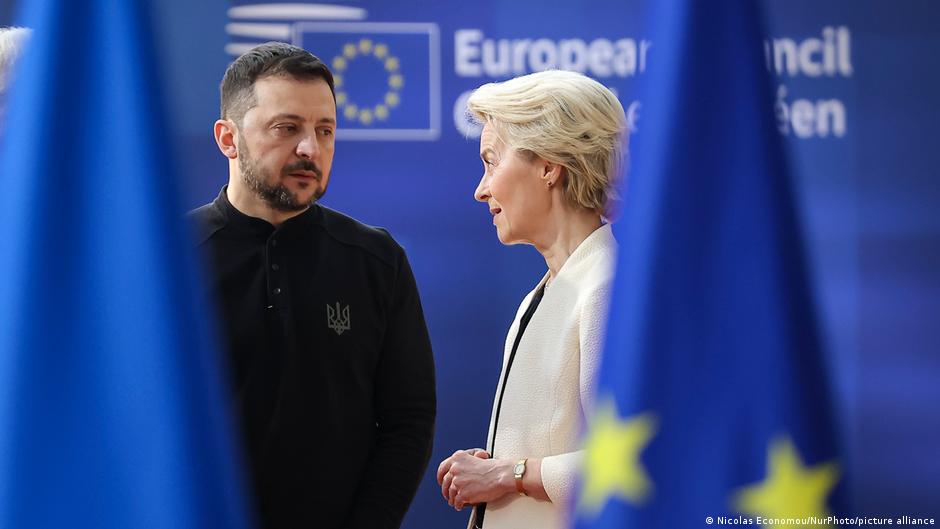
The EU and Ukraine on Monday formally launched the first phase of accession talks with a view to one day Kiev joining the 28-member bloc.
Russia’s full-scale invasion of Ukraine in 2022 promoted an idea that was once controversial among the country’s voters.
Why did the former Hungarian government delay this process?
This process was stalled for the last two years. That’s because it requires unanimous approval from existing EU governments to launch, and former Hungarian Prime Minister Viktor Orban was blocking the move.
Despite Hungary’s obstruction, negotiations had begun at the technical level.
Hungary’s new Prime Minister, Peter Magyar, recently announced that he has reached an agreement with Ukraine on measures to strengthen the rights of the ethnic Hungarian minority in the country. Magyar had made such an agreement a condition for removing Budapest’s veto on Ukraine’s EU accession talks.
What did European and Ukrainian leaders say about the move?
“Today, we are taking a historic step towards Ukraine’s future within the EU, by starting formal negotiations for its accession. A united and resolute G7 is essential to help end this war and achieve a just and lasting peace,” European Council President Antonio Costa wrote online while attending the G7 summit in Evian, France.
European Commission President Ursula von der Leyen said opening the first so-called dialogue cluster was a “huge step forward”, highlighting the progress Ukraine has made so far on reforms on issues such as corruption and the rule of law.
Ukrainian President Volodymyr Zelensky said Monday’s events “send a clear message that Europe’s progress cannot be stopped.”
He said he was happy to speak on the issue to Chisinau, Moldova, which took the same step on Monday before attending the G7 summit in France as a guest.
He said, “Our neighborhood with Moldova is strong. And we support each other, and we are moving towards the EU together – and we will get there together.”
What happens in the accession process?
To join the EU, potential members must demonstrate compliance with the bloc’s standards in a number of areas.
These are divided into six so-called “clusters” which make a total of 33 chapters. Outside the six groups, the other two chapters are discussed separately.
The first cluster to open and the last cluster to close is always labeled “Fundamentals”, which includes core issues such as the judiciary and fundamental rights, economic norms and the functioning of democratic institutions.
All EU member states must agree that all requirements have been met, and then the EU Executive, the European Commission and all member states – as well as the European Parliament – must agree to close the negotiation process.
This then paves the way for a final set of decisions on whether to sign and ratify an accession treaty by the candidate country, which again requires the approval of all EU members, currently 27 countries.
How long does the access process usually take?
The accession process takes years or often decades.
The last country to join the EU was Croatia in 2013, with Bulgaria and Romania joining in 2007.
In 2004, the largest enlargement in the bloc’s history took place simultaneously in Cyprus, the Czech Republic, Estonia, Hungary, Latvia, Lithuania, Malta, Poland, Slovakia and Slovenia.
The addition of 13 new members to the bloc in less than a decade created a series of teething problems and reduced the appetite and scope for further expansion.
Perhaps the most famous example of a bid to join the EU that has been stalled for decades is that of Turkey. The government in Ankara began its first formal accession negotiations with the EU in 2005, after initially applying for membership in 1987.
Ukraine’s negotiations are also likely to take years, and finalizing accession may not be possible as long as the country is still at war with Russia.
Could there be a faster path towards partial membership?
Many European leaders are calling for the introduction of some kind of “two-tier membership” to accelerate the process of bringing Ukraine, Moldova and other candidates closer, at least in Brussels.
German Chancellor Friedrich Merz recently proposed a special “associate member” status for Kyiv, suggesting it could include participation in EU summits and ministerial meetings but without any voting rights.
The move met with opposition within Ukraine, amid concerns that such a position could sideline the country rather than bring it closer to membership.
Meanwhile, two other EU prime ministers – Serbia’s Aleksandar Vucic and Albania’s Edi Rama – have recently proposed another possible form of partial membership.
It envisioned bringing countries into things like the European Single Market and giving them rights like freedom of movement, but it stopped short of granting them full political membership and veto powers.
However, this proposal, which set out more concrete economic incentives for partial membership, was met with silence and hesitation from Brussels and supporters of two-tier membership systems such as Germany or France.
Don’t let algorithms hide news. If you trust our team for reliable reporting, please take a moment to select us as your preferred source on Google By clicking here and pressing the “Star” or “Favorite” buttonThat’s why you’ll always see our verified news first.
Edited by: Wesley Rahn