June 16, 2026
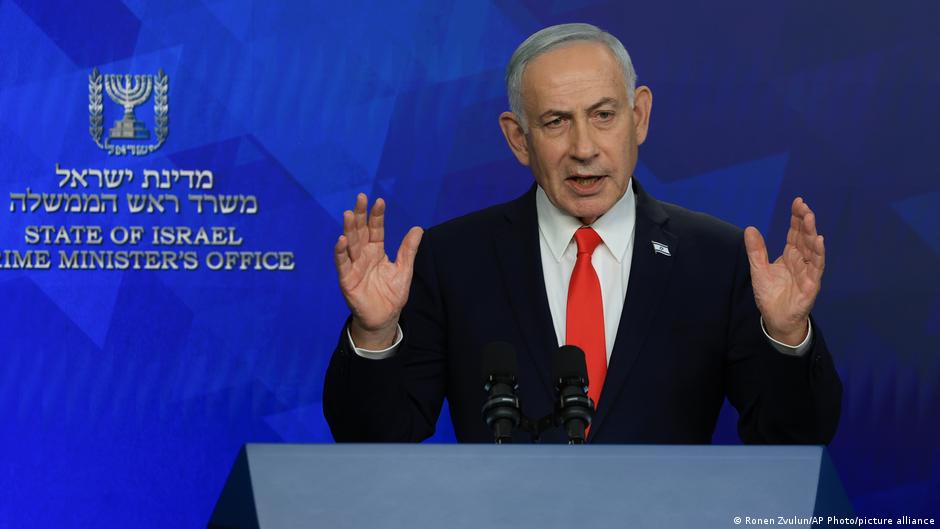
Netanyahu says he and Trump didn’t always share the same views
Asked about reports of disagreement with US President Donald Trump at a news conference on Monday, Israeli Prime Minister Benjamin Netanyahu said the two leaders did not always share the same views.
“I am responsible for Israel’s security interests,” he said.
The US and Iran on Sunday agreed to an initial deal that is set to reopen the Strait of Hormuz and extend a ceasefire once the pact is formally signed this Friday in Switzerland.
The details of the agreement have not been published as yet, with Netanyahu telling reporters that “we still do not know what the agreement will look like.”
Netanyahu and Trump launched the war against Iran from an aligned position, but Israel is not party to the deal with Iran.
In Israel, the deal has been criticized primarily by opposition politicians, who have described it as acapitulation to Iran.
https://p.dw.com/p/5FTDY
Netanyahu says Iran war outcome ties into halting Iranian nuclear program
Prime Minister Benjamin Netanyahu said on Monday that Israel’s military campaign against Iran had prevented Tehran from acquiring nuclear weapons in the near term and averted an existential threat to the Jewish state.
“We saved the state of Israel from the threat of nuclear annihilation,” Netanyahu said.
The Israeli leader said that “Iran would already have nuclear bombs” if Israel didn’t carry out military operations with the US. The campaign had removed that danger for “years” to come, he said.
President Trump has claimed that the US agreement with Iran will ensure that the country doesn’t develop nuclear weapons.
But there is no clarity on what exactly Iran has committed to since the text of the document has yet to be released.
Iran has previously also promised to halt its nuclear weapons program, including under the deal brokered by the Obama administration.
“With or without an agreement, Iran will not have nuclear weapons,” Netanyahu said. “As long as I am prime minister of Israel, that will not happen.”
Netanyahu added that Israel’s campaign against Iran and its regional allies was not over. Israeli forces would remain in “security zones” in Gaza, southern Lebanon and Syria for as long as necessary, he said.
https://p.dw.com/p/5FTDc
June 15, 2026
Trump: Deal will likely be published ‘sometime after Friday’
Donald Trump told reporters that the US hoped to publish the terms of its deal with Iran “in the very near future,” but not until a signing ceremony planned for Friday.
He was speaking in the town of Evian alongside French President Emmanuel Macron as he arrived for the G7 summit this week.
Trump said that Vice President JD Vance would be in Switzerland for the physical signing, but left his own attendance open, saying “I may be involved, I may not.”
He seemed to dispute or at least reframe supposed elements of the deal reported in Iranian media, saying that there would be no sanctions relief for Iran “until they do what they are supposed to do.”
Trump also told reporters that he wanted to “see if we can straighten out Lebanon,” seemingly in reference to what might well be one of Iran’s expectations in any deal.
Asked whether any European help would be useful to secure commercial shipping in the Strait of Hormuz, Trump said he did not think much help would be needed, but nevertheless said that perhaps it was “not a bad idea” to have “a ship or two” from other countries on hand.
Macron meanwhile reiterated his “offer” of a naval mission involving France and the UK.
“As the president said, maybe it won’t be desired, or maybe it won’t be needed, but in any case it is a mneasure that demonstrates our willingness to help,” Macron said.
https://p.dw.com/p/5FST4
June 15, 2026
US official says Trump, Vance, Ghalibaf already electronically signed accord
A US official speaking on condition of anonymity has told major news outlets that senior US and Iranian leaders electronically signed the “memorandum of understanding” on Sunday already.
The official told outlets including Reuters and AFP that President Donald Trump, Vice President JD Vance and Iranian negotiator and parliamentary speaker Mohammad Ghalibaf had signed the document.
“The president wanted to sign it personally because he wanted to show his… dedication to bring this through to a successful resolution,” the official claimed.
JD Vance had also alluded to electronic signatures in a TV interview and said the White House hoped to release the document in the coming days.
It’s not entirely clear if the document referred to here is or will be the same as the one both sides have said would be signed in person in Switzerland on Friday, or whether work on the deal was ongoing.
Mixed messages about the potential content have already started to emerge. Both sides also say the Switzerland signing will mark the start of further negotiations.
https://p.dw.com/p/5FSSb
June 15, 2026
IN DEPTH: Reported peace deal sparks both relief and anger
US and Iranian sources have given competing narratives of what the agreement actually contains. Competing narratives over sanctions, Iran’s nuclear program, Lebanon, the Strait of Hormuz and enforcement mechanisms show that the deal may be easier to announce than to implement.
Reza Alijani, a Paris-based political analyst originally from Iran, warned that the agreement should primarily be understood as a limited memorandum, not a full settlement.
Read the full analysis here
https://p.dw.com/p/5FSS9
June 15, 2026
US military warns Iran blockade still in effect, as Trump claims ships are passing through Hormuz
The US military has issued an advisory note warning seafarers that its attempted blockade of Iranian ports remains in effect pending completion of the framework deal between Washington and Tehran.
“A military blockade of Iranian ports remains in effect restricting all traffic inbound and outbound from these ports,” the advisory said. “Do not attempt to cross until explicit direction is given.”
Meanwhile, US President Donald Trump issued a flurry of social media posts from his flight to the G7 summit in Europe. In two of them, he claimed that commercial ships had started transiting the Strait of Hormuz in larger numbers.
“Ships are starting to move, many loaded up with Oil, out of the Strait of Hormuz,” he wrote with a characteristic disregard for the rules of capitalization. “They are going along the Southern ‘Highway,’ which is totally safe, secure and pristine. There are other areas of travel, also!!!”
It wasn’t entirely clear what Trump meant with his references to a southern “Highway” and other areas of travel, but the southern side of the Strait is the furthest from Iran’s coastline.
Soon after, Trump also shared an article from a maritime news website that cited unnamed US military sources as saying they had observed more ships moving through the waterway than open source maritime tracking data suggested.
However, that article was dated June 5 and had nothing to do with the latest agreement.
https://p.dw.com/p/5FSJ4
June 15, 2026
JD Vance says there are ‘a lot of very important details’ still to ‘figure out’
US Vice President JD Vance has said that he hopes text from the purported agreement with Iran will be released this week, as further negotiations on the deal were set to continue.
Speaking to CNBC, Vance said the US “expects” the economically vital Strait of Hormuz to be opened without tolls for the long term.
“Our expectation is that the Strait is going to be opened in a toll-free way on a long-term basis,” Vance said.
“That’s the sort of thing that we’re going to figure out in these technical negotiations,” he said.
“You know that there are a lot of very important details to figure out that we’re actually going to sit at the table and discuss together and figure out a path forward.”
The claim from President Donald Trump that the framework deal would include a provision to restore free movement through the Strait — the norm up until February of this year — buoyed the markets and led a falling oil prices on Monday.
But it’s still not entirely clear that the deal will achieve this, or under what terms.
It may hinge on other issues like sanctions relief for Iran, an end to hostilities in Lebanon between Israel and Hezbollah, or the outcome of talks on Tehran’s nuclear or missile programs.
Nevertheless, the “framework” is being billed as the biggest step towards resolving the conflict that began at the end of February. It was then somewhat calmed by a partial ceasefire in early April that still failed to fix reciprocal naval tensions in the Persian Gulf.
Vance said that Iran’s foreign minister and house speaker would represent Iran at a signing in Switzerland, without saying who would represent the US.
https://p.dw.com/p/5FSBg
IN DEPTH: Will the global energy crisis end soon?
A potential US-Iran deal to end the war and reopen the Strait of Hormuz could ease the global energy crunch, but oil prices and supplies may take months to stabilize as shipping restarts and infrastructure recovers.
Once the strait reopens, ensuring the free flow of traffic “might take eight weeks, perhaps longer, depending on how long each step takes,” Neil Crosby, head of research at market intelligence firm Sparta Commodities, told DW earlier this month.
Read the entire story here
https://p.dw.com/p/5FSC5
June 15, 2026
WATCH: German Foreign Minister Johann Wadephul welcomes the US-Iran deal
https://p.dw.com/p/5FR6k
June 15, 2026
Iranian, Turkish FMs discuss ceasefire announcement
Iranian Foreign Minister Abbas Araghchi held a phone call with his Turkish counterpart Hakan Fidan on Monday where they discussed the ceasefire announcement.
Abbas said that Israeli attacks against Lebanon must stop under the deal, according to a readout on Telegram.
Fidan expressed optimism about the announcement but warned against any potential “provocations” that could derail the agreement.
Abbas also held separate calls with the foreign ministers of Egypt and Iraq, his office said.
https://p.dw.com/p/5FR1E
June 15, 2026
Fresh Israeli strikes reported in Lebanon
Israel continued to launch artillery and air attacks at southern Lebanon overnight, despite news of the tentative ceasefire agreement.
Lebanon’s state-run National News Agency (NNA) reported fresh Israeli attacks near the southern city of Nabatiyeh.
On Monday morning, local authorities in Nabatiyeh urged residents against returning to the city “under any circumstances,” citing continued security risks.
Israel did not immediately comment on the reports, but the Israeli military said it intercepted a drone from Lebanon overnight.
Hezbollah has not officially commented on the announcement but Lebanese parliament speaker Nabih Berri, a Hezbollah ally who acts as an intermediary between the group and the US, thanked both sides for their “an essential and binding clause on halting the Israeli aggression on all of Lebanon.”
Lebanese President Joseph Aoun said in a statement on Monday that he hoped the peace deal would put a “definitive end” to the conflict between Israel and Hezbollah.
Aoun praised the US-Iranian memorandum of understanding for affirming that “Lebanon’s security and safety are an integral part of any effort to consolidate stability in the region.”
Meanwhile, an unnamed Lebanese security source told the AFP news agency that “Lebanon was not informed of the terms of the agreement or the time of the ceasefire.”
https://p.dw.com/p/5FQdE
June 15, 2026
UN rights chief welcomes announcement at ‘fragile moment’
UN human rights chief Volker Türk welcomed news of a tentative ceasefire deal and called on all sides to “exercise maximum restraint” during what he called a “fragile moment.”
“I welcome the announcement that the United States and Iran have agreed on a peace deal that provides for an immediate and permanent ceasefire, the reopening of the Strait of Hormuz, and a framework for further negotiations,” Türk said in a briefing on Monday morning.
“At this fragile moment it is clear all sides need to exercise maximum restraint and work to implement the agreement reached quickly and in good faith,” Türk said.
Türk also called for an immediate end to hostilities in Lebanon, where Israel and Hezbollah are engaged in a conflict, and called on Israel to withdraw from the south of the country. He called for a probe into whether the parties to the conflict had committed violations of international law.
https://p.dw.com/p/5FQ95
June 15, 2026
Saudi Arabia, Qatar react to news of regional ceasefire
Saudi Arabia welcomed the ceasefire announced by the United States and Iran as a basis for initiating detailed peace negotiations.
The kingdom’s Foreign Affairs Ministry insisted that the ultimate deal should “take into consideration the security interests of regional states, sticking to the principle of non-interference in the interior affairs of other countries.”
Iran has struck Saudi Arabia a number of times during the conflict, primarily targeting US bases in the Gulf nation.
Neighboring Qatar, which depends on the Strait of Hormuz to export gas, also welcomed the announcement.
In comments published by the state-run Qatar News Agency, Doha’s Foreign Ministry called it “an important step toward consolidating sustainable peace and promoting economic growth regionally and internationally.”
https://p.dw.com/p/5FPow
June 15, 2026
European leaders express cautious optimism
European leaders welcomed the news of a ceasefire deal between the United States and Iran but said the announcement must be followed by action.
EU chief Ursula von der Leyen said the “priority now is its swift and full implementation.”
She called for the immediate resumption of toll-free transit through the Strait of Hormuz, for an end to Iran’s nuclear program and for the ceasefire to apply in Lebanon, where Israel has been conducting strikes against Hezbollah.
“Of course there can be no peace in the Middle East while Lebanon is in flames,” von der Leyen said. “Once again Europe calls on all parties to respect Lebanon’s sovereignty and territorial integrity and implement a genuine ceasefire.”
British Prime Minister Keir Starmer also welcomed the announcement but work must still be done to secure a lasting peace.
“Obviously, nothing is guaranteed, but it is, I think, a significant breakthrough, a very significant breakthrough,” Starmer told a press conference on Monday morning.
“Hopefully, something which as we work together we can turn into that enduring peace that we all want to see.”
The comments on Monday follow earlier reactions from the likes of Germany’s Friedrich Merz, who stressed the deal must be implemented with “determination,” and France’s Emmanuel Macron, who similarly called for the “swift and full implementation” of the agreed-upon terms.
https://p.dw.com/p/5FPXr
June 15, 2026
China hopeful for Strait of Hormuz reopening
China has reacted positively to the news of a ceasefire deal between Iran and the United States that would reopen the Strait of Hormuz to international trade.
“China welcomes the agreement … and expresses appreciation for the mediation efforts made by Pakistan,” a Foreign Ministry spokesperson said on Monday.
China “hopes that safe and free passage through the strait will be restored as soon as possible,” the spokesperson said.
https://p.dw.com/p/5FPQV