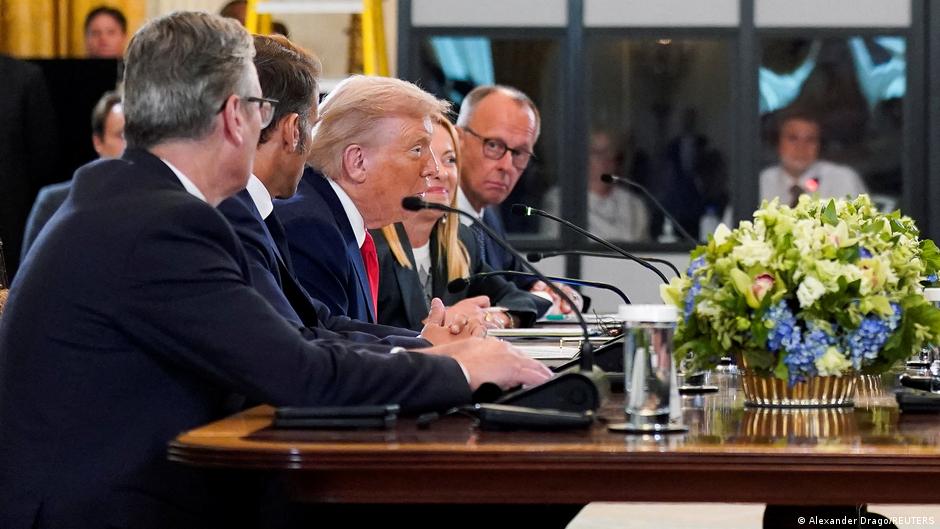
US President Donald Trump, French President Emmanuel Macron, Italian Prime Minister Giorgia Meloni and British Prime Minister Keir Starmer are among Chancellor Friedrich Merz’s closest foreign policy partners.
Yet these relationships have evolved in very different ways – some much better, some worse than expected.
Emmanuel Macron: Unable to find common ground
Few people in Germany would have expected things to deteriorate between Merz and Macron.
In early June, FCAS – a German-French flagship project – collapsed. After nine years of negotiations, France and Germany ended their efforts to create a joint fighter aircraft as a successor to the Eurofighter.
“Symbolically, the failure underlines that German-French cooperation and the political will for closer defense integration between Europe’s two largest military powers has faltered,” Lynn Seeley of the German Council on Foreign Relations told DW. “This is a very bad sign for European cooperation.”
While in opposition, Merz complained that his predecessor, Chancellor Olaf Scholz of the centre-left Social Democratic Party (SPD), had neglected relations with France and vowed to revive them.
Yet according to Lynne Seeley, that ambition has fallen short: “Chancellor Merz started out with a strong commitment at EU level and in German-French relations. Meanwhile, however, German-French relations have cooled significantly.”
The two leaders often have divergent positions on trade and financial policy, as well as on EU budget planning. The termination of the FCAS project was also not jointly announced; Instead, Berlin surprised Paris with the move.
Giorgia Meloni: right-wing pragmatist
For German politicians, relations with Italy often outweigh relations with France. In recent years, there have also been political reasons: When Giorgia Meloni became head of the right-wing coalition in Rome in 2022, Germany’s centre-left government at the time kept its distance.
Meloni’s party, Fratelli d’Italia (Brothers of Italy), is variously described in Germany as far-right, post-fascist, or at least right-wing nationalist. It was widely seen as the Italian equivalent of Germany’s Alternative for Germany (AfD) party – a group of mostly centrist parties that wanted nothing to do with it.
However, this changed with the beginning of the Chancellorship of Friedrich Merz in May 2025. This change had less to do with Merz sharing Meloni’s political positions, but rather his effectiveness as a practical mediator in the conflict between the EU and the US over the tariff dispute and Trump’s ambitions in Greenland.
However, apart from efforts to resolve the crisis with Trump, the governments of Berlin and Rome appear to have more in common: They share a desire to promote greater competition within the EU and reduce bureaucracy. For Lynn Seeley, it is no coincidence that Merz and Meloni have found common ground: “Both share a pragmatic approach to European policy.”
Furthermore, “Italy and Germany are very similar economically and politically: a relatively strong industrial base, an economic structure shaped by SMEs (small and medium-sized enterprises), and a federal system of government. These shape their view of the world and foster a sense of closeness.”
Nevertheless, Celle believed that Italy would never play any more of a role for Germany than for France. Reason: “The German-French partnership has an institutional closeness and an intensity of exchange that Germany does not have with any other partner.”
Donald Trump: Flabbergast fails to build friendships
Friedrich Merz has made great efforts to build relations with US President Donald Trump. Whether it was US military operations in Venezuela or Trump’s demands regarding Greenland, Merz expressed any objections with great restraint, if at all.
Even when the United States and Israel took the initiative on Iran, he was initially cautious in his criticism. Three visits to the White House have underlined how important the German Chancellor values relations with the US president.
Johannes Warwick, a political scientist at the University of Halle, recently told DW one reason: “Merz thinks in terms of the threat from Russia and is clearly convinced that the Americans must be on board to deter Russian aggression.”
However, that approach came under strain when Meraz criticized what he saw as a lack of strategy in the Iran war and commented that Iran had humiliated the United States.
Trump expressed his anger directly at Merz on his platform Truth Social, reacting furiously: “No wonder Germany is doing so badly, economically and otherwise.”
Whether Merz will launch a new attraction offensive despite the recent humiliation or instead step back for a while remains to be seen.
Keir Starmer: calls for rapprochement with the EU
Friedrich Merz regrets that Britain has been out of the EU for many years. Yet Labor Prime Minister Keir Starmer is trying to reconcile the bloc – and in doing so he is pushing for an open door in Berlin.
Starmer and Merz come from different political families: Starmer, from the Labor Party, is roughly equivalent to Germany’s center-left SPD, while Merz’s center-right Christian Democratic Union (CDU) is similar to the British Conservatives. Nevertheless, the two leaders have built a relationship of trust and close cooperation, particularly in support of Ukraine.
“Starmer, like Merz, is a pragmatist; both are united in their strong support for Ukraine,” Lynn Seale told DW. “Merz is also deeply influenced by the Anglo-Saxon world, has followed Brexit closely, and aims to promote closer political relations between the United Kingdom and the European Union (while also seeing the UK as Germany’s historically close ally within the EU).”
threat of the far right
However, both leaders are under heavy political pressure from the right: Merz from the AfD and Starmer from Reform UK.
And this is something else that unites not only the conservative Merz and the Labor politician Starmer, but also the centrist Macron: In Europe’s three strongest countries, the ruling parties are, in some cases, far behind their right-wing rivals in the polls.
Such politicians are already in power in the United States and Italy. In dealing with Trump and Meloni, Merz has already got an idea of the kind of leaders he may have to contend with in France and the United Kingdom in the future.
This article has been translated from German.