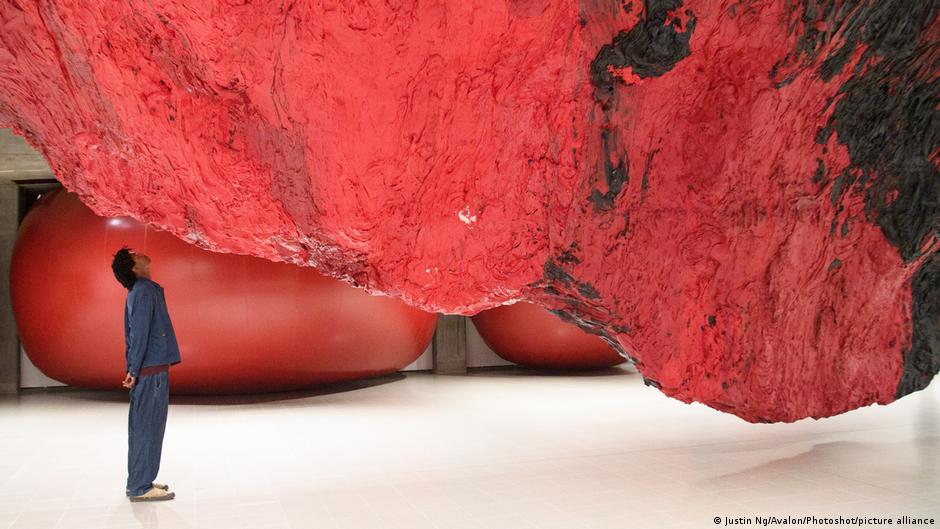
Anish Kapoor can demand a lot from his audience. For some people, depending on one’s mental state, looking into the darkest of whirlpools, into the blackest of colors, can be disturbing. It is mixed with dark red wax, one of his favorite ingredients: it symbolizes flesh and blood. Associations that reach directly to the origin.
And yet, the artist looks happy and relaxed as he talks about his work. However, sometimes it also makes him feel a little uncomfortable. Take, for example, the major exhibition of his work currently on display Lehmbruck Museum In Duisburg. In an interview with ARD, he walks around “First Body”, a sculpture made of resin, and says: “It’s fleshy, if you like. It’s kind of doing a weird thing,” he laughs, while his shoulders tremble.
Perhaps one reason why Kapoor’s own installations elicit such a strong response is that he begins working with the material without knowing how it will end up. “I go into the studio and say, ‘I don’t know what to do. I’m lost.’ Then stuff comes up and it’s the thing in the room that you work with,” he once told the magazine. talk. “I’m really interested in it as a process because the process takes you in directions that you couldn’t logically put there.”
Kapoor’s art in Chicago and Munich
Born in Bombay (today Mumbai) in 1954, Anish Kapoor has long been among the world’s best-known and most sought-after actors. He won the Turner Prize in 1991 and was knighted by Queen Elizabeth II in 2013. For more than 50 years, he has been living in London, and now Hayward Gallery A major exhibition is being dedicated to him.
Kapoor’s artworks are on permanent display in many locations around the world, where they blend seamlessly into both urban architecture and vast natural landscapes.
In Chicago, the “Cloud Gate” (known locally as “The Bean”) has graced Millennium Park since 2006. It is a massive, bean-shaped stainless-steel sculpture that reflects the city’s skyline.
Since 2020, “HOWL,” a giant PVC sphere, has been installed in the rotunda of Munich’s Pinakothek der Moderne. Kapoor said its reddish-brown color reflects menstrual blood.
Regarding the speech, Kapoor says that it mesmerizes him. “There’s an eerie kind of darkness to it,” he said.
But Kapoor knows things could be worse. In 2016, they secured the exclusive rights to the blackest thing ever created: Vantablack.
Originally developed for military purposes using nanotechnology, this extremely black substance absorbs approximately 99.6% of incoming light. Because the eye cannot sense how little light is reflected, objects coated with it appear to have any texture, wrinkles, or loss of shape. The viewer has the impression of a two-dimensional, infinitely deep hole in space. “It’s as dark as you can imagine, so dark that you lose your sense of who and where you are and especially your sense of time,” the artist told BBC Arts in 2016.
accidentally falling into a ditch
In 2018, Kapoor’s playful use of this illusory black substance led to an accident for a visitor to the Serralves Museum in Porto: convinced that the black surface in front of him was solid, the visitor to the exhibition stepped into the void and fell two and a half metres, landing on a surface coated with Ventblack. “Descent into Limbo” was the work’s suggestive title. The man suffered only minor injuries.
The void has long been a central theme in Kapoor’s work. In Western philosophy, the concept of “void” is often defined as the lack of something, but Kapur’s concept is heavily influenced by Eastern philosophy, especially Hinduism and Buddhism. For Kapoor, the void is the origin of everything, an infinite space full of possibilities, promises and unborn forms.
Instagram can’t capture it
While one should never literally allow oneself to fall into the void the way the man in Portugal did, Kapoor intends for the audience to experience the feeling of dizziness or falling.
Speaking at an exhibition at London’s Tate Modern, Kapoor once said that he had created works that depicted the act of falling: “But that falling doesn’t have to be downwards. Falling in some strange way can also be towards the horizon or upwards. Vertigo though is at the heart of it – disorientation.”
And so, while Anish Kapoor’s works are indeed Instagrammable, like many other successful contemporary artists, they are not always as easy to photograph as, say, the art of Yayoi Kusama or Jeff Koons. Their true power is revealed only when there is no smartphone to distract the viewer’s gaze from the artwork.
The Lehmbruck Museum in Duisburg is exhibiting Anish Kapoor’s work until August 30, 2026. His works are on view at the Hayward Gallery in London until October 18, 2026.