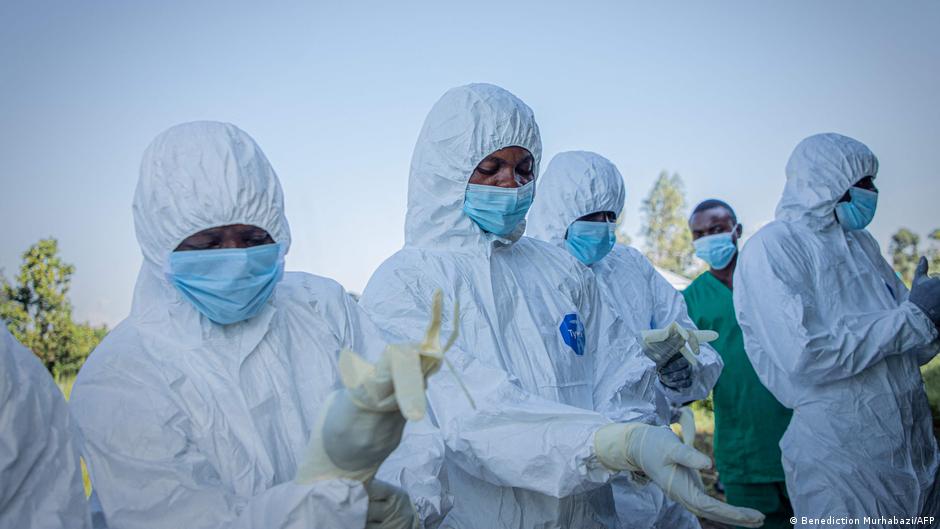
The European Commission said on Wednesday It was building on an aid program of about €493 million (about $580 million) in humanitarian assistance and health protection amid the latest Ebola outbreak centered around Ituri province in the east of the Democratic Republic of Congo (DRC).
It came a day after leaders gathered at the G7 summit in Evian, France, calling for a strong and coordinated international response to the outbreak, praising the support efforts of the US, EU and others.
The outbreak of the comparatively rare Bundibugyo strain of the Ebola virus has led to 837 confirmed cases and 196 deaths — 29 of which occurred in a 24-hour period, according to the DRC government late Tuesday.
What did the EU say about its aid programme?
The European Commission said its funding and assistance was a mix of “frontline medical assistance for the immediate outbreak response”, humanitarian assistance in the Great Lakes region and neighboring Uganda, vaccine and treatment research, and “longer-term work to prepare and improve health systems”.
It said European health officials still considered the risk to European citizens to be low, but officials nonetheless stressed the importance of cooperation.
“This is a reminder that health security is shared security,” said Commission President Ursula von der Leyen. “Countries can better protect their citizens by working together.”
Hadja Lahbib, the European Commissioner responsible for crisis management, called the outbreak a “test of global solidarity”.
“As some people turn inward, the EU remains present, engaged and a reliable partner,” Lahabib said, before recounting his recent visit to a treatment center in the outbreak area in the DRC.
“In Bunia, I met doctors, nurses and frontline responders who are working under extraordinary pressure to save lives, as well as communities living in fear and uncertainty,” she said. “But they are not facing this crisis alone.”
What did the G7 say about the outbreak?
G7 leaders gathered in the French Alps issued a joint statement There have been calls for a “strong and coordinated response to address the health security risks” posed by the outbreak, which the World Health Organization has deemed a public health emergency of international concern.
Partner countries Egypt, India, Kenya and South Korea, whose leaders were guests at the summit, also supported the call, expressing deep sorrow for the loss of life and strain on local communities.
“The current outbreak is concentrated in an isolated, conflict-affected area in the DRC, making containment, medical treatment and response logistics challenging,” the G7 statement said. “Current vaccines, diagnostics and treatments are not fully effective against the related rare viral strains.”
Praising existing US and EU programs aimed at supporting the local response, the international leaders “called for other countries and partners beyond the G7 to commit”. resources to address this global threat through the means they deem most appropriate.”
What is Ebola and where is the outbreak located?
First identified in 1976, Ebola is a deadly viral disease spread primarily by direct contact with the bodily fluids of symptomatic patients or the deceased. It can cause severe bleeding and organ failure and is believed to originate from bats.
This is the 17th Ebola outbreak in the Central African country. The deadliest killed nearly 2,300 people between 2018 and 2020.
Most of the cases in the current outbreak have been found in a conflict-ridden gold mining center in the east of the DRC, near the border with Uganda.
Some cases have also been reported in Uganda, forcing some countries to impose travel restrictions on the DRC as well. However, the Ugandan government has said that these cases are imported from the DRC, arguing that the situation is under control inside its borders.
“We therefore call on all countries that have imposed unfair sanctions on Ugandans to stop Ebola because Uganda has effectively controlled Ebola in the current outbreak,” Vice President Jessica Alupo told a conference of African leaders and donors in Nairobi on Tuesday.
The Red Cross warned on Tuesday that the outbreak had not yet reached its peak.
Don’t let algorithms hide news. If you rely on our team for reliable reporting, please take a moment Choose us as a preferred source on GoogleThat’s why you’ll always see our verified news first.
edited by: