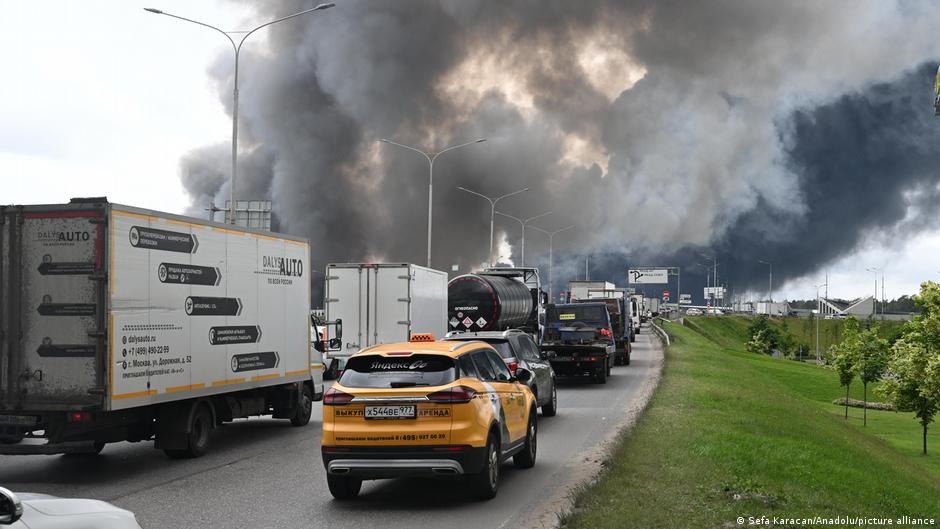
Ukrainian drones appear to be getting better at bypassing Russian air defenses to attack critical infrastructure.
After Ukrainian drones attacked various locations in Moscow on June 18 – the largest attack since the beginning of Russia’s full-scale invasion of Ukraine – debate was sparked about holes in the country’s defense net.
A major oil refinery in Moscow, which supplies 40% of the region’s fuel, was set on fire and production appeared to be halted for several days after the attack. Evacuations also took place at Russia’s largest airport. Eyewitnesses flooded social media with footage of what appeared to be the drone’s failed air defense intercept.
“This impression is formed among non-experts who see a missile flying by without hitting the drone,” Ruslan Leviev, a Russian dissident, military analyst and founder of the investigative group Conflict Intelligence Team, told DW.
Exiled Russian journalist Ivan Filippov tracks pro-Kremlin bloggers and notes their growing concern that Ukraine has found a gap in Russian security.
“They don’t want the war to stop — they want a more effective war, which means a radical reform of the Defense Ministry and Russia’s military-industrial complex,” Filippov told DW. “But I think they understand very well that these reforms are impossible. So these lessons tend to be pessimistic.”
Ukrainian aviation expert and former Air Force officer Anatoly Khrapchynsky attributed the June 18 breach of Moscow’s air defenses to a combination of two factors: a systemic erosion of Russia’s defense architecture and the technological development of Ukraine’s strike capabilities.
Leviev was not so sure. His team did not note a weakness in Russia’s defenses because it had actually shot down more than 90% of the UAVs over Moscow. But what the Russians managed to achieve by air defense caused considerable damage.
Leviev believes the main issue is quantity. As the scale of the attacks grows, the challenge is the same for both Russia and Ukraine: large-scale drone attacks require more hardware than any industry can supply.
Russia’s weaknesses
Khrapchinsky told DW that Russian systems, including the Pantsir-S1, were designed to counter classic, large-scale attacks such as cruise missiles. They were calibrated against highly radar-reflective targets made of metal – but modern drones are often made from composite materials such as plastic or plywood. This means that those systems are basically “blind” to small drones.
The sheer size of Russian territory is a challenge in itself. Building a monolithic “wall of air” or a single “dome” is impossible, Leviev said.
And Moscow is an even easier target for drones because of its high urban density. Leviev pointed out that the denser the development – especially tall buildings – the easier it will be for drones to hide from radar behind buildings.
Ukraine is taking advantage of this. Khrapchynsky pointed out that Kiev’s long-range drones have significantly improved their ability to plot complex flight paths and avoid potential interception zones.
At the same time, Russia has also redeployed some of its air defense systems, sending them to Russian-occupied parts of Ukraine.
Experts say the best air defense systems are layered, with different interceptors able to operate at different altitudes and target attackers approaching at a variety of speeds, including missiles and drones.
Khrapchinsky said Russia’s redeployment has led to the disintegration of the once layered air defense system and is now more of a patchwork.
US media outlet CBS also cited Ukrainian sources who say Russia may lack S-300 systems, a series of long-range, surface-to-air missile systems used to counter air strikes. It is believed that sanctions on Russia have prevented replacement components.
Khrapchinsky links the reduction to Russia’s retooling of its S-300s for surface-to-surface attacks on Ukraine.
Khrapchinsky concluded, “Russia has fallen into the trap of the same ‘math of war’ it once tried to impose.” Namely, Russia depleted its stockpile of interceptor missiles by trying to weaken Ukrainian air defenses with S-300 attacks.
Kremlin does damage control
After the June 18 attack on Moscow, Russian officials were more troubled by how well the attack was documented than by the actual attack itself.
Kremlin spokesman Dmitry Peskov said Russian air defense had performed appropriately and urged people to focus on Russian attacks on Ukraine. Peskov said, “The footage is impressive – showing the results of the attacks carried out by our armed forces. These attacks will continue.”
The Kremlin’s approach is to play down the attack. As Leviev says, militarily the June 18 drone strikes changed little. He believes such attacks serve more as “political attacks”, a way to destabilize public opinion, especially ahead of elections this September for the State Duma, the lower house of Russia’s parliament.
Edited by: C. Shehar