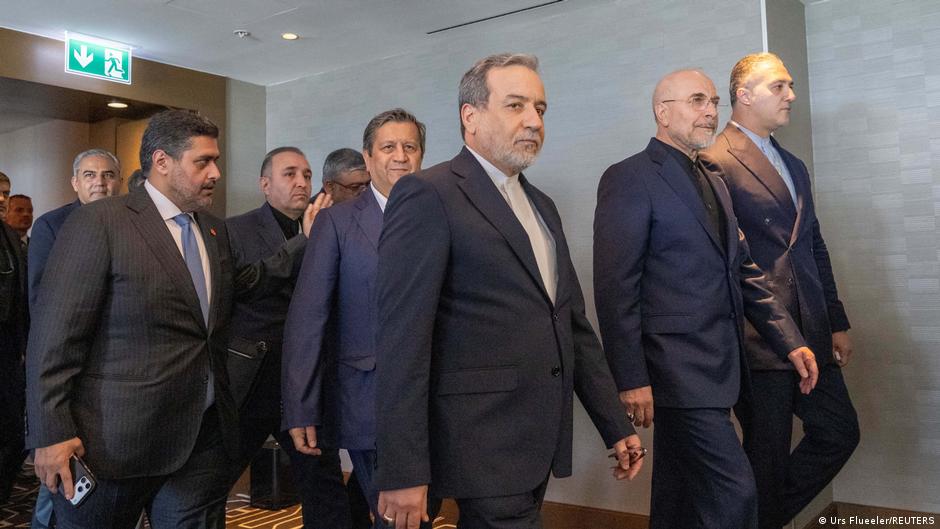
US Vice President JD Vance announced on Monday that a “very good foundation” has been laid for a successful final deal with Iran after direct talks between the two sides at a mountain-top resort in Switzerland.
The talks were the first phase of a two-month negotiating period set out under a preliminary agreement agreed last week aimed at ending the war started by the United States and Israel on February 28.
Iranian Foreign Minister Abbas Araghchi wrote on Twitter that “major progress has been made toward ending the Lebanon war” in the context of the conflict between Israel and Iran-backed Hezbollah militants.
He also said Tehran had secured waivers for oil and petrochemical exports, the release of some of its frozen funds and the launch of a reconstruction and development plan for Iran.
Iran’s top negotiators left for Tehran after the talks, while the technical team led by Deputy Foreign Minister Kazem Gharibabadi is still in Switzerland and will continue talks, Iranian state media reported.
However, the peace process has been under pressure from multiple directions between US and Iranian officials even before the talks began. Hardliners in Iran termed the talks as a retreat. In the United States, parts of the memorandum of understanding faced criticism for offering too much to Iran while leaving key questions unresolved.
At the same time, Israel is continuing its attacks in Lebanon, while Tehran is insisting that the ceasefire there is part of the interim agreement.
a delicate and fragile truce
The talks got off to a rocky start on Sunday when the Iranian delegation briefly halted talks after US President Donald Trump threatened in a social-media post to resume attacks on Iran if Tehran did not rein in its allies in Lebanon.
Iranian Parliament Speaker Mohammad Bagher Qalibaf, Tehran’s chief negotiator, and Foreign Minister Abbas Araghchi responded by saying Iran did not take the US threats seriously and warned Washington to be careful with its words.
“They better be careful with their statements, our armed forces are prepared to respond differently,” he said on his X account. “Whatever they say, we are the ones who will act.”
The exchange underlined the difficulties of turning a shaky diplomatic gambit into a durable agreement.
Finland-based political analyst Kambiz Ghafouri told DW that the fundamental ideological contradictions between the two parties have never been resolved..
“The Iranian government is still a revolutionary government,” he said.
“It still has the Supreme Leader of the Revolution, it still has the Islamic Revolutionary Guard Corps, and it still shouts slogans against the US and Israel. Under these terms, it should be clear how Iran wants to interact with the country it still defines in those terms.”
In his view, this tension is not just a diplomatic issue, but a problem of political identity, as a system built around permanent enmity cannot easily move toward stable coexistence without creating internal tensions. The clearest sign of that tension, he said, is the fighting in Lebanon.
Iran unlikely to abandon Hezbollah?
Iran has treated the Lebanon ceasefire issue as part of the negotiating framework, while the US side has tried to limit the talks and divert regional tensions from the main agreement.
But events on the ground have made that separation difficult.
Analyst Ghafouri said Iran was unlikely to abandon Lebanon-based Shiite political party and terrorist group Hezbollah in any meaningful way.
“Hezbollah is like a child to the Iranian regime,” he told DW. “He created it and strengthened it. Under these circumstances, it is very unlikely that Iran will accept reducing Hezbollah to the level of a normal political party.”
For Tehran, Hezbollah is not just a political instrument. It is part of the regime’s long-term regional architecture and ideological self-image.
For Washington and Israel, this makes it harder to trust Iranian commitments, Ghafoori said. America, Israel and many other countries declare Hezbollah a terrorist group.
He also argues that trust between both sides is weak.
From Tehran’s perspective, Trump withdrew from the previous international nuclear deal with Iran and then twice attacked the Islamic Republic militarily during negotiations.
On the other hand, Washington is deeply suspicious of Iranian promises to change its nuclear and regional policies.
That’s why, Ghafouri said, the chances for success will be limited unless Iran’s negotiators isolate or sideline regime hardliners.
America made a big offer at a high political cost
The most ambitious part of the interim framework agreement is the promise to lift all primary and secondary US sanctions on Iran.
This will go far beyond the scale of relief provided under the 2015 nuclear deal.
It would also be politically difficult for any US president to take immediate action, as these restrictions are rooted in decades of Congressional legislation and executive orders.
Reversing them will take time, political capital, and sustained implementation.
But by putting such an offer on the table, Washington is signaling that it is willing, at least in principle, to consider something much larger than a narrow nuclear understanding.
Vice President Vance’s statement about Washington being ready for “fundamental changes” in relations with Iran reflects that ambition. This suggested that the US side wanted to present the talks not as a temporary crisis-management exercise, but as a potential turning point after decades of hostilities.
domestic problem inside iran
Some analysts believe that the main obstacle to reaching a long-lasting agreement may not be the foreign terms of the deal, but the internal conditions of the Islamic Republic.
“The Iranian people were ignored in these negotiations,” London-based political analyst Omid Shams told DW.
In his view, any compromise that transcends human rights, civil liberties and political prisoners may still fail to stabilize the country internally. If those issues remain untouched, he argued, domestic pressures will continue to build, and the state may once again fall back on more aggressive foreign policy behavior as a way of managing an internal crisis.
That argument points to a deeper problem.
Even if Tehran and Washington ease tensions externally, the Islamic Republic still faces overlapping crises domestically, including inflation, declining purchasing power, corruption, environmental stress, and a growing legitimacy gap between the state and society.
A break, not necessarily at the end
Shirin Shams, a human rights activist active in the Women, Life, Freedom movement, told DW that she sees no reason to expect sustainable success.
“I don’t think we should expect any fundamental changes or lasting results from the Switzerland talks,” he said.
He argues that over the past four decades, the Islamic Republic has often used negotiations not to change its domestic policies, but to buy time, reduce international pressure, and avoid moments of crisis while maintaining repression at home.
According to their reading, even if a short-term agreement is reached, it will remain fragile given the wide range of disagreements between the two sides – not just the nuclear program but also issues such as Tehran’s regional influence and support for proxy terrorist groups throughout the Middle East.
The challenges are further complicated by divisions within the Iranian regime – one side favors negotiations while the other sees it as surrender – and opposition from Israel, which sees Iran’s Islamic regime as an existential threat.
However, for Shams, the most important variable is still internal. The real question is not whether the talks succeed on paper, but whether an agreement can repair the rift between the state and large sections of Iranian society.
He believes that as long as the demands for freedom, equality, social justice, dignity and political accountability remain unanswered, no external agreement can solve the deep crisis inside Iran.
Edited by: Srinivas Majumdaru