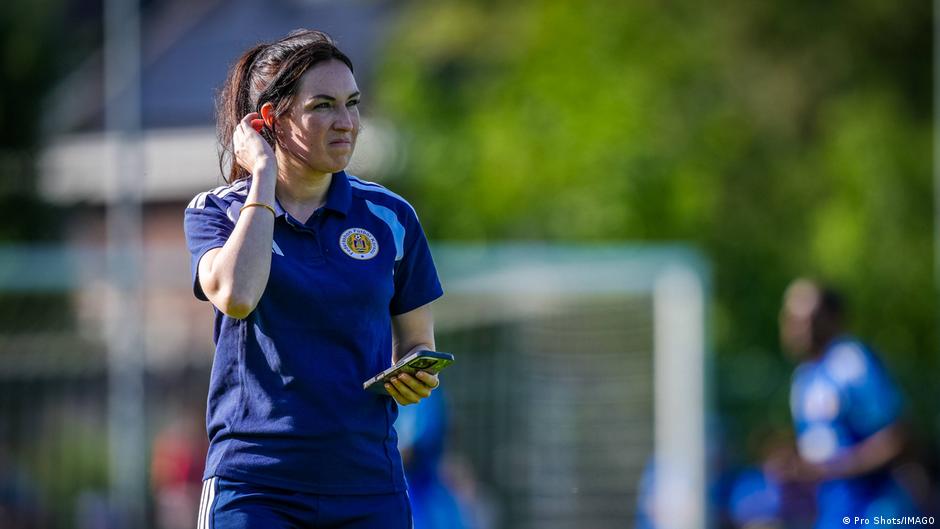
Dr. Suzanne Heuermann is the only female head physician at the 2026 World Cup. The 36-year-old Netherlands player is featuring for Curacao, the smallest nation to qualify for the World Cup and Germany’s opponent in the first round of play.
Apart from Dr. Silja Schwarz, who has been a doctor (but not the head) for the Germany men’s team for the past three years, Hurmann is the only female doctor at the entire tournament. In the history of the competition, Heuermann is the third woman to be a doctor of any kind for a team at the World Cup.
The reasons for this are varied, but most are linked to male dominance in the football industry.
“It’s not because there aren’t good female doctors, because in medical school the class was 70% to 80% female. It’s becoming less and less common as you go into specialty sports medicine, especially male sports medicine. It’s still a real male-dominated culture,” Heuermann told DW.
“You really have to prove yourself. It takes longer before they see you, before they accept you. It’s all about proving your quality, showing that you are there to do everything possible to support them and their health. But it’s difficult because you have to face a lot of barriers, a lot of prejudices. They say: ‘No, you can’t work here because you’re a woman and we have a man in the men’s team. Don’t want the woman. I’ve heard it a million times. You just have to prove yourself, keep moving forward and don’t give up because someone tells you ‘no’.
Hoorman’s journey is a clear proof of this. She started at the Dutch football club Go Ahead Eagles Deventer, has been the head of medicine in professional sports since 2015 and worked at Real Madrid for several years.
In her experience, problems arose at the director and higher management levels of large organizations, where she often received the answer: “No, we cannot allow a woman in the male staff.”
Hurman focused on work
Hoorman makes every effort to let her work and experiences speak for themselves.
“Being the only woman on the whole team, I try not to focus on it,” Hurman said. “I try to do my best as a doctor, do maximum deliveries every day and keep everything ready. This is the most important thing for me.”
“Of course it’s unfair, but the whole world is unfair so we can complain about it, but as a professional the only thing you can do is prove your worth and show that you are capable.”
In March this year, FIFA approved new legislation that women’s teams in tournaments must have at least two female staff members, one of whom must be a head or assistant coach. Nothing like this has been implemented for the men’s side of the game, where the majority of staff members are men.
“The first challenge for female doctors entering the male-dominated football world is getting them to accept you – even if your CV is perfect, you are still a woman,” Heuermann said. “And then, once you get there, it takes longer for them to accept you for who you are and what your potential is. But when you show your knowledge and skills and they see that it’s top level, that’s OK. That’s the biggest challenge before that.”
Hope for more women in the future
Doctor Who equality is still a long way off, but there are some encouraging signs from other games. According to ISAKOS (International Society of Arthroscopy, Knee Surgery and Orthopedic Sports), the U.S. Olympic team saw a huge jump in the number of female physicians between the 2012 London Games and the 2024 Games in Paris. In 2012, 19% of doctors were women but 12 years later, the number was 32%.
“I hope there will be more female doctors at the next World Cup,” Heuermann said. “I think the world is changing because in other sports you see it more, but football is really male-dominated. Hopefully in four years it will be a lot better.”
Thanks to pioneering players like Heuermann and Schwarz, football’s male-dominated environment is being challenged. Additionally, despite the many challenges and prejudices many women face in elite sports, a growing number of women are stepping up to inspire the next generation. American referee Tory Penso is another example: he is set to take charge of Germany’s final group-stage game against Ecuador.
Thomas Klein conducted the interview for this article.
Edited by: Carla Bleiker