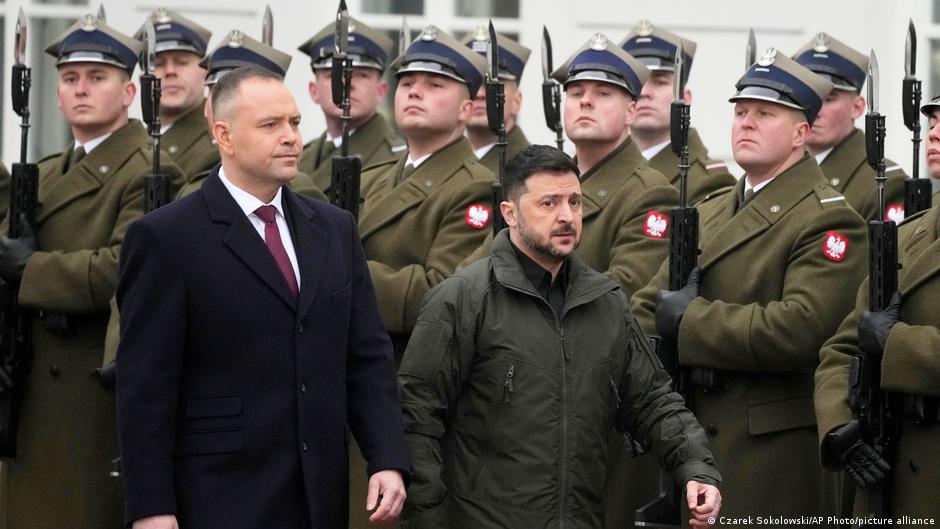
For a long time, Poland and Ukraine were the closest allies.
The political and military support Ukraine received from Poland made a major contribution to Ukraine’s ability to successfully defend itself in the early days of a full-scale Russian invasion beginning in February 2022.
However, now, a dispute over the past, which has been going on for weeks, is pushing the two neighbors into ever-deeper trouble.
Withdrawal of Poland’s highest state honor
On Friday evening, Polish President Karol Nawrocki announced on Twitter that he was withdrawing Poland’s highest state honour, the Order of the White Eagle, from Ukrainian President Volodymyr Zelensky.
In doing so, Nawrocki fulfilled a threat he had made several weeks earlier during the controversy over the name given to a Ukrainian special forces unit, “Heroes of the UPA”.
The announcement sparked a strong reaction in the Ukrainian capital.
“We believed that the Order of the White Eagle, awarded in 2023, was for the Ukrainian people and our army. That’s what it said at the time. Today, I sent the order back to the President of Poland,” Zelensky wrote on his social media account on Saturday.
He thanked Poland for its support and solidarity so far and said that since the honor has also been given to Russian Empress Catherine II, Italian dictator Benito Mussolini and former German Chancellor Gerhard Schröder, “we will not debate this in Ukraine.”
He also posted photos, without comment, showing him sending orders to Nawrocki through the private Ukrainian postal and courier service Nova Post.
Inspired by Nairobi domestic politics?
Speaking in an interview with Ukrainian television channel 1+1, Zelensky later accused his Polish counterpart of taking the step because of parliamentary elections in Poland next year.
“President Karol Nawrocki is fighting for his party’s position against the Prime Minister [Donald Tusk]. this is the same thing [former Hungarian Prime Minister Viktor] Orban did it. This is the wrong way. “I think it will end badly,” Zelensky said.
Ukrainian politicians returned the honors
Over the weekend, there was an almost unanimous response from politicians in Ukraine.
Three of the country’s four living former presidents – Leonid Kuchma, Viktor Yushchenko and Petro Poroshenko – returned their Polish orders. The fourth, pro-Russian Viktor Yanukovych, fled Russia in 2014.
Presidential Chief of Staff Kyrillo Budanov and Foreign Minister Andrey Sibiha also returned their respects.
“Navroki has become a destroyer of the positive progress we have made in recent times. It is not without reason that he receives praise from Moscow,” Sibiha said. He further said, “No president of any other country will let our history dictate to us.”
Without going into specific details, the foreign minister said Ukraine would reflect Nawrocki’s move.
UPA: the root of the current controversy
It is the most serious dispute between Warsaw and Kiev since Russia’s full-scale invasion of Ukraine four years ago.
It began in late May, when Zelensky issued a decree approving a request to use the honorary name “Heroes of the UPA” of a special forces unit within the Ukrainian military.
In doing so, Zelensky explicitly honored the memory of the fighters of the Ukrainian Insurgent Army (UPA), who continued armed resistance to Soviet rule in Ukraine until the 1950s.
This resistance is at the forefront of Ukraine’s current public culture of remembrance and is one of its central elements.
However, the UPA’s approach in Poland is actually very different.
During World War II and starting in 1943, the UPA carried out several massacres targeting the Polish population in Volhynia, a western Ukrainian region while fighting for independent Ukraine. Overall, UPA units killed approximately 100,000 civilians.
20,000 Ukrainians were later killed in retaliation by Polish partisans.
The Polish Parliament declared the UPA’s crimes genocide in 2016.
Setback after cautious progress
The issue of how this past is assessed has been a source of political and diplomatic disputes between Poland and Ukraine for decades.
These disputes came to a halt for a time as a result of Russia’s invasion of Ukraine in February 2022.
However, last year Volodymyr Zelensky agreed to a Polish request to open mass graves containing Polish victims in Volhynia for exhumations. The authorization to open the first mass graves was issued by the Ukrainian Ministry of Culture in early June.
Nawrocki’s decision to remove Zelensky from the Order of the White Eagle has potentially dealt a serious blow to this cautious process of addressing the past.
“There are certain limits in Polish-Ukrainian relations that should not be crossed,” the Polish president said in a video statement posted on Twitter last Friday.
He also threatened to block Ukraine’s access to the EU.
The Polish President said, “A united Europe was built on the rejection of totalitarianism and the cult of violence. These principles must apply to everyone. There can be no place in the EU for people who do not understand this and Poland will certainly not allow this.”
Naoroki has no interest in custody?
It was Nawrocki’s predecessor Andrzej Duda who awarded Zelenskiy the Order of the White Eagle in 2023.
Duda had made military alliance with Ukraine a priority of Polish foreign policy.
It is not only Warsaw’s military and political support that has been of great help to Ukraine since 2022, Poland has also hosted millions of Ukrainian war refugees.
However, the mood has soured in recent days. Ukraine and Ukrainian refugees have become a major domestic political issue in Poland.
Most of all, right-wing Polish citizens are criticizing welfare payments to Ukrainians in Poland and questioning Warsaw’s military support for Kiev.
writing in polish daily newspaper Gazeta WyborczaColumnist Bartosz Wielinski said that Nawrocki is not interested in peace between Warsaw and Kiev for domestic political reasons.
That’s because the right-wing conservative president is locked in a battle with Tusk’s center-left government in hopes of smoothing the way for right-wing and far-right opposition parties to return to power in the 2027 parliamentary elections, Vilinsky wrote.
A dilemma for Tusk
Nawrocki’s move has put pro-European Prime Minister Donald Tusk in an awkward position because, as prime minister, he is required to countersign the document removing Zelensky’s order.
If he signs, he will damage relations with Poland’s eastern neighbor, on which military success against Russia and Poland’s security also depend. On the other hand, if he refuses to sign, Poland’s right wing will label him a traitor who is turning a blind eye to the feelings of his compatriots.
For this reason, Tusk has been engaged in damage limitation since the controversy began. While he, too, considers the renaming of the Ukrainian special forces unit a scandal and an insult to the feelings of Polish citizens, he also criticizes Nawrocki’s radical reaction.
“Getting into conflict between politicians in Poland and Ukraine is a strategic mistake that will damage both sides: trade-wise, geopolitically and reputation-wise. And in politics, as we know, a mistake is worse than a crime,” Tusk warned on Sunday. He said that Putin is the only person who is happy with the rift between Poland and Ukraine.
Prominent Polish intellectuals and civic activists responded to Nawrocki’s Friday announcement over the weekend by awarding Zelensky the “Civil Order of the Future”, an honor invented especially for the occasion.
“The Polish president is promoting Russian propaganda,” he wrote. “As citizens of the Republic of Poland, we are awarding our own medal. In this way, we are demonstrating that many Poles refuse to be against Ukrainians.”
This article was originally published in German.