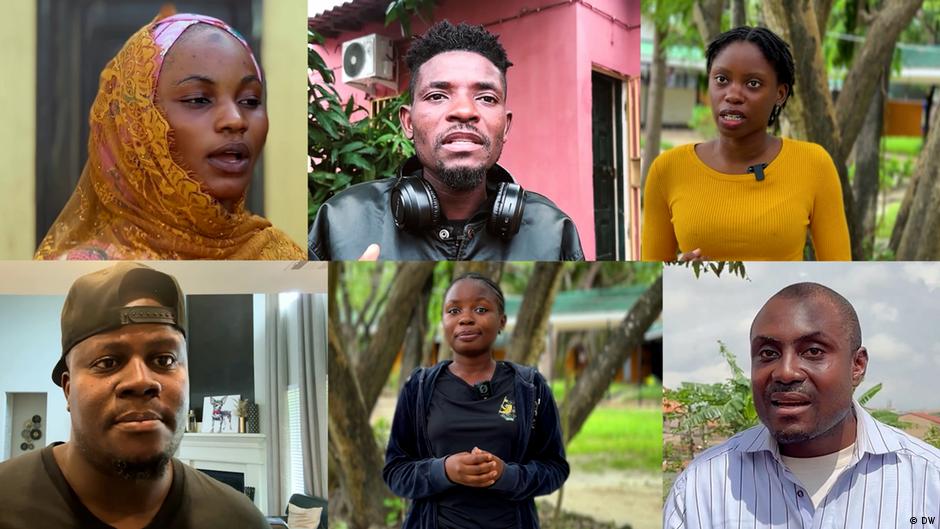
“We are not only the future, we are also the present,” says a young man named Clinton on a street in Lusaka, Zambia. “But are they listening to us?”
“There is no Cameroon anymore,” says Jean-David Blot in Douala, part of a grassroots movement called “The Ocwellians.” “We have to rebuild everything. Everything.”
“If you want to run for office, that’s great,” says Mbayo Akiri, a student in Dar es Salaam, Tanzania. “But there are some systems in place that make sure certain types of people don’t grow past a certain point.”
They represent a trend that can be felt across Africa: a young generation, inspired and full of ideas, wants to make decisions and drive change – but faces the limitations of a system created by a small, often aging elite. Opportunities seem limited. Is democratic participation a dead end, or are there new paths forward? These are the questions DW is exploring in a mini-series featuring reports from five African countries.
When voting doesn’t help
Africa is a young continent. According to data platform worldometerThe current median age is 19.5 years – meaning that almost half of all people living in Africa are under the age of 20. In 2023, more than 870 million of the approximately 1.5 billion Africans were under the age of 25, while only 53 million were 65 or older.
How young Africans view democracy was examined by researchers Christine Hackenash and Godfred Bonah Nkansah in a meta-study for the Interdisciplinary. “Megatrends Africa” Research initiatives by government-funded German institutions. Using survey data from the platform “Afrobarometer” Collected over several years, they identified a trend: youth in Africa are becoming less likely to go to the polls.
“Young people are disillusioned with their governments,” Bonah Nakansah told DW. “They think it won’t make much difference whether they vote or not.” The credibility of elections and electoral fraud are perceived as major problems among young people: “There are some ruling parties that circumvent constitutions to stay in power.”
But they are not ready to admit it easily, say Ghanaian researchers Kofi Annan International Peacekeeping Training Center: “The data shows that young people are increasingly exploring alternative methods of political influence – for example through protests.” These protests are taking place on the streets of major cities in Africa and also in the digital sphere People organize through social networks.
Kyle Findlay, co-founder of digital consulting firm Murmur Intelligence, looked at the issue from a different perspective. The South Africa-headquartered company also analyzes activity on social networks in the context of elections. He draws one conclusion from several analyses: “People in Africa no longer trust democracy as strongly as they used to. Of course, there are differences depending on the country, but the perception is that democracy in Africa has not consistently produced the desired results.”
Desire for change and escape from the digital world
When democracies fail to create better living conditions for people, when they suppress freedom of expression, frustration grows – as does the desire for change.
As the government of President Samia Suluhu Hassan cracked down on social openness in Tanzania, many people took to the streets. For student Mbayo Akiri, this represents a clear break with the culture: “We were raised with this idea of not questioning power. When someone in power speaks, you listen.” But that has changed. “We are not known for protests. Our neighbors are, but we are not.”
Akiri welcomes the change – but it also scares her. She does not participate in protests: “There are ears everywhere. And you never know who will be next.” She says she doesn’t mean this as a criticism – it’s just how government works. “But I think our lives can be better.”
In fact, the Tanzanian government’s crackdown has made demonstrations almost impossible. The resistance has increasingly gone online.
According to Bonah Nakansah, virtual space offers many possibilities – especially when it comes to spreading political information or organizing people. “Social networks seem to be a good way to amplify shared concerns. I talk about unemployment there, someone else picks it up, and suddenly it, for example on X, creates a wave.”
Young Africans are networking beyond borders
Many people in Tanzania now express themselves only anonymously. Diaspora celebrities such as musician Wakazi use their public profile to draw attention to issues such as corruption or restrictions on civil rights. They also highlight cases where people who expressed criticism disappear. Activists in East Africa have shown solidarity with the struggle of people in Tanzania.
A look at the history of Africa reveals both the potential of this type of networking and its limitations. Bayreuth sociologist Joschka Phillips says the first major example came in 2011 with the Arab Spring, also known as the Facebook Revolution. Since then, similar patterns have emerged repeatedly – for example when Congolese activists took inspiration from protests in Senegal and Burkina Faso in 2015.
“There are new resources or new reserves that youth movements can tap into,” Phillips told DW. “On the other hand, this is always the point where movements become vulnerable. States and governments have also learned to use social networks to identify various protest leaders and then silence them.”
This observation matches Murmur Intelligence’s analysis. An example is Uganda, where a popular musician has long since moved into the role of opposition leader: “Bobi Wine has fought an incredible fight for ten years. But in the most recent elections, we saw President Museveni and his camp adopt all the trappings of this youth technocracy movement,” says Findlay.
Understanding Complexity with Patience
Is there a danger of the democratic movements losing momentum in this way? Not necessarily, says sociologist Phillips – and he calls for more patience.
“The fact that these states have colonial origins remains highly relevant today. The way in which democracy was allegedly promoted from the Global North was in fact an undemocratic construct.” These created systems that did not serve the broader population. Paradoxically, even young people who today support military leaders such as Burkina Faso’s junta leader Ibrahim Traoré and their anti-Western rhetoric may be seen as a sign of democratic empowerment.
Amid these complex realities, people in different African contexts are finding new paths – and practicing patience.
“Digital democracy can’t bring about real-life change,” Akiri says. “But in our hearts, we are changing. And if we had the chance, maybe we would do things differently.”
Grassroots activists at The Oakwellians in Cameroon, where 93-year-old President Paul Biya is not in his eighth term, know they need patience.
Doris Ngam says, “If we want to heal and rebuild, it is vital that we educate the next generation to become visionary leaders who serve others.” That’s why he is one of the many activists visiting schools. Their message: “Don’t wait for the government. You are the change!”
Elizabeth Essen (Douala), Imani Luvunga (Dar es Salaam), and Kathy Short (Lusaka) contributed to this article.