It has been nearly two decades since the largest information technology companies began dictating how ordinary people get their news – dominating how news is made, how it is disseminated and how it is received, dominating everything from search engines to social media and, more recently, artificial intelligence.
The influence of these tech giants reaches beyond the media to the political arena, as the heads of these influential companies get involved in elections and put pressure on governments.
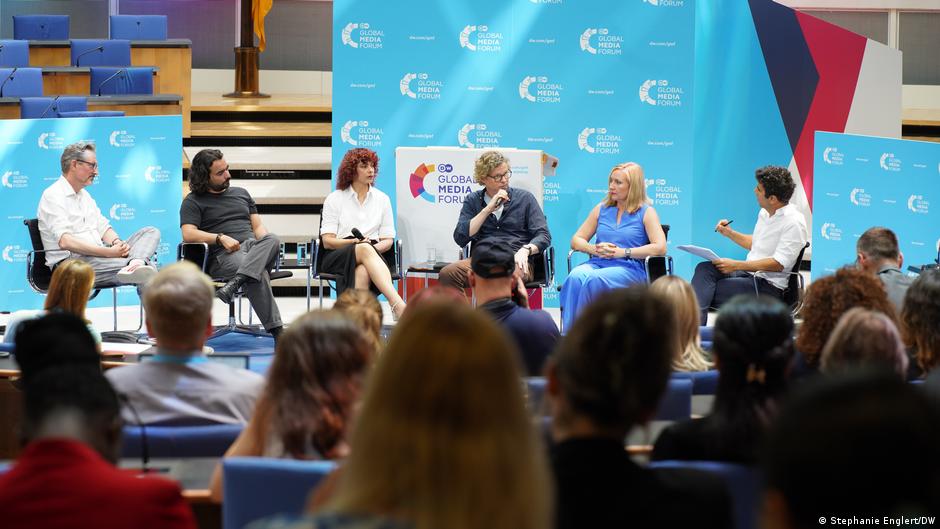
So how can the media and the state in general maintain their independence in such a scenario? And what kind of relationship should journalists have with the five so-called Big Tech companies: Alphabet (Google’s parent company), Apple, Meta, Amazon and Microsoft? That was a key question at German public broadcaster Deutsche Welle’s annual event, the Global Media Forum, which opened in Bonn on Tuesday.
Media ‘preparation for battle’
Even just the date is a question, Courtney C. Radsch, director of the US-based Center for Media and Digital Governance, said at the event.
“Society doesn’t correlate the word big with an industry out of respect and admiration,” he said during the panel, “Between Innovation and Dependence: Journalism’s love-hate relationship with Big Tech,” which was moderated by DW journalist and presenter, Jafar Abdul Karim.
“We do it out of fear, to prepare for the fight,” Radsch said.
Online platforms are now extremely powerful and do everything from deciding how visible certain types of content should be to distributing and monetizing it. Radsch suggested that it is difficult to find real cooperation between platforms and journalism. “Are we partners when we clean up all the filth and disinformation spreading online?” he asked.
And in another example, Radsch explains how large language models, or AI systems, are often trained on journalistic content and are typically given no compensation for the use of that content. Journalists play an important role in this training, she says, because the information they provide keeps AI based on facts and reality.
“How do we know what we know?” Raj asks. The entire system collapses when AI models are trained on content generated by AI models. “Like a photocopy of a painting, each generation [of the AI models is] “Going a little out of touch with reality.”
Radsch argues that AI needs us more than we need it. “At least I like to think so,” she admits.
Radsch’s final statement is somewhat dramatic. “When monopoly power and political power begin to converge in a single company, you are not looking at a problem of competition,” he concluded, “you are looking at the architecture of technofascism.”
Cyriac Roding, a Silicon Valley entrepreneur and investor, called for a change in perspective and greater responsibility from the media.
“I think it’s time we abandon this standard argument of Big Tech against poor journalists,” he said during the same panel. Media outlets themselves should innovate and Develop new business modelsMove forward with a paid subscription-based model and use new technologies.
“If you don’t pay with cash, you pay with brain rot,” Roing said.
However, this doesn’t work everywhere, points out Marcela Duarte, director of innovation at the long-running Brazilian fact-checking organization Aís Fátos (in English, To the Facts).
Paywalls are unrealistic in countries like Brazil because many people can’t afford them, he said. “People don’t have money to eat sometimes. Is it fair that I want people to pay for their stuff? I don’t think so.”
Follow the audience?
Journalism should be where its audience is, and often that’s exactly where they are on platforms like Meta’s Facebook and Instagram or Alphabet’s YouTube. Duarte argued that The New York Times’ subscription model has been successful but that the model cannot necessarily be transferred to every country.
German television presenter Eckart von Hirschhausen, who is also a medical doctor, talked about the real-life effects of Big Tech’s dominance over information sources.
“People are now dying of measles because of the propaganda… so this is not just a debate on relationships. This is really a matter of life and death,” he said.
Von Hirschhausen wants platforms run by Big Tech to be held accountable for the harm they cause and also for European networks to be guided by values, “not by profits and lies.”
‘Journalism Out Loud’
The theme of this year’s Global Media Forum is the motto, Journalism Out Loud: Speak. Lists. act. More than 1,400 media professionals from more than 110 countries are in Bonn to discuss how media outlets and journalists everywhere should deal with disinformation, polarization and technological change.
During the forum, which runs till June 24, participants will also discuss new ways to strengthen the vital role of journalism in democracy.
“Freedom of the press and freedom of expression are not a luxury,” said DW director Barbara Massing. In your initial comments On the stage. “They are indispensable for democracy, security and free societies.”
DW’s Freedom of Speech Award on Tuesday was presented to Hong Kong media entrepreneur Jimmy Lai, a prominent advocate of press freedom and democracy. The founder of Apple Daily has been in jail since 2020. His daughter accepted the award on his behalf in Bonn.
This story was originally published in German.