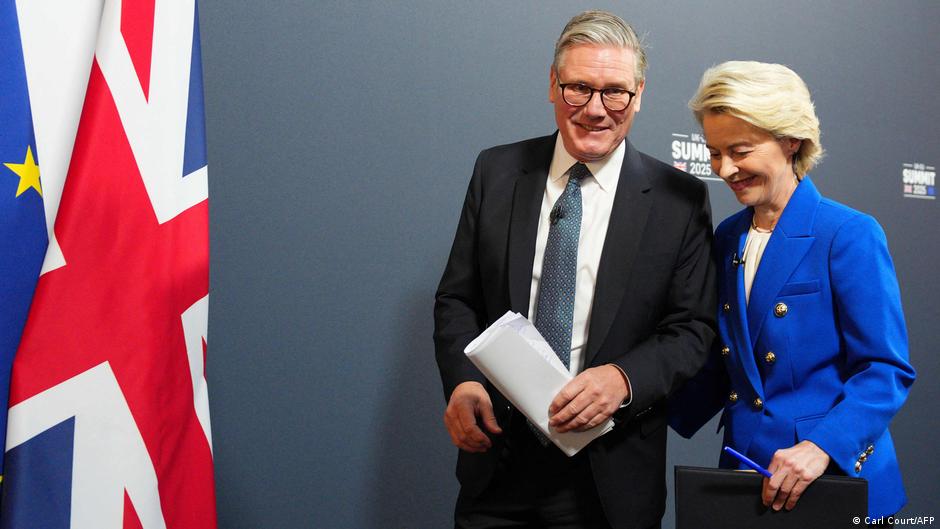
British Prime Minister Keir Starmer, who announced his resignation on Monday, may not have been that popular among his British constituents recently, but he certainly had many friends among the EU’s top politicians.
As European Commission President Ursula von der Leyen reacted to his resignation on Monday, she wrote: “European and Ukrainian security is stronger because of you. Thank you, dear Kiir.”
French President Emmanuel Macron also expressed gratitude for Starmer’s participation in Europe’s “coalition of the willing” for Ukraine and for reviving EU–UK relations.
Starmer actually strengthened his reputation in Europe as a supporter of Ukraine in the war against Russia. Along with Macron, Starmer was the leader of the so-called “coalition of the willing”. The coalition of 35 states supports military aid to Ukraine and, if a ceasefire occurs, will help Ukraine with its long-term defense.
On the social media platform X, Ukrainian President Volodymyr Zelensky also expressed his gratitude to Starmer.
Olivia O’Sullivan, director of the UK in the World program at Chatham House, a British think tank, confirmed Starmer was a very active and trusted participant within the “coalition of the willing”.
O’Sullivan notes that Starmer worked with other leaders to consider how Europe could play a strategic role in achieving peace, even as he struggled to find the money needed to meet his self-imposed military spending targets. But that’s a challenge the next British prime minister will also have to face, she points out.
Helping set EU policy
Britain also played a major role in advocating for Ukraine in what became known as the E3 format. This framework involves Germany, France and the UK and is believed to help coordinate the foreign and security policy of the three.
O’Sullivan says the E3 is behind many European strategies, not only with respect to Ukraine but also in dealing with the US government, which is playing a less significant and less predictable role in European security.
For example, the E3 format has been used to make statements in response to US demands on how Europeans should contribute to securing the Strait of Hormuz.
O’Sullivan says the fact that Europeans will now need to adjust to a new British Prime Minister is not a huge blow, although Starmer’s departure may see the E3 lose some of its momentum.
Who’s next?
Exactly how Britain’s relations with the EU and European leaders develop in the future will depend on who succeeds Starmer. At present, there are strong indications that former Manchester Mayor Andy Burnham will become the next British Prime Minister.
O’Sullivan told DW that Burnham is broadly considered pro-European. She expects him to essentially maintain Starmer’s course regarding the EU and Ukraine, although, she says, it is difficult to tell precisely because he focuses most on domestic matters. It is therefore not clear whether Burnham will prioritize foreign policy in the same way as Starmer did.
O’Sullivan says the biggest achievement of the Starmer government in foreign policy was probably the establishment of the EU-UK Security Partnership, which was formalized at the first EU-UK summit after Brexit last year.
Starmer had campaigned for a “fresh start” with the EU and had already made gains in some areas, such as youth mobility and exchange programs as well as the fisheries sector.
EU-UK summit postponed
The new “Security and Defense Partnership”, which was signed last May, aims to facilitate further cooperation on Ukraine and other security and defense initiatives, as well as provide opportunities for regular dialogue.
O’Sullivan says this success was somewhat diminished by the fact that the UK received only limited access to the EU’s SAFE (Security Action for Europe) programme, a €150 billion financial instrument designed to accelerate defense preparedness in member states. Britain was unable to participate fully last November because the British were unwilling to pay the participation fee.
There is no doubt that Britain’s relationship with the EU will be something the next British Prime Minister will soon have to grapple with.
In fact, it seems the EU is waiting for a new British leader to do this. On Monday, European Council President Antonio Costa announced that the EU-UK summit, originally scheduled for July 22, has been postponed for the time being.
This story was originally published in German.