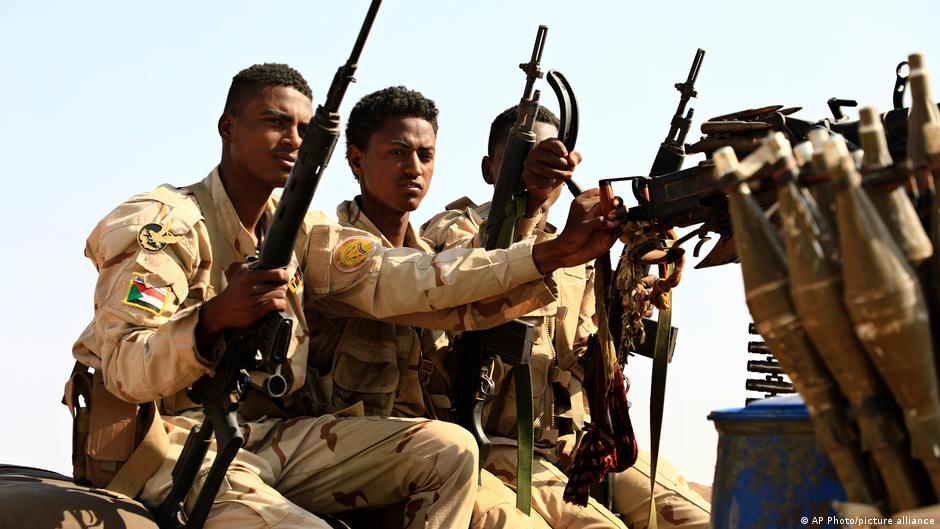
The next major frontline in Sudan’s war is likely to be the strategically important city of al-Obeid in North Kordofan. This week, the United Nations Security Council, several European countries and the United States Marked “Imminent threat of mass atrocities” as increasing numbers of Rapid Support Force (RSF) troops are being deployed around the city.
The broad perception is that the RSF is preparing a ground attack to try to recapture the city, which has been under the control of the Sudanese Armed Forces (SAF) since February 2025.
The war in Sudan has been ongoing since a rift escalated in April 2023 between two rival generals – Abdel Fattah al-Burhan of the Sudanese Armed Forces and Mohammed Hamdan Dagalo of the Rapid Support Forces. Since then, fighting has divided the country between army-held areas in the north and centre, including the Sudanese capital Khartoum and Sudan’s West Darfur region, and RSF-controlled areas in parts of the south.
Sudan, rich in oil and gold and with vast agricultural lands, has also been plunged by war into the world’s largest humanitarian and displacement crisis. According to the United Nations, more than 14 million people have been displaced in Sudan and neighboring countries. The estimated death toll ranges from 40,000 to 250,000 people as reliable figures are difficult to obtain due to the ongoing fighting.
What makes Al-Obeid a target?
The city of al-Obeid, with a population of about 500,000 people, is at the crossroads between central Sudan, Khartoum, and the western Darfur region. It is therefore a major gateway for military activities and military or humanitarian supplies. It is also home to a large SAF military base and a military airfield.
“El-Obeid has been an important logistics hub for supply lines throughout its history,” Hagar Ali, a researcher at the German think tank GIGA Institute for Global and Area Studies, told DW.
He said, “If the RSF managed to recapture al-Obeid, they would not only benefit from its urban infrastructure and lucrative gum Arabic trade, but they could also use the city as a strategic forward operating base to launch drones.”
During the war, drones have become a major weapon for both factions. According to the UN human rights agency, more than 1,000 civilians were killed in drone strikes between January and May 2026.
However, as the rainy season begins in July, the trajectory of combat drones becomes less predictable, Ali said. “If the RSF wishes to advance towards other cities within Sudan, the most sensitive course of action is to find a forward operating base that is very close to their intended targets, to overcome the difficulties operating drones face during the rainy season,” Ali told DW.
repeated warnings
Meanwhile, a spokesman for UN Secretary-General Antonio Guterres warned in a statement in early June that “We must not allow the horrors of al-Fashar to be repeated in al-Obeid.”
The Darfur town of al-Fashar has become synonymous with mass atrocities after RSF troops held the town for 18 months before fighters killed nearly 6,000 people in three days last October in what the UN and human rights observers described as “characteristics of genocide”.
“We have every reason to fear that if the RSF are allowed to take al-Obeid, they will continue their mass atrocities,” Kenneth Roth, former executive director of Human Rights Watch, told DW. “The RSF has shown a blatant disregard for civilian life,” he said. “Indeed, deliberately killing large numbers of civilians appears to be their primary objective,” Roth said.
Amgad Farid Eltayeb, political and foreign affairs adviser to Sudan’s Transitional Sovereign Council, also sees the situation as similar to the months before the attack on al-Fashar. “We are looking at the same script that has been reworked on al-Obeid,” he told DW.
The warnings last October did not fail due to lack of evidence, he said. “They failed because the warnings were never intended to be prevention,” Farid Eltayeb told DW.
justice, accountability, sanctions
It’s important nonetheless to speak out, says Philippe Dam, EU advocacy director at Human Rights Watch. “This sends a clear message to the leadership of the Rapid Support Forces, but international states should also send a very clear message to supporters,” he said.
“The UAE has proven responsibility for fueling the conflict and for the atrocities committed by the Rapid Support Forces; sanctions must be imposed on those involved,” Dam told DW.
However, the UAE has denied any involvement in the war or support for the RSF. The SAF is officially supported by Egypt, Türkiye, Russia and Iran.
In his view, immediate sanctions could help protect civilians and still prevent atrocities. “Given his command’s responsibility for the crimes committed by the RSF, it is important to sanction the RSF leadership today and make it clear that this individual should have no role in the future of the country,” he said.
RSF General Mohammed Hamdan Dagalo, also known as Hemedti, established a “government of peace and unity” in areas under his control in 2025. However, Hemedti actually claims to have jurisdiction over all of Sudan, like his counterpart, Sudanese Armed Forces General Abdel Fattah al-Burhan.
So far, the US has imposed sanctions on both the generals as well as several individuals associated with both the factions in January 2025. The European Union has also imposed sanctions on individuals and entities associated with both sides, however, the United Nations has not imposed sanctions on neither the generals nor their associated organizations.
“Designating the RSF as a terrorist organization is the only way to make it harder for the UAE to continue supporting and financing one genocide after another in Sudan,” agrees Amgad Farid Eltayeb.
“However, the world decided not to take action seriously,” he fears. In his view, every statement by the international community that laments the coming atrocity, while avoiding naming its financiers, is not a step towards prevention, it is a step around it.”
Edited by: Andreas Illmer