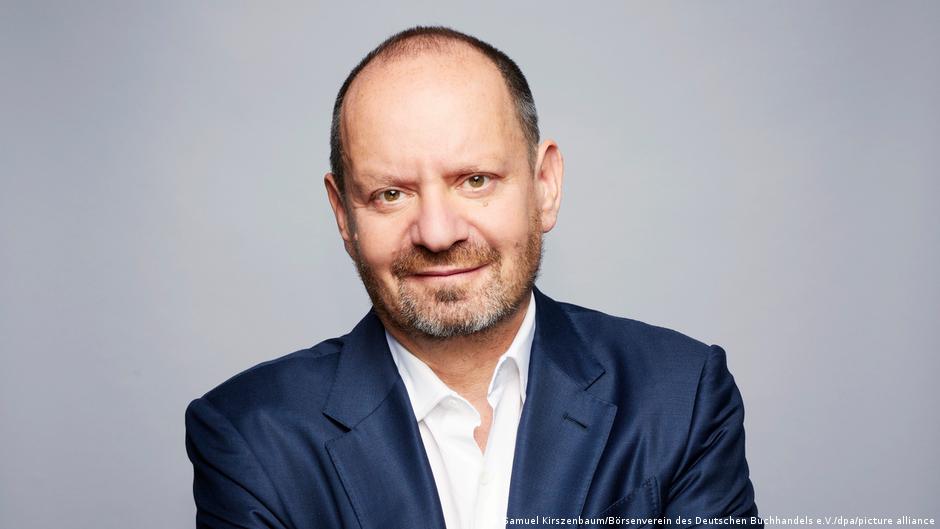
The German Book Trade’s 2026 Peace Prize, a prestigious award that honors individuals who contribute to the achievement of peace through their work, goes to French-British lawyer and author Philip Sands, the prize’s board of trustees announced on Thursday.
“In his literary work, which is distinguished by both narrative brilliance and historical depth, Philip Sands pays as much attention to the motives of criminals as to the suffering and lives of his victims,” said the jury. statement. “At the heart of his legal work is a commitment to the universal rights of every human being, evidenced in his advocacy for victims of war crimes, racism, torture and colonial injustice.”
In addition to being a historian of crimes and violations of international law, Sands is also a leading figure in the campaign advocating for the recognition of ecocide as an international crime.
Family history of a life dedicated to justice
Born on October 17, 1960 in London, Sands completed his law degree from the University of Cambridge in 1983. He soon established himself as a highly sought-after expert in international law.
As a descendant of Holocaust survivors, he draws on his family history to trace the emergence of the framework of law that led to the legal concepts of genocide and crimes against humanity.
His 2016 historical memoir, “East West Street: On the Origins of Genocide and Crimes Against Humanity”, examines the lives of two Jewish lawyers who established these concepts after World War II. It has been translated into more than 30 languages.
In more than two dozen cases so far, Sands has appeared as counsel at the International Court of Justice (ICJ) in The Hague.
He has represented the Solomon Islands at the ICJ in proceedings relating to the threat and use of nuclear weapons; Georgia’s dispute with Russia over the South Ossetia conflict; And Croatia claimed genocide against Serbia.
During the 2024 ICJ public hearing regarding the legal consequences of Israel’s policies in the occupied Palestinian territories, he argued for Palestinian statehood and the inherent right to self-determination.
He is currently acting for Gambia in the ICJ case against Myanmar, which is accused of committing genocide against Rohingya Muslims.
Best-selling non-fiction books inspired by historical cases
Sands was involved in the historic arrest of Chilean dictator Augusto Pinochet in 1998. In a landmark legal case, he argued against Pinochet’s immunity. The decision of the case, which fundamentally reshaped international law, established that former heads of state do not have absolute immunity for international crimes.
In Sands’s 2025 non-fiction work, “38 Londres Street: On Impunity, Pinochet in England and a Nazi in Patagonia”, he revisits the relationship between Pinochet and Nazi commander Walther Rauf, who helped create Chile’s internal security apparatus during the military dictatorship, and efforts to extradite both men.
Sands also drew inspiration from another of his cases in his book “The Last Colony: A Tale of Exile, Justice and Britain’s Colonial Legacy”, published in 2022, which describes how in the late 1960s – amid unprecedented changes to end the effects of colonialism – the inhabitants of an island in the Chagos Archipelago in the Indian Ocean were deported to form a new colony, the “British Indian Ocean Territory”. Was forced to leave the motherland. The Mauritian government is still struggling to regain control of the Chagos Archipelago.
Sands was also a leading figure among legal scholars, developing the concept of ecocide in the early 2020s. Based on the principles of international criminal law, he argued that serious, large-scale environmental destruction should be recognized as an international crime in its own right and prosecuted accordingly.
He has since campaigned for ecocide to be recognized as a crime under the jurisdiction of the International Criminal Court, to make it the fifth major international crime alongside the four established crimes: genocide, crimes against humanity, war crimes and the crime of aggression.
Salman Rushdie also included among Peace Prize winners
The Peace Prize of the German Book Trade carries a prize of €25,000 ($28,382), and is traditionally awarded at the end of the Frankfurt Book Fair, held this year from 7 to 11 October.
The German Publishers and Booksellers Association – the professional organization representing the trade – has been presenting the award since 1950.
Last year, the honor was given to historian Carl Schlogel, and it will be presented to Anne Applebaum in 2024.
Notable past winners include Salman Rushdie, Margaret Atwood, Svetlana Alexievich and Mario Vargas Llosa.
Edited by: Sarah Huckle