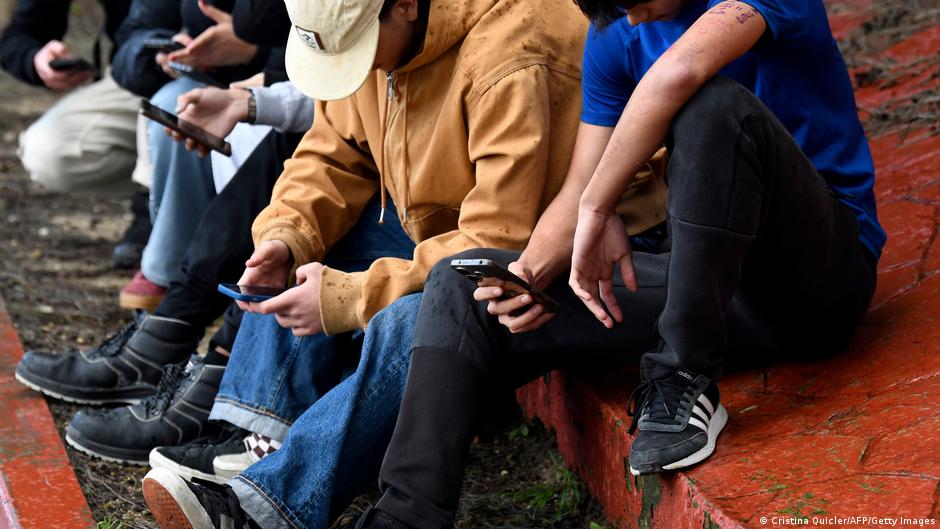
According to a newly published study, youth spend an average of 4.5 hours on screens during a typical school day, and more than 6 hours on weekends. eu data.
Furthermore, it revealed that almost 14% of teenagers in the EU, or one in seven, say they spend at least eight hours or more on screens – this figure rises to more than ten hours a day on Saturdays and Sundays.
When asked what impact screen time has on their lives, 40% of teens surveyed said it was positive, while only 29% said a negative impact. Nearly half of 13 to 18-year-olds feel optimistic about the effects of social media, with 48% saying social media has a positive impact on their mental health.
But, at the same time, almost one in three teens reported feeling sad, stressed or socially excluded because of social media. About 40% said they had difficulty concentrating or trouble sleeping.
The survey supported widespread concerns about youth being exposed to harmful content through these channels. More than a third of European teenagers reported seeing false or misleading information on social media, while a quarter reported encountering hate speech and almost one in five saw unwanted violent content.
Screen time is not the same as social media use
However, Tanya Notley, a professor at Western Sydney University and an expert in digital media literacy, warned against making an automatic link between social media and deteriorating health in young people.
“None of the research in this survey shows any connection between mental health and social media. I think it’s more nuanced than that,” he told DW.
Notley said policymakers should differentiate between how young people feel about screen time and how they feel about social media.
“When we talk about screen time, it’s very broad. We’re talking about their time on television, but also the time they’re doing homework,” she said. “It’s more useful to look at social media use.”
When it comes to dealing with teens’ exposure to social media, nearly half of those surveyed urged social media platforms to improve their enforcement of existing rules, while 44% said more social-media education is needed.
Overall, almost half of the young people involved in the consultation said they think additional restrictions and age limits should be imposed.
Support for ban on social media is growing
Among those pushing for legal limits is former clinical psychologist Susie Davis, founder of the UK-based charity Papaya (Parents Against Phone Addiction in Young Teens). He said he was concerned about mental-health impacts and called for a ban for those under 16.
“Modern platforms are designed to take advantage of our dopamine reward pathways,” he said. “This makes us all vulnerable to excessive consumption and compulsive use.”
Restrictions on social media are “a necessary response to the realities of the modern digital world”, he said. “Teens are particularly vulnerable because the prefrontal cortex – the part of the brain responsible for decision making, impulse control and emotional regulation – is still under construction and developing well into early adulthood.”
Earlier in June, the UK announced that teenagers under 16 in England, Scotland, Wales and Northern Ireland would be banned from social media from spring 2027. Australia is next, where a complete ban on access to social media platforms for minors came into effect last December. Norway and Canada, among several others, are working on a ban.
Even though the EU has some of the strongest digital regulations in the world, including imposing content moderation obligations on platforms through its Digital Services Act and Digital Fairness Act, some member states are demanding more.
France, Spain, Greece, Austria and Denmark are considering banning social media at the national level and want it implemented across the bloc.
In Germany, the most recent report from a government-appointed commission recommended a complete ban for those under the age of 13, arguing that Europe should move ahead with such a ban.
The commission has been formed amid increasing demand for action. An independent panel on online child safety. It will deliver its findings in mid-July and then the Commission will decide how to proceed. Analysts say there are preparations to ban social media for youth under 16 years of age.
Can the ban backfire?
However, Reres Voicu, president of the European Youth Forum, is skeptical about imposing a complete ban.
“This impulse to ban is too simplistic and it doesn’t really address the complexity of the issue of social media use for children, teens or young people,” he told DW.
“Social media has become a fundamental part of our lives, and for young people, the online space is where they get their news and where they socialize with friends,” he said.
Nandi Vijayakumar, a research fellow at Deakin University in Victoria, Australia, who recently co-authored a report on social media and teen mental health, also spoke about the benefits of social media.
“So much is happening online today, and we know it really helps young people develop their sense of identity, friendships and stay connected with their friends. Some young people can find communities online that they might not have easy access to offline.”
Voicu of the European Youth Forum believes it is important to consider the consequences of banning social media on young people under 16: “What are they going to do instead of spending time on social media? New kinds of activities will be needed that foster the same sense of community that social media does.”
Calls to ban social media use for those under 16 have become increasingly prevalent across countries, particularly after Australia imposed a ban. However, Professor Tanya Notley of Western Sydney University argued that it is too early to assume that the Australian experiment has been successful: “This is a high-risk policy and is not based on strong evidence.”
Notley said that rather than simply imitating, nations should try pilot initiatives, evaluate existing regulations and focus on improving digital media literacy.
She also said the first research into whether Australia’s social media bans are having a measurable impact on young people’s mental health, well-being and safety will come out later this year: “I would strongly advise governments to stop and wait and take a look at that research,” she said, adding that the policy change has “massive implications for young people”.
Edited by: Jess Smee