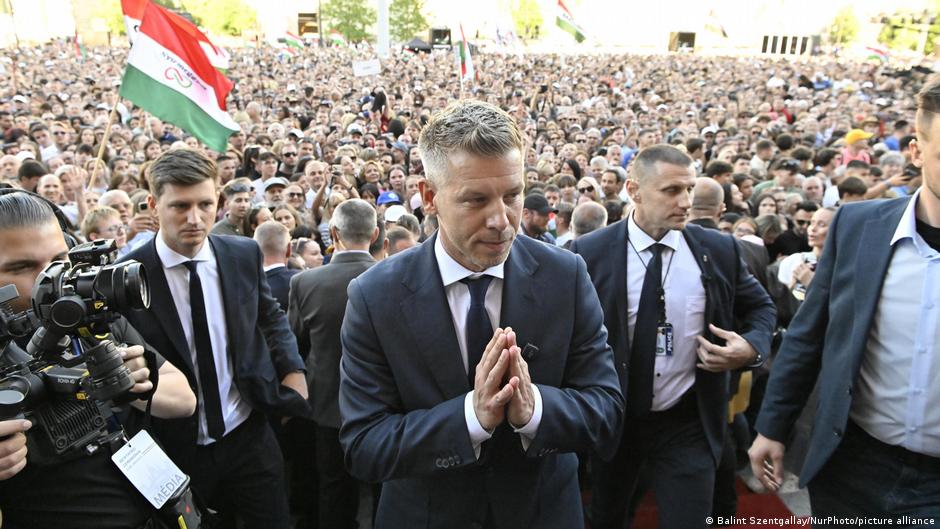
Hungarian Prime Minister Peter Magyar and his government are setting a fast pace for reform.
In his first few weeks in office, Magyar lifted the EU blockade introduced by his predecessor, Viktor Orbán, and began a dialogue with Ukraine, which Orbán had labeled the “Evil Empire”.
Back home in Budapest, the parliament approved cuts to the salaries of MPs and ministers and limited a prime minister to a maximum of two terms in office.
Much of this was anti-Orbán symbolism.
But with these changes under its belt, Magyar has now turned his attention to the essence of his erstwhile regime.
Orbán had made plans spanning decades into the future: in the event his party lost the elections, civil servants who would be difficult to replace would ruin the work of the new governments. Furthermore, billions were spent to continue financing Orbán’s network.
Tearing the Orbán system apart
With a two-thirds majority in parliament, Magyar and his Tisza party government can now destroy these structures.
Addressing parliament on Monday, Magyar called Orbán’s governing style a “mafia system.” They promised to root it out completely using what they called “Operation Purgatory”, a name possibly coming from the Magyars’ penchant for religious and historical symbols.
Magyar has promised that a comprehensive investigation will be conducted to establish how Orbán’s family and friends, as well as oligarchs and high-ranking party members, lined their pockets and that illegally obtained assets will be recovered.
He has also pledged that state institutions, the judiciary and the media will be reformed in a way that will make it impossible to return to the Orbán system – that is, to political control of state institutions and the public.
Online news outlet 444.hu said, “Orbán wanted to tie the hands of the next ten governments.” “The Magyar administration is now scrapping that plan.”
First package of laws passed
On Tuesday, Parliament passed the first major package of laws related to “Operation Purgatory.”
Most of them were anti-corruption measures. These were key to ensuring that the EU released approximately €17 billion ($19.3 billion) in EU funding to Hungary, which had been blocked by Brussels due to perceived risk of corruption while Orbán was in power.
The timing was critical as the deadline for payment of a large tranche of these funds, approximately €10.4 billion, expires in August.
One of the most significant measures is the abolition of the private foundation, known as the Public Interest Asset Management Foundation (KEKVA), which organizes and manages universities, cultural institutions and historical monuments in Hungary.
symbol of corrupt governance
KEVKA was established during Orbán’s tenure with the aim of transferring huge amounts of public assets – approximately €5–9 billion – into private hands. The foundation is seen as a symbol of the majoritarian system under Orbán.
Also, some of these foundations were used to establish a new administrative structure in most Hungarian universities. These structures were filled with Orbán loyalists, destroying the autonomy of the respective universities.
The most famous kevka in Hungary is the Matthias Corvinus Collegium (MCC), the most important specialized training and propaganda school for Orbán’s Fidesz party. In 2020, at the behest of the Orbán government, the MCC was gifted 10% of state shares in both the oil company MOL and the pharmaceutical company Richter Gedeon. In total, the gift was worth an estimated €1.3 billion.
More transparency in tender process
In addition to these laws, the new parliament has also given greater powers to the so-called “integrity authority” and tightened the rules governing the declaration of their assets by politicians and senior civil servants and the obligation of transparency and accountability in public tenders.
During Orbán’s time in power, tenders were one of the most important means of corruption and self-enrichment.
For example, the company owned by Orbán’s school friend Lorínc Mészáros, who started out as a plumber and gasfitter in the village where Orbán was born and became a billionaire and Hungary’s richest man under the former prime minister, benefited from such tenders. He is often referred to as “Orbán’s wallet”.
media reform
Parliament also fulfilled another of Magyar’s election promises on Tuesday when it approved a restructuring of public service media in Hungary and a sweeping ban on political hate campaigns using nationwide poster campaigns and advertisements, which were par for the course in Orban’s Hungary.
During Orbán’s 16-year rule, public service media became purveyors of propaganda and fake news. Despite their legal obligation to report impartially, voices other than Fidesz rarely appear on their programs.
The old holding companies for public service media are now being abolished and replaced by new bodies that will include not only politicians, but also representatives of journalism organizations.
Society needs to see justice done
The first steps towards other important legislative and constitutional reforms were also taken this week.
Most independent Hungarian observers consider the law concerning the planned establishment of the National Property Recovery and Preservation Office (NVVH) to be the most important of all these laws.
This was one of Magyar’s most important election promises: to take back the billions of dollars that went into the pockets of people close to Orbán in non-transparent and often illegal ways while he was in office, and to bring these people to court.
Speaking in a podcast on 24.hu, political scientist Gábor Torok described the planned establishment of the NVVH as the Magyar government’s “most important political measure” because, he said, it satisfies the society’s need to be “handcuffed on the wrists”.
This, he added, is something that no Hungarian government has achieved since the fall of communism in 1989/90.
Magyar’s triple challenge
The intention is that now there will be a debate in the society regarding the establishment of NVVH.
Magyar also plans to remove President Tamás Süleok, whom Peter Magyar has described as a “puppet of the Orbán regime”, and wants to limit the legislature to a maximum of three terms in parliament. This last proposal has faced criticism, particularly in Hungary.
Writing on the website Social Europe, foreign policy expert Zsuzsanna Szélény, who was a member of Orbán’s then-liberal Fidesz party in the early 1990s, said that “the Magyar government must navigate the ‘trilemma of post-liberal rule'”, which must “rapidly reverse the damage of the liberal regime, prevent a populist resurgence, and strictly adhere to constitutional norms.”
“Balancing speed, efficiency and legitimacy is essential for Hungary’s re-democratization,” he said.
This article was originally published in German.