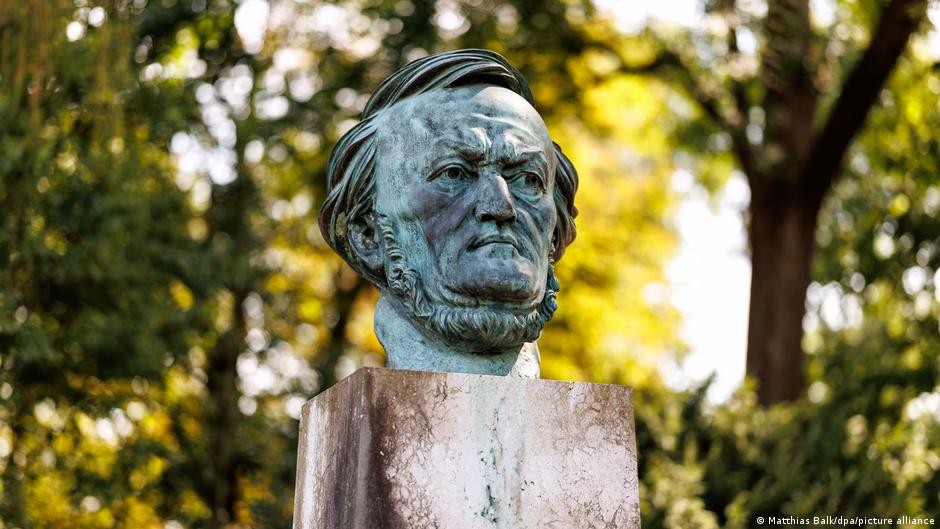
To mark the 150th anniversary of the Bayreuth Festival, a commemorative event titled “Silenced Voices” will take place on July 26, before the premiere of the opera “Rienzi”.
The program will feature works by Richard Wagner, Gustav Mahler and the Jewish composer Pavel Haas, who died in the Auschwitz-Birkenau concentration camp.
Organizers also invited broadcaster, journalist and former vice president of the Central Council of Jews in Germany, Michel Friedmann – himself a onetime DW show host – to speak about Wagner’s anti-Semitism and his legacy.
The event aims to confront the festival’s own history, while proceeds from the event are intended to provide scholarships for Israeli musicians.
The Holocaust Memorial Concert made headlines when the festival leadership abruptly canceled it, citing security concerns. german newspaper south german newspaper The decision was first reported on June 15.
But following a public outcry, the program was later reinstated.
Why was it cancelled?
When the cancellation was first made public, interim managing director Heinz-Dieter Sens told the German public broadcaster bavarian radio The security services could not handle two high-level security operations at the festival site in one day.
He pointed to the limited time between the morning program and the 4 pm opening performance of Wagner’s “Rienzi.”
“Given the current global situation, everyone is extremely cautious,” Sens said. “If no one can guarantee that it’s possible, I can’t organize the event.”
Festival organizers said they would require the highest level of security to protect Friedman.
Germany has seen an increase in anti-Jewish violence in recent years. Friedman faced the cancellation of an appearance in the state of Mecklenburg-Western Pomerania last October.
Police and city say they were not involved
Questions remain about whether safety concerns alone led to the cancellation. The festival declined interview requests from DW. Spokesman Hubertus Herrmann wrote in a statement only that security officials had not approved the original plan.
However, both the regional police headquarters of the state of Upper Franconia and the city of Bayreuth informed DW that they were not involved in the planning process.
Michelle Friedman had expressed deep anger in the interview earlier also south german newspaper and other media outlets. He said that canceling programs due to security reasons in a democracy is tantamount to surrendering to extremists and termed the move as “suicide”.
Friedman questions the official explanation
Amid the controversy, Friedman also expressed his skepticism about the official security argument.
He said in interviews that the organizers had not started selling tickets even six weeks before the event.
Speaking to DW, he said he had no desire to comment further, but reiterated his suspicion that organizers never intended to hold the event.
“To me, the whole thing is a miracle,” Friedman said. “I don’t know what’s behind it, but I think everything got canceled and they forgot about me.”
He also said that organizers had originally planned the event for a different venue – the FrederiksForum – rather than the main festival building, refuting claims that security at the venue was causing the scheduling conflict.
Festival director Katharina Wagner said the concert is a “passion project” and part of a critical reflection on the festival’s own history.
according to south german newspaperHe has since apologized to Michelle Friedman and invited her back to the festival.
The commentator and former vice president of the Central Council of Jews decided to accept the invitation: “I gladly accept his personal apology. When someone takes a step, one must move forward with it,” Friedman said. He considered Wagner’s “words of regret addressed to me to be sincere and credible.”
Festival’s own dark past
The history of the Bayreuth Festival contains dark chapters. As told by Friedman south german newspaper“The soil in Bayreuth is contaminated.”
Adolf Hitler, an admirer of Wagner, frequently attended performances. Winifred Wagner, then head of the festival, maintained close relations with the Nazi leadership.
Richard Wagner’s own anti-Semitic writings continue to shape the debate surrounding his work. In his 1850 essay “Judaism in Music”, he outlined his racist theories on Jewish influences on the music of the time. His widow Cosima Wagner later promoted many of those ideas.
The “Silenced Voices” concert will also honor Jewish musicians who faced professional banning or were murdered under Nazi rule and during the Holocaust.
This article was originally written in German