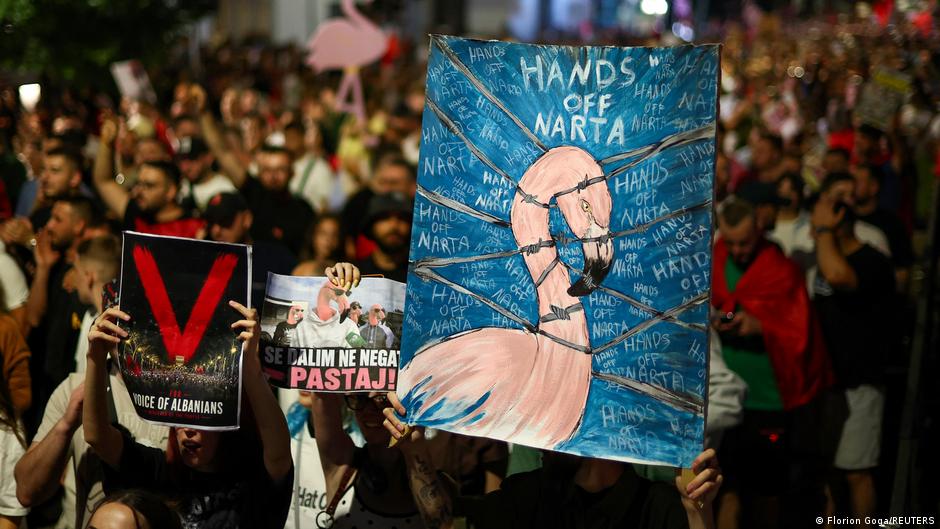
Every evening at 7 p.m., protesters return to the same square in Tirana, the capital of Albania, with the same symbols and the same demands.
More than three weeks of uninterrupted daily demonstrations have turned the “Flamingo Revolution” into Albania’s largest civil protest movement since the fall of communism.
It began when a government-approved luxury tourism project in Zvernec, a protected coastal area in southern Albania, sparked protests that soon grew into a broader political movement.
Initially motivated by environmental concerns, the demonstrations have now transformed into broader demands, including the resignation of Prime Minister Edi Rama.
Ram rejects the idea that the unrest can be explained solely by domestic political grievances. Instead, he has argued that the protests are unfolding in what he describes as a “hybrid war” driven by external influences and digital manipulation.
Kushner’s Luxury Resort
For Rama, the controversy gained international notoriety only when it became linked to US President Donald Trump’s son-in-law, Jared Kushner, who is planning to build a luxury tourism project in Zverneck.
“The world woke up not because of Nerta’s fate, but because of Jared Kushner’s name,” Rama said at a meeting of the Socialist Party’s parliamentary group on June 20.
The Prime Minister has argued that what he has referred to as a “digital cyclone” has allowed protests to be escalated by a broad group of external actors, including Trump opponents, anti-Israel groups and what he calls state-sponsored “digital mercenaries”.
“State-sponsored actors have been identified, including those from Iran,” he said.
Echoes of Albania’s communist past
Jonila Godole, scholar of political communication and collective memory at the University of Tirana, said that Rama’s interpretation of the protests reflected a familiar communication strategy: shifting attention away from the protesters’ demands and onto the perceived forces behind them.
“When a civil protest is presented as anti-Iranian, anti-Israel or driven by Trump’s opponents, the focus shifts from the protesters’ demands. The debate shifts to the alleged authors of the protests – the external enemy,” he told DW.
Godole also sees echoes of Albania’s communist past in Rama’s rhetoric. During Albania’s communist period, political dissent was routinely portrayed as the work of hostile foreign forces.
He argued that the language of external enemies reemerges whenever those in power face domestic pressure.
“Fear was the political capital of the communist regime,” he said. “It kept society under control and kept power centered around the leader. Today, that language no longer works the same way. Young people no longer recognize that political code. They reject it.”
Can an algorithm explain a conflict?
Academic and communication theorist Artan Fuga said that blaming algorithms for protests risks confusing the medium with the cause.
Digital platforms can speed up the spread of information, he said, but they cannot explain why citizens choose to take to the streets.
“The algorithm is part of the communication environment. It can speed up the spread of messages, heighten emotions and increase visibility. But it is not the cause of social discontent,” he told DW.
“Technology may influence the way protest spreads, but it does not cause protest. Confusing algorithms with social dissent is mistaking the channel for the source.”
There has been tension for years
For many observers, the turning point occurred not online but on the beach of Zvernec on 30 May.
In front of mobile phone cameras and in the presence of police officers, a protester was dragged through the sand by private security guards. The footage spread quickly on social media, turning what had started as an environmental protest into a broader national debate about power, accountability, and the rule of law.
Fuga said the photos resonated because they reflected the tensions that had built up in Albanian society over the years.
“It was a shocking moment for the Albanian public,” he said. “That scene exposed the conflict between citizens and the state, between the individual and their rights, and between private interests and the public good.”
More than just an environmental protest
Political scientist Blendy Cajciu said the protests highlight a much deeper crisis than a dispute over environmental protection.
In his view, what unites the protesters is not a shared ideology but a shared rejection of Albania’s political model.
“We are witnessing a deep crisis of Albania’s democratic model. What unites these protesters is no longer ideology, but the belief that the country’s political system no longer represents them,” he told DW.
Cajciu said the protesters are attempting to reclaim public space from what is gradually being taken over by narrow political and private interests.
He said, “The fence erected in Zverneck became a visible example of what many citizens feel has happened to the Prime Minister’s Office, Parliament and political parties: they have been cornered by their ‘masters’.”
beyond albania
This debate has already spread abroad and reached the corridors of power in the European Union.
In its latest progress resolution on Albania, the European Parliament expressed “serious concern” about developments in the Vjosa-Nerta Protected Area, and called for an immediate moratorium on new permits and construction in protected areas.
The proposal argues that environmental protection and the rule of law remain part of Albania’s EU accession commitments.
Jonila Godole believes that the Parliament’s resolution shows that the European institutions have acknowledged the environmental and rule-of-law dimensions of the dispute.
However, he said that portraying the protests using the language of mixed threats and foreign interference risks shifting international attention away from protesters’ democratic demands and toward questions of security and stability.
“For years, Europe has called for a stronger civil society to strengthen democracy,” he said. “Today, Albania has a strong civil society that has mobilized on an unprecedented scale, yet there has been little international response in support of that mobilization. The question is whether civil society is welcomed only when it is weak, not when it becomes a real political actor.”
Edited by: Angiel Flanagan