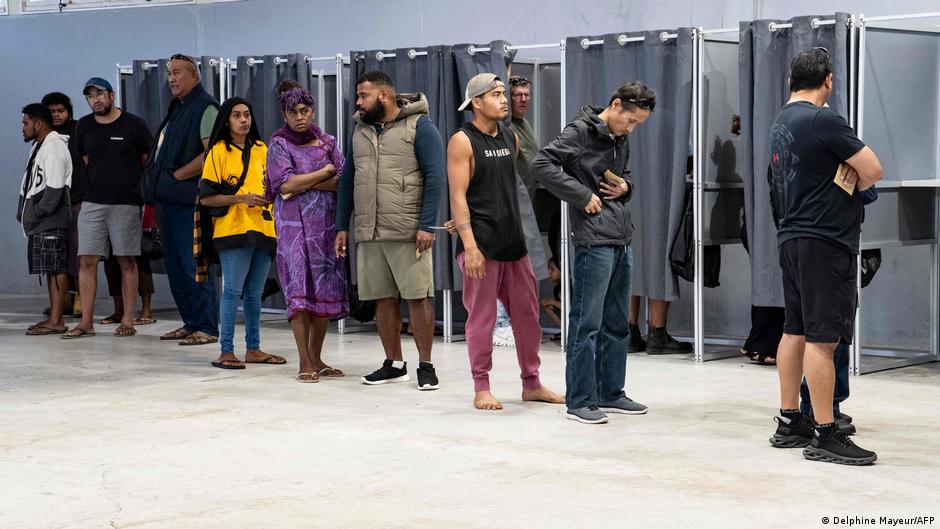
Security was tightened at polling stations in the French South Pacific territory of New Caledonia on Sunday, as voters began casting ballots in provincial elections originally scheduled for 2024.
About 2,500 police were dispatched to protect polling stations across the archipelago as voters began voting at 8:00 a.m. (2100 GMT Saturday) in the first such poll since 2019.
Sunday’s vote will determine the balance of power ahead of negotiations with France over the territory’s status, with 76 councilors elected to the region’s provincial assemblies. Fifty-four of those councilors would become members of the New Caledonia Congress – the sole body authorized to pass local laws.
Congress, which is headquartered in the capital Noumea, will elect 11 members to the region’s executive, known as a collegial government.
French voter-roll plan sparks violence, delaying 2024 vote
New Caledonia was paralyzed by violent unrest between the indigenous Melanesian Kanaks, who make up 41% of the population, and French loyalists ahead of a planned 2024 vote and scheduled talks with France.
France’s role in the islands’ affairs has been a divisive issue for New Caledonia’s approximately 270,000 residents for decades.
Ahead of the 2024 vote, France announced its intention to grant voting rights to thousands of non-indigenous residents, sparking riots that left 14 dead and more than €2 billion ($2.2 billion) in damage.
A law passed in May granted voting rights to about 10,575 “native-born” residents, including more than 4,000 people with “customary civil status” — meaning Kanaka — in the first expansion of the frozen voting rolls since 1998.
About 190,000 people are eligible to vote in Sunday’s elections.
The issue of independence continues on Noumea and Paris
Despite a large portion of the islands’ residents speaking in favor of separation from France, three recent independence referendums, held in 2018, 2020 and 2021, have failed.
Independence campaigners had called for a boycott of the most recent referendum, arguing that it coincided with the traditional Kanak mourning period following deaths from the COVID-19 pandemic.
France has tried to put the issue to rest once and for all, proposing a so-called Bougival Agreement of 2025 as a way to stabilize relations.
This agreement would have created a New Caledonian state and enshrined New Caledonian nationality in the French constitution, as well as prohibiting any future independence vote.
Pro-independence groups, which enjoy strong support among the Kanak population, rejected the French proposal.
Located about 1,500 kilometers (930 mi) from Australia, New Caledonia was named by English explorer Captain James Cook in 1774 and became a French colony in 1853.
In 1946 it officially became a French overseas territory.
French Prime Minister Sébastien Lecornu has promised that talks on New Caledonia’s future will resume next month and has expressed a goal to conclude them by the end of the year.
Edited by: Zack Crellin