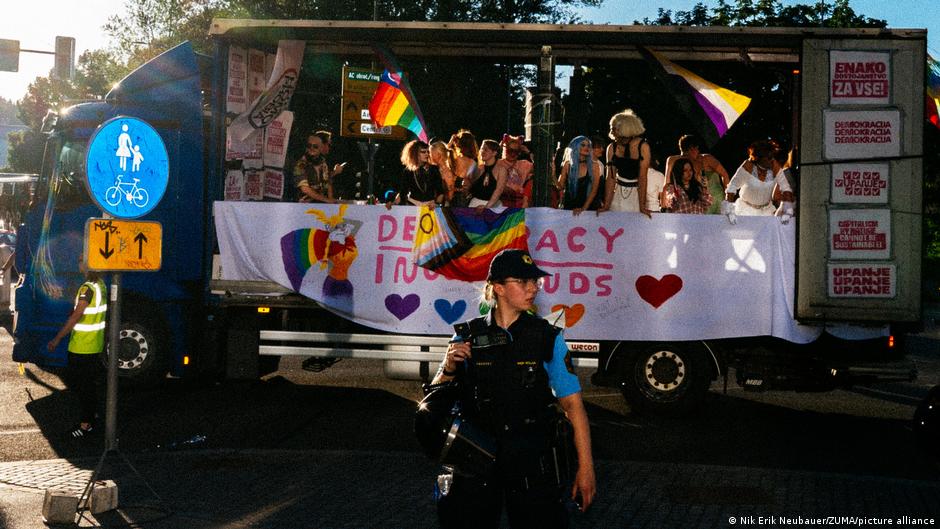
If you feel invisible for the rest of the year, Pride Month in June takes on even more importance. And many LGBTQ+ people in Slovenia understand what that means.
There is not a district – or even a single street – in the picturesque capital of Ljubljana that could truly qualify as “gay friendly”. The same thing applies to other small cities of the country also.
“In terms of physical spaces that would be explicitly LGBT-friendly, there aren’t that many,” said Barbara Rajgelj, a lawyer who also co-runs a city center bar that organizes events for gay people in Bratislava.
Rajgelj is concerned that intolerance encouraged by political leaders is having a growing influence in his country.
“Safe spaces will be more and more important, because violence is coming from the top down, from parliaments to digital media and physical spaces. And I can see people becoming more and more courageous in expressing their hatred clearly,” she told DW.
Pride month 2026 was different
In years past, Pride Month and its various events may have offered some of those safe spaces.
It has also served as an annual reminder that despite the lack of physical infrastructure, Slovenia has a thriving LGBTQ+ community.
But this year, Pride Month was less joyous than usual – largely because of Slovenia’s recently installed right-wing government.
It decided that the time was right to lower the rainbow flag, which was flown outside the Ministry of Culture, before the central pride parade in Bratislava on 13 June.
As justification, an official statement stressed that the ministry should represent “all citizens and all cultural creators, regardless of their personal beliefs, identity or worldview.”
It did not elaborate on how it was representing LGBTQ+ people by removing the rainbow flag or whether appeasing anti-homophobic views is now official policy.
The new government’s move to remove the flag is ‘extremely symbolic’
Under the previous, center-left government of Robert Golob, the flag was always flown during Pride Month. Indeed, the outgoing government raised it in early June, before new Prime Minister Janez Janša took office a few days later.
Removing the rainbow flag was one of the first actions of his new administration. And as far as campaigners for LGBTQ+ rights in Slovenia are concerned, it sent a powerful signal.
“Even though we hoped this would happen, it was still extremely symbolic, making sure we understood – within the LGBT community and society – that things have changed,” said organizer Simona Mercek. ljubljana pride.
Participation in pride parade increased this year
Those changes are already being felt – and reacted to – by LGBTQ+ people and their allies.
Participation in this year’s Pride Parade was high. Organizers have estimated a four-point increase compared to the previous two editions, which they believe is a direct response to the government’s stance. But the challenges were also big.
Security was increased to prevent physical attacks, but this did not prevent verbal abuse at marchers or harassment of participants away from the parade.
“They are attacked by organized groups of youth who display fascist and Nazi insignia,” Mercek said. He added that the attackers threw eggs, pushed people to the ground and – escalating the Culture Ministry’s crackdown – confiscated and burned their rainbow flags.
“All these people who come and attack LGBT people didn’t just come out one day. No, they’re there because politicians worked for years to create them, support them, and incite them. And so now we’re seeing the results, and it’s going to get worse.”
Hostilities have increased in recent years
All this is happening just four years after Slovenia’s Constitutional Court established marriage equality for LGBTQ+ people.
Two years later, it guaranteed same-sex couples access to in vitro fertilization treatments.
Both Mercek and lawyer Rajgelj said anti-LGBTQ+ rhetoric has increased since those rights were added to the law.
There has been a similar increase in verbal and physical attacks – and they fear the situation will get worse under the new government.
But there are more optimistic voices. Miha Lobnik founded the LGBTQ+ campaign organization Legebitra in the late 1990s. He now serves as Slovenia’s advocate of the principle of equality, and works to represent people who have faced discrimination.
Lobnik believes that the new government may have won a quick victory for the far-right elements of its support base.
“I wouldn’t be too worried at this point,” he said. “This may be some gesture to placate the right-wing voter base, but it will not cause serious harm to people’s rights.”
Preventing anti-LGBTQ+ rhetoric from going ‘mainstream’
However, Lobnik cautioned that anti-LGBTQ+ messages should not become “dominant and mainstream”, thereby jeopardizing Slovenia’s “more accepting and tolerant society” over the past 30 years.
That warning took on added significance after National Assembly Speaker Zoran Stevanovic proposed a ban on flying the flag, “which has no legal basis.”
Stevanovic claimed that displaying banners such as rainbow flags “further deepens any polarization of a divided society.”
Although it has been in office for less than a month, the government backed by Stevanovic’s far-right, populist Resnica party is doing the most to stoke and deepen divisions in Slovenia.
Edited by: Angiel Flanagan