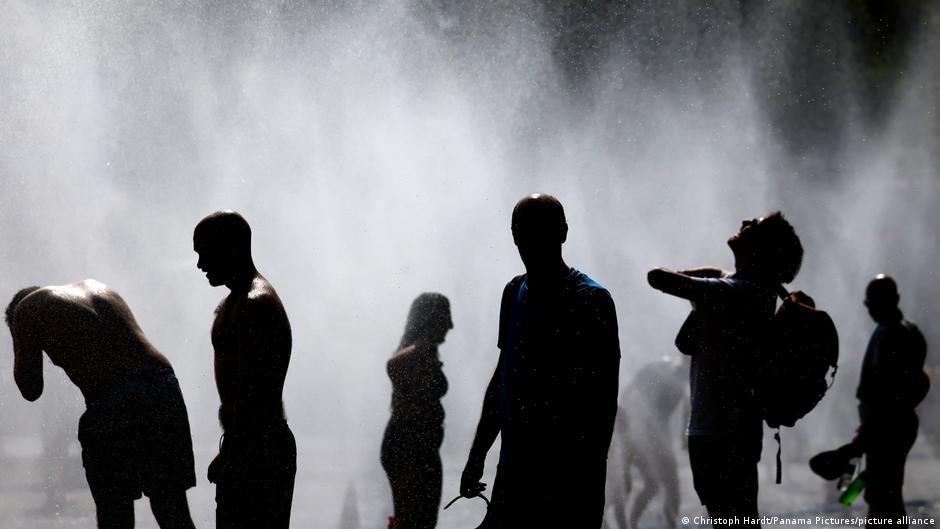
This past weekend record-breaking temperatures exceeded 40 degrees Celsius (just over 107 degrees Fahrenheit), leading to limited opportunities to cool off at night and a lack of water. These are life-threatening conditions for retirees and nursing homes and hospitals with little or no air conditioning.
One reason for this is that Germany has no national heat conservation regulations that would require cooling systems in such facilities.
Infrastructure was also affected, with trains and trams unable to operate and the asphalt on many roads cracked.
Experts have been issuing warnings for a long time. But I am saying Deutschlandfunk Radio (DLF)Climate expert Andreas Becker of the German Weather Service said that temperatures in Germany are continuously rising and will continue to do so in the coming years.
Europe is most affected by global warming
According to the Federal Environment Agency, about 50 hectares of land in Germany will be converted to residential, transport and commercial areas every day between 2021 and 2024. In other words: every day in Germany, natural areas worth 70 football fields disappear.
Sealing soil prevents rainwater from seeping into the ground, causing severe flooding during heavy rainfall. Additionally, sealed surfaces do not allow water to evaporate, causing cities to overheat and urban areas to become dangerously hot.
So, what can policymakers do to ensure that countries are better prepared for extreme temperatures in the future?
Plans for cities already exist, but they take time and are expensive to implement. Environment Minister Carsten Schneider of Germany’s center-left Social Democratic Party (SPD) said on public broadcaster Monday ARD He believes it is not up to the federal government in Berlin to lead adaptation to climate change. “The responsibility lies with the federal states and the municipalities,” he said. “For example, I can’t even give financial aid because Germany’s basic law prevents me from doing so.”
The environment minister promised to discuss with his conservative coalition partners the possibility of amending the Basic Law so that the federal government could play a more active role in implementing such changes. But he said states and municipalities have about €100 billion ($114 billion) available for climate projects thanks to a €500 billion infrastructure program approved after last year’s federal election.
Climate Council: Germany set to miss its own CO2 reduction target
Greenhouse gases are primarily produced by burning fossil fuels. They act as an insulation blanket around the Earth, reducing global warming.
Germany has committed to cutting its greenhouse gas emissions by about 65% by 2030, as measured against 1990 levels, and has already achieved 48% of that target. But many experts do not believe that the government can achieve its promised target.
Even with a strong climate policy, the effects of the greenhouse effect are expected to intensify over the next few years in Germany, as they are the result of past years’ CO2 emissions.
However, the current government led by Chancellor Friedrich Merz of the conservative Christian Democratic Union (CDU) is once again allowing the installation of new oil and gas heating systems.
Greenpeace proposes ecological tax on billionaires
“Many municipalities are already heavily in debt, which means that special funds alone are insufficient to, for example, quickly dismantle heat-absorbing concrete surfaces, create water-retaining green spaces, or plant shade-providing trees. Such measures require long-term public support and investment and cannot be financed by one-time investments alone,” Martin Kaiser, head of International Climate Politics at Greenpeace Germany, told DW.
Greenpeace has proposed an environmental tax on billionaires as a solution; However, there does not seem to be enough support for it within the ruling coalition at present.
Germany’s opposition parties are quick to criticize the government. Ines Schwertner, chair of the Socialist Left Party, said there needed to be more investment in public transport – especially in cities – so that buses and trains could run safely even during extreme heat.
Green Party leader Felix Banaszak called for providing direct support – without red tape – especially for vulnerable facilities such as retirement and nursing homes. Banaszak also commented on the government’s failure to issue a statement during the heat wave: “It seems that Friedrich Merz and his government have agreed to remain silent on this issue and were just hoping to avoid saying anything about the situation until it rains again,” he told reporters.
Climate protection has lost most of its urgency
What’s more, most Germans do not seem to be as concerned about climate protection as they used to be. In a nationwide survey published in early June by polling institute Infratest-Dimap, only 10% of respondents said environmental protection and climate change were the most important or second most important issues to them. Instead, issues like the economic recession and immigration top the list.
As noted, the survey was conducted before Germany experienced its hottest heat wave ever.
This article was translated from German.