30 June 2026
Police is active to curb violence
South African police have deployed in large numbers to ensure security at planned anti-immigrant protests amid fears of possible looting and violence.
The country’s Police Minister Firoz Kaichalia has emphasized that any illegal action will be dealt with strictly.
He said crime, intimidation, violence, destruction of property and any attempt to undermine public safety will not be tolerated.
It comes as thousands of people, mostly from Malawi and Zimbabwe, gathered in Cape Town and Johannesburg, still waiting for aid to return to their home countries.
Some people have said they have been evicted from their homes or fired from their jobs by landlords or employers because they fear reprisals from vigilante groups.
Several African governments, for the first time, have organized planes or buses to repatriate their citizens ahead of an unauthorized June 30 deadline set by anti-immigrant groups for undocumented foreign nationals.
South Africa has seen some deadly incidents of violence targeting undocumented foreign nationals in the past, with 62 people killed in riots in 2008.
https://p.dw.com/p/5GIbm
Read: Is this a crisis of the government’s own creation?
Analysts who spoke to DW argue that the anti-migrant unrest is not really about migration but reflects deeper structural problems in South Africa.
This includes deeper issues like high unemployment, inequality and public frustration with governance.
He says that delay in government action, weak police system and corruption have made the situation worse.
DW has asked him whether this crisis is a crisis of the government’s own making?
https://p.dw.com/p/5GGmP
WATCH: Xenophobia in South Africa: Who’s really paying the price?
Thousands of African migrants have been driven out of South Africa by anti-immigrant groups, who accuse foreigners of “stealing jobs”. The result: Brand South Africa is suffering losses.
https://p.dw.com/p/5GARp
30 June 2026
Shops closed in Johannesburg city
The Johannesburg city center and surrounding areas are unusually quiet.
Shops on main streets in Fordsburg and Newtown are closed.
The popular shopping center Oriental Plaza is also closed, as well as many other shops in downtown Johannesburg.
Johannesburg is bracing for anti-immigrant protests Despite assurances from South African police and government that today will be a normal day, store owners do not seem convinced.
https://p.dw.com/p/5GIDX
Published June 30, 2026Last updated June 30, 2026
“We are ready to keep this country safe,” the police commissioner told DW.
Police were gathering at a stage in Mayfair, south of Johannesburg, in preparation for an anti-immigrant march taking place today.
Two events are planned for South Africa’s largest city, one in Johannesburg’s city center and one in the densely populated area of Hillbrow.
Acting Police Commissioner Puleng Dimpane told DW:
“We are ready for today. We are ready to keep this country safe.”
https://p.dw.com/p/5GI8Z
30 June 2026
Ramaphosa urges peaceful protests
President Cyril Ramaphosa urged those planning to protest to do so peacefully.
in his weekly newspaperPublished a day before Tuesday’s demonstrations, they acknowledged public concerns about “illegal immigration, border management, pressures on public services, criminal syndicates exploiting our immigration system and the impact these challenges have on communities”.
However, Ramaphosa stressed that the constitutional right to protest does not permit violence, intimidation or vandalism.
“Freedom comes with responsibility,” he wrote.
The South African President also rejected vigilantism and said that immigration enforcement should remain the responsibility of legitimate authorities.
Ramaphosa said the government was pursuing reforms including stronger border management and anti-corruption measures.
He said many foreign nationals live and work legally in South Africa.
“They work, study, raise families, invest in our economy and contribute positively to our society. They are also entitled to the protection of our laws and our Constitution,” he said.
https://p.dw.com/p/5GGd0
30 June 2026
WATCH: Migrants are leaving South Africa due to fear and uncertainty
DW spoke to people caught up in the anti-immigrant rhetoric across South Africa.
https://p.dw.com/p/5GGSH
30 June 2026
Why have some South Africans turned to the African diaspora?
Protesters in South Africa are demanding undocumented foreigners leave by Tuesday, amid fears that planned anti-immigrant rallies could turn violent.
Citizen-led groups have backed an unofficial deadline after weeks of unrest, including attacks on migrant-owned businesses.
South Africa, one of Africa’s largest economies and a country of about 65.5 million people, has long attracted migrants looking for work. The number of foreign-born residents is estimated to be between 2.4 and 3.1 million.
But unemployment in South Africa is the highest in the world, with almost a third of people out of work and deep inequality is fueling people’s anger.
Some activists blame migrants for crime and pressure on public services, although rights groups warn such claims risk escalating tensions.
An Anthropological Research Council survey conducted last year showed that South Africans were more hostile towards immigrants than ever before, with only one in six adults saying they would welcome all foreigners and 42% saying they would welcome none, up by more than a third in 2021.
https://p.dw.com/p/5GGiP
30 June 2026
Welcome to our coverage
Today a unilateral deadline has been set by anti-immigration groups for all undocumented immigrants to leave South Africa.
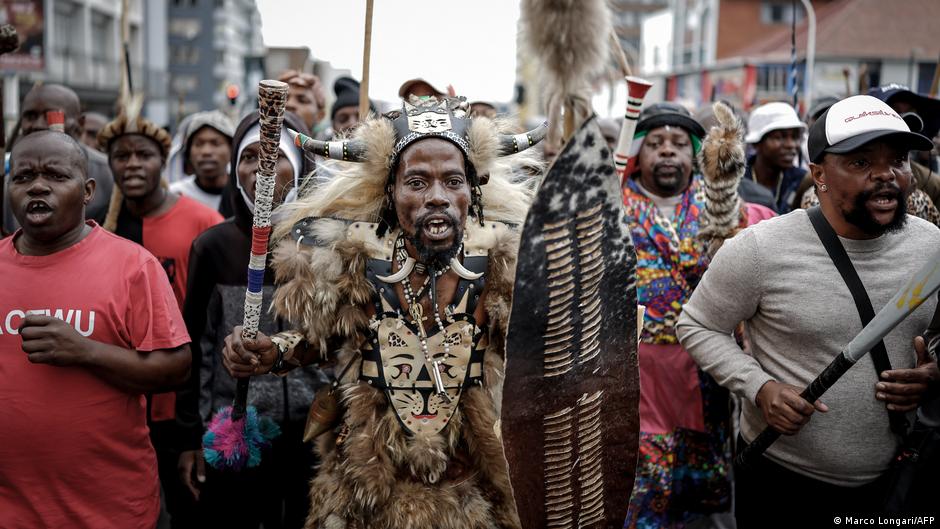
Marches are planned in major cities across the country, with the main demonstration taking place in Durban in the KwaZulu-Natal province.
March & March, the main organization behind the protests, said it was not calling for violence.
But the tension is very high. Three people, including a Malawian and two Mozambican citizens, were killed during recent anti-immigration protests in the lead up to today’s “deadline”.
There have also been reports of self-styled vigilantes intimidating migrant parents and children in schools. Some migrants have also been stopped from reaching hospitals.
The South African government has condemned the violent incidents and distanced itself from the deadline imposed by anti-immigration groups, however, it has also faced criticism from other African states and civil society groups for failing to stop the violence.
Several countries, including Nigeria, Ghana and Malawi, have helped repatriate citizens who say they no longer feel safe in South Africa.
DW will be covering today’s developments with a team that includes correspondents in South Africa and Zimbabwe and elsewhere on the continent.
https://p.dw.com/p/5GARg