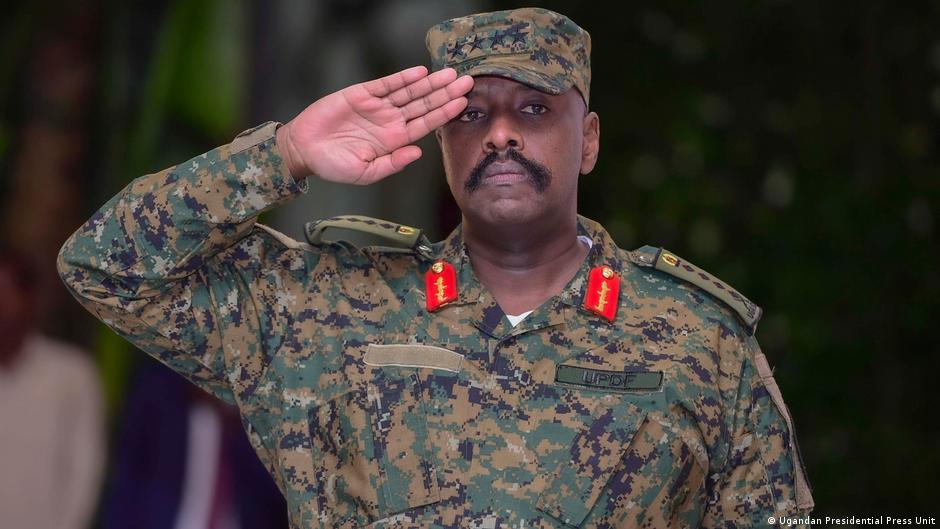
The rights group Amnesty International has called on the Ugandan government The harassment of workers should be stopped immediately and the media should be allowed to work. Their demand comes after Ugandan military chief Muhoozi Kainrugaba ordered the closure of independent media company Nation Media Group (NMG). Kainrugaba, the son of President Yoweri Museveni, is known for threatening government critics, especially opposition leaders. His attack on the press is the latest escalation. Several opposition figures, including Kizza Besigye, remain in detention on what rights groups and activists say are politically motivated charges.
On June 28, troops surrounded the editorial and broadcasting facilities of the company, NTV, a channel owned by NMG. The military carried out a broadcast campaign on NTV and Spark TV. The “Daily Monitor” and “The East African” newspapers, as well as radio stations, have also been affected.
“Negotiations are ongoing at various levels for reopening,” Susan Nsibirwa, managing director of NMG in Uganda, said on Monday, according to news agency Reuters.
US condemns Uganda’s attack on freedom of expression
Jim Risch, chairman of the US Senate Foreign Relations Committee, reacted strongly to Kainarugaba’s actions: he urged Washington to review its security relationship with Uganda, saying Kainarugaba’s attacks on free speech, including the closure of major media houses, made him and the Ugandan military “unfit partners”.
Army chief Kainrugaba did not give any specific reason for closing the media outlets, but wrote on Platform X: “I do not believe in a free press. The press should be directed by the cadres of the revolution.” He also confirmed that the orders were approved by his 81-year-old father, who has ruled Uganda for 40 years and begins his seventh term in January 2026.
The opposition and human rights groups accuse Kainirugaba of being a central figure in the highly repressive regime led by his father, a former rebel leader.
Under Canarugaba’s orders, demonstrations are often crushed by brute force. “The president’s son continues his unchecked and unjust campaign to harass and intimidate independent media and civil society,” Tigray Chaguta, Amnesty’s director for Eastern and Southern Africa, said in a statement on Monday.
Is Museveni ‘handing over power’ to his son?
“We are seeing a transfer of power to the president’s son,” a source at an international foundation in Uganda, who wished to remain anonymous for security reasons, told DW. “General Kainrugaba has been increasing his influence within the government since taking over the leadership of the army in 2024,” he said. daily monitor It is Uganda’s most influential independent newspaper and is known for its investigative journalism, editorial independence and critical reporting on the government.
Canarugaba had threatened to shut down the news outlet just weeks earlier. According to the source, the reason for this was critical headlines and critical analysis by NTV regarding the army general’s influence on national institutions, especially the Ugandan Parliament.
However, even the institutions responsible for regulating the media – such as the Uganda Communications Commission – have “acted very cautiously towards the action of the army chief of staff,” he said.
Commission director George William Nyombi Thembo reserved his statement: “We are in contact with relevant authorities within government institutions to gain a comprehensive understanding of the current situation. As soon as we have all the facts, we will issue a comprehensive statement as the regulatory authority,” he told DW.
Opposition also ‘under siege’
Opposition parties repeatedly criticize the government’s repressive policies. According to political observers, they face pressure and face arbitrary arrests, kidnappings, and politically motivated charges.
“We are convinced that Uganda should be governed in accordance with the principles of the Constitution and the rule of law,” Lulum Baiga, deputy leader of the People’s Front for Freedom (PPF), told DW, commenting on the commission’s statement. “This is the body that should take responsibility for shutting down media outlets.”
However, according to human rights lawyer Kathy Anite, the institutions responsible for media governance in Uganda have retreated. “It is absolutely clear that the state is disregarding rights and laws regarding media freedom,” he told DW.
Enite is a member of the Independent High-Level Panel of Legal Experts on Media Freedom and founder of the Freedom of Expression Hub in Uganda. “In my view, all media restrictions, including the closure of media outlets, should be enshrined in law and serve a legitimate purpose.”
“We are currently witnessing an erosion of media freedom and a blatant disregard for the policy standards that govern a free press,” Anite said. He said Uganda’s political leadership has created a complex and contradictory environment that has blurred the lines between constitutional guarantees, legal restrictions and media freedom.
“This arbitrary closure will have a negative impact on media freedom and citizens’ freedom of expression in the country and will undermine accountability and rule of law,” he warned. He further said, “The media has a mandate to criticize the state.”
Journalists are disappointed with the restrictions on press freedom in the country. “We are afraid to express our opinions and do our jobs,” Kathy Luzige, a journalist for television station NBS TV, told DW.
He said, “In this media profession, it is a serious blow and a big shock when you cannot speak or think without fear.”
Edited by: Crispin Mavakideau