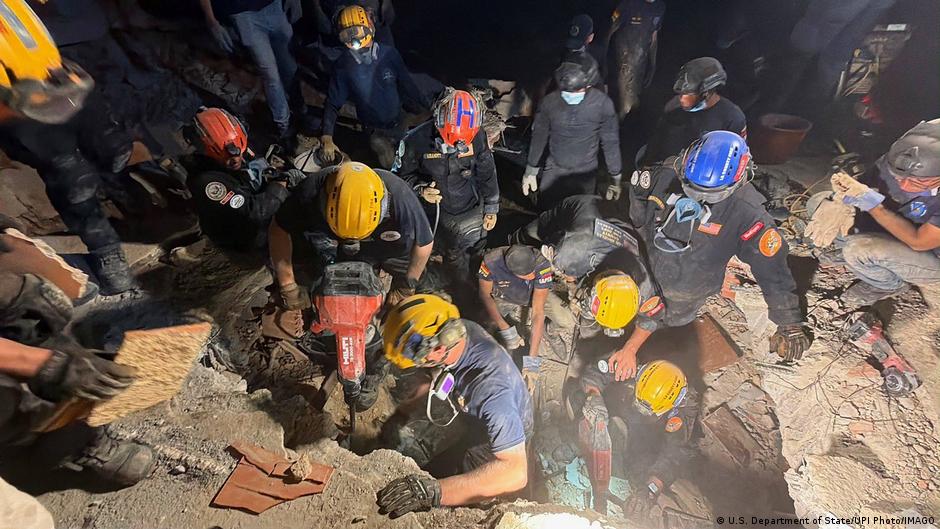
Rescuers raced to find survivors in Venezuela on Tuesday, nearly a week after two earthquakes devastated parts of the country.
According to data collected by the Venezuelan government, opposition, UNICEF and the National Aeronautics and Space Administration (NASA), following the magnitude 7.2 and 7.5 earthquakes that struck just seconds apart last week:
- At least 1,943 people died
- more than 10,500 injured
- About 16,000 people became homeless
- More than 6,400 people were rescued
- About 43,000 are missing
- Approximately 680,000 children are in need of humanitarian assistance, and
- 59,000 buildings were damaged
What is the status of the rescue operation?
However, the pace of rescue has slowed as the critical survival window of 72 hours has closed.
Rescue workers are hoping to find survivors, but now they are also searching for the dead.
On Tuesday, Ecuadorian and US rescue teams launched operations in Macuto, La Guaira, after they failed to get a response after more than 40 hours of trying to free a mother and her three children trapped under the debris of a building.
Major Jorge Montenero, leader of the Ecuadorian team, said, “In the end, we believe the days have already passed and all we will find now is death.”
In some cases, hope still remains as Jordanian rescue teams pulled a three-year-old boy alive from the debris in Caracas on Tuesday, one of the few survivors in recent days.
What are aid agencies saying?
Meanwhile, aid agencies have warned of worsening hunger, disease and a collapsing health care system.
The World Food Program (WFP) has appealed for $50 million (€43.83 million) to provide emergency food assistance to 500,000 people over the next three months.
The World Health Organization (WHO) warned on Tuesday of pressure on Venezuela’s healthcare system.
WHO said at least three health centers were seriously damaged and six others were only partially functioning.
WHO spokesman Christian Lindmeier sounded the alarm over the spread of measles, malaria, yellow fever and dengue among thousands of displaced people due to a lack of sanitation facilities and low vaccination rates.
Edited by: Srinivas Majumdaru
Don’t let algorithms hide news. If you rely on our team for reliable reporting, please take a moment to choose us as your Favorite sources on Google By clicking here and pressing the “Star” or “Favorite” button, you will always see our verified news first.