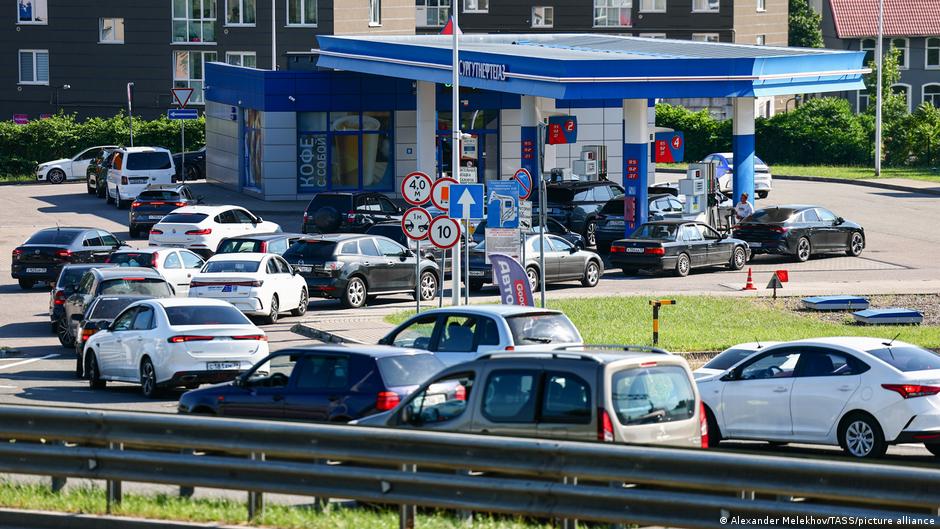
For several months, Ukrainian forces have been targeting Russian territories and energy infrastructure in the illegally occupied Crimean peninsula. Russian supply routes into the occupied territories, as well as major oil refineries inside Russia, have also come under attack.
In June alone, refineries in Moscow, Nizhnekamsk, Tyumen and Volgograd were affected. A total of 16 refineries were attacked in May. As a result, gasoline production has declined by 25%, Reuters reported citing its sources. Russia is currently producing only 85,000 metric tons of gasoline per day, while summer demand is 110,000 metric tons per day.
“This summer, Russia is headed for the worst fuel crisis in its history,” experts from the US think tank Energy Intelligence said.
Putin admitted fuel shortage for the first time
On June 28, Russian President Vladimir Putin publicly acknowledged “some fuel shortages” for the first time.
“There has been some damage,” he said in an interview on Russian state television, adding that all damaged facilities are being repaired fairly quickly, and the problems are not serious.
“Putin was forced to openly admit that the problem exists,” Zavadskaya, a political scientist at the Finnish Institute of International Affairs, told DW. “Most importantly, they identified the cause of the problem – Ukrainian drone strikes.”
According to estimates by Russian business outlet RBC, 40 Russian regions have already banned the sale of the fuel. At least 78 regions may be affected, according to Vyrostka, an independent Russian news outlet that analyzed official information and eyewitness reports. Long lines have formed at gas stations in many cities.
Christina Harvard, an expert at the Institute for the Study of War (ISW) in Washington DC, said Ukraine has already attempted to attack Russian refineries in 2025.
“What’s different this year is that Ukraine has clearly increased the number of their drones and the quality of their drones. They’ve improved the range of their drones and over the last few months they’ve also been attempting to identify and destroy Russian air defense systems,” Harvard said.
Attacks on Russian military supply lines
At the same time, Ukrainian forces are trying to disrupt the supply routes of the Russian army near the front line. According to Harvard, the increasing number of attacks on targets 20 to 200 kilometers (up to about 120 miles) behind the front line “is a new development on the Ukrainian side in this war.”
She says there are increasing reports that supplies to the front are beginning to slow down.
Harvard said, “We’ve seen reports that in the Hulyajpol direction – to the east and west of the Zaporizhia region – troops are not getting as much fuel. They’re not getting as much ammunition. And they’re not getting all the other supplies they need.” He said there were increasing problems delivering artillery ammunition and even reconnaissance drones to the Donetsk region.
Harvard also said that the Crimean Bridge, which has recently come under repeated Ukrainian attack, is a major supply route not only for the Russian military but also for civilians on the occupied peninsula.
If the Ukrainians were able to completely destroy the bridge, “it would really cut off one of the main arteries of Russia,” he said.
Occupied Crimea ‘difficult to maintain resupply’
A state of emergency has been in effect in occupied Crimea and the city of Sevastopol since June 26. Russian-established authorities imposed the measure after a series of Ukrainian attacks led to fuel and food shortages on the peninsula.
According to British historian Mark Galeotti, Ukraine has identified Crimea as one of Russia’s key vulnerabilities.
“It is very difficult to maintain re-supply. It is very difficult to maintain fuel, electricity, water and all the things that are needed,” the professor emeritus at University College London told DW. “And so they’re hoping that by turning the screw on Crimea, they’ll force Putin to get serious about some kind of peace talks and peace talks on their terms.”
Ukrainian President Volodymyr Zelensky described the attacks on fuel depots and refineries as “long- and medium-term sanctions” aimed at forcing Moscow to come to the negotiating table.
At the same time, Galeotti said there is a risk that the campaign could push Putin to escalate the conflict.
“But that is the gamble that currently dominates Kiev,” he said.
Galeotti rejected speculation that Ukraine was preparing to retake Crimea by military force, calling such claims “more psychological warfare than real preparations.”
He said, “I think not only would it be really, really hard to do, but I think it would be the kind of thing that Putin would have to respond to.” “It would be a great humiliation for him to lose the Crimea, which he considered the ‘crown jewel’ of his conquests.”
From Ukraine’s perspective, Galeotti said, “It’s about pressure rather than conquest.”
Can Putin be pressured for peace?
Asked what potential Russian tensions might look like, Galeotti said Putin has several options.
He said, “He could mobilize hundreds of thousands of additional reservists, even though it would be incredibly unpopular and disruptive politically. He has about 150,000 troops that he hasn’t sent in yet because again, that would be very unpopular.” “The nightmare scenario – that he might use tactical nuclear weapons – I think is incredibly unlikely. But anyway, the point is that he has a range of options, but they are all self-harming options.”
So how far is Putin going to go? Is Kiev’s strategy to force Russia towards peace producing the desired effect?
According to Galeotti, there is currently “no reason to think that the economy is going to collapse, or the public is going to rise up, or there is going to be a coup or any other extreme situation like that.”
However, at the same time, he doubts that Russia can maintain the war at its current intensity for much longer.
“Take it another year. And clearly, the damage to the Russian economy will be huge. So under those circumstances, there is a need to at least think about alternatives,” the expert said.
This article was originally published in Russian.