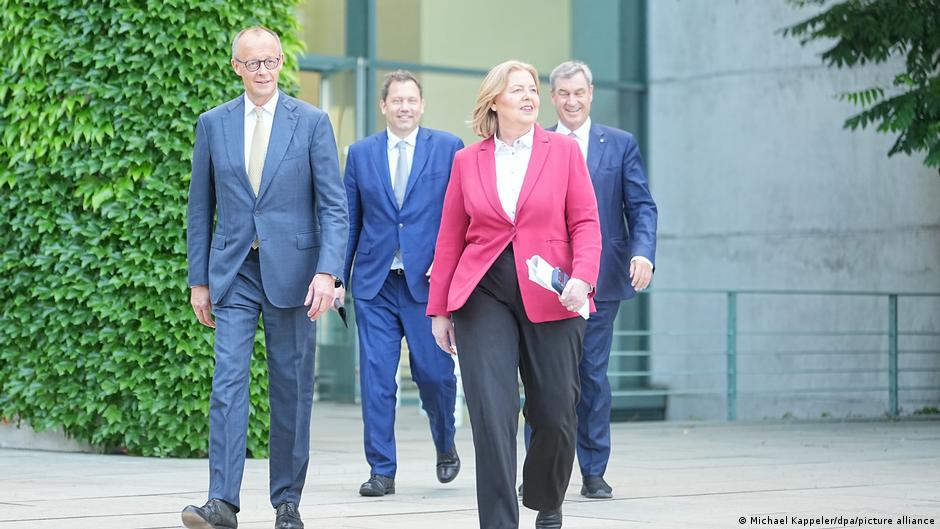
German Chancellor Friedrich Merz said his conservative CDU/CSU bloc and the center-left Social Democrats (SPD) had approved a “list of important reforms” to modernize the economy and restore competitiveness.
The announcement was made at a news conference on Thursday, in which Merz was joined by SPD leaders Barbel Baas and Lars Klingbeil, as well as Markus Söder, leader of Bavaria’s conservative Christian Social Union. The four coalition leaders met in Berlin the previous day to consider final details of the reform package.
The measures include €10 billion ($11.4 billion) in income tax relief, the end of phone-based sick notes and the implementation of Pensions Commission proposals by the end of 2026.
Germany’s reform plan at a glance
- Pension: Implementing the Pension Commission’s proposals, which include adding a new investment-based element to Germany’s largely pay-as-you-go state pension system, and gradually raising the retirement age over the coming decades.
- Tax: Providing annual relief to households of around €10 billion, partly funded by increasing the top tax rate for very high earners from 45% to 47%.
- Laboratory: Removing the ability of employees to receive sick notes by phone, requiring medical certificates from the first day of illness, and giving firms greater flexibility over fixed-term contracts and dismissals for higher earners.
- Industry: Supporting strategic sectors including cars, chemicals, medicines, batteries, semiconductors, AI and clean tech.
- welfare: Strict action against benefit fraud through greater data sharing and stronger enforcement.
- energy: Accelerating electricity grid expansion and giving clear grid-connection timelines to industry.
- Business: Strengthening EU anti-dumping and anti-subsidy instruments with greater scrutiny of strategic non-European investments.
- Accommodation: Creating a federal housing company, supporting affordable housing and making mortgage financing easier.
- Bureaucracy: Cutting out form and reporting duties for companies, and automatically approving some applications if authorities do not take action within four months.
What did the government say about the schemes?
“We are providing relief to workers and businesses by cutting taxes and reducing bureaucracy. We have now completed our first year of reform. From the beginning, we have set an agenda with a single goal: We want to get Germany moving again. It is now clear that this is possible,” Merz said.
With her party trailing the far-right Alternative for Germany party in the polls, Merz faces pressure to pass reforms to reinvigorate Europe’s largest economy, but struggles to overcome squabbling within the coalition.
Appearing with Merz at the Chancellery Garden press conference, three other leaders of the coalition parties enthusiastically lauded the reforms.
SPD co-leader and Finance Minister Klingbeil said he believed the reforms would have broad public support, especially with regard to fairness.
“The coalition has agreed on solutions that can be supported by the broad majority of our society,” he said, adding, “They are confident that these decisions will give new strength to our country.”
Baas, another co-leader of the SPD, said the package would “really ensure that the economy grows again, that we achieve growth and secure jobs, as well as maintain social balance, and above all, that we strengthen solidarity within our country.”
Meanwhile, CSU leader Söder described the package as “well-rounded”.
Each coalition partner would like to see more in some areas, he said, “but coalition means compromise.”
“We’re making progress,” Soder said. He said that while the package itself was not a “big bang”, it was another step away from economic stability.
Who is in favor of reforms?
Deutsche Bank CEO Christian Sewing welcomed the reform package, calling it an important launchpad for restoring Germany’s competitiveness.
“This reform package is a very successful starting point and supports our call for reforms that boost growth, competitiveness and innovation,” the head of Germany’s largest bank said.
Sewing said the government must now maintain that momentum, step up implementation and initiate further reforms.
The German Insurance Association (GDV) warmly welcomed the ruling coalition’s measures aimed at boosting growth.
“What is decisive now is quick and consistent implementation as part of the parliamentary process,” said Jörg Asmussen, managing director of GDV.
Rainer Dülger, president of the Confederation of German Employers’ Associations, also welcomed the coalition’s reform package as “long-awaited change.”
Dalgar said the package has strengthened competitiveness and confidence.
However, he also called for further measures, arguing that social security contributions are too high and there is no sign of relief for high performers and major contributors.
Who is against reforms?
The Verdi Services trade union has sharply criticized the government’s reform package, seeing plans to provide workers with a doctor’s certificate from the first day of illness as an expression of a culture of distrust.
“Distrust of workers and the insane extension of fixed-term employment contracts do not lead to growth,” said Frank Wernecke, head of Verdi, Germany’s second-largest trade union.
Germany’s largest trade union, IG Metall, was more ambiguous in its response than Verdi, describing the package as “a mixed bag of light and shadow”.
Union president Christian Benner welcomed the planned tax relief for workers. But he lamented the expansion of fixed-term employment contracts, calling it an “attack on workers’ rights.”
He also opposed the abolition of telephone sick notes, saying it fulfilled an “anti-social wish list” of employers.
Felix Banaszak, co-leader of the environmentalist Green Party, sharply criticized the government’s reform package, calling it a “vote of no confidence among citizens”.
The Socialist Left Party condemned the coalition’s reform package as a “program of distrust and ignorance”.
“A reduction of a few euros in taxes does not compensate for high living costs, insecure pensions and the growing burden in the health care system,” the party leadership said.
Family doctors described the government’s plans on sick notes as “absolutely disastrous”.
Markus Blumenthal-Beer, president of the German Medical Association, said the alliance was “acknowledging the full burden on the practice of our doctors.”
He said it would create a “huge wave of bureaucracy” and cause needy patients to wait longer.
Edited by: Sean Sinico, Dmytro Lyubenko
Don’t let algorithms hide news. If you rely on our team for reliable reporting, please take a moment to choose us as your Favorite sources on Google By clicking here and pressing the “Star” or “Favorite” button, you will always see our verified news first.