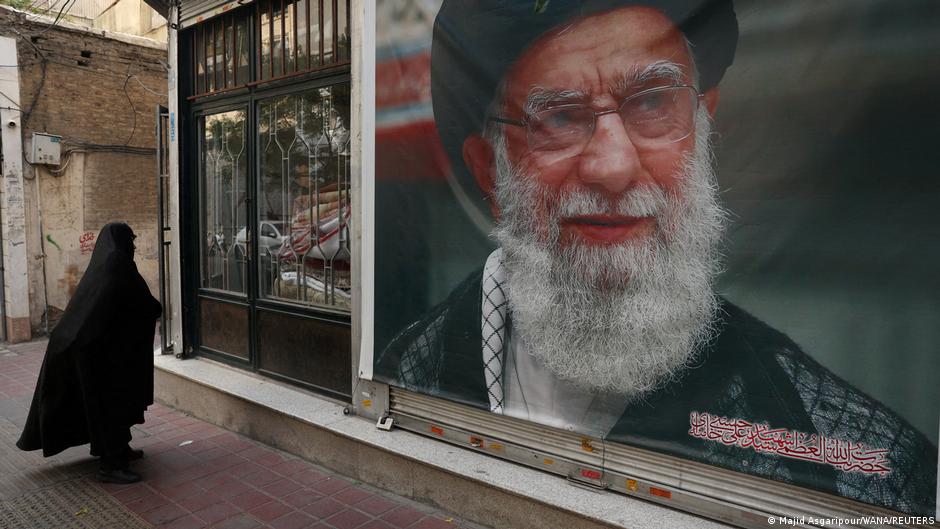
According to Iranian media, Tehran’s acting mayor Alireza Zakani said the ceremony for former supreme leader Ayatollah Ali Khamenei would be “the largest gathering in the history of the capital”.
Khamenei, who was the supreme authority on all major state affairs for 37 years, was killed in missile attacks on his residential and work compound in central Tehran at the age of 86.
The attacks occurred on February 28, the first day of the war, when the United States and Israel launched attacks on Iran. Several members of his family, including his daughter and two grandchildren, were also reportedly murdered.
Satellite photos show significant destruction at the site, but it is unclear whether bodies have been recovered and in what condition.
The funeral was originally planned for early March, but was delayed due to the conflict. Now it is going to start on 4th July. Iranian officials announced the celebrations after a fragile ceasefire between Washington and Tehran took effect.
According to Ali-Akbar Purdjamshidian, head of the organizing committee, the six-day event aims to “strengthen national solidarity and unity” across political, social and religious groups. It remains uncertain whether this target will be achieved.
nationwide mobilization
In the country of about 93 million people, authorities are now mobilizing supporters for celebrations. Three official days of mourning are scheduled in Tehran starting Saturday. During that time, the capital will effectively be closed, businesses will be closed and work will be suspended. Extensive preparations have been made for the visitors coming from across the country.
Khamenei will be buried on July 9 in the northeastern city of Mashhad, his birthplace. A day earlier, a funeral procession is expected to pass through Iraq, including the holy cities of Najaf and Karbala – a move widely seen as a sign of Iran’s regional influence.
under heritage scrutiny
Mehrzad Boroujerdi, a political science professor at Missouri University of Science and Technology, said, “Unlike Ayatollah Ruhollah Khomeini, who ruled for a decade after the 1979 revolution, Khamenei led the country for 37 years with apparent micromanagement and interference in almost all areas of governance.”
During his tenure, tensions with the outside world increased, while corruption, economic mismanagement, and sanctions related to the nuclear dispute increased pressure on the country. Public dissatisfaction continued to grow, resulting in repeated waves of unrest.
These included the Green Movement of 2009, the “Women, Life, Freedom” protests in 2022, and nationwide demonstrations in late 2025 and early 2026 – all of which were suppressed by force.
“Khamenei’s approach was to make no concessions to his opponents, whether to critics of the regime or to reformists within the system,” Boroujerdi said.
This has contributed to the growing gap between society and the political system. “A lot of people are tired of the current system,” he said.
A women’s rights activist in Tehran, who asked that her name not be used, said many protesters were still struggling to accept that the Islamic Republic had finally won.
“At the same time, its supporters have gained new momentum,” he said.
The war has also reinforced the feeling among many Iranians that they cannot rely on outside help. Heavy bombing of densely populated cities and the destruction of key industries, including petrochemical plants and steelworks, led to the loss of thousands of jobs, deepening disillusionment – especially among young people.
Continuity of Khamenei’s foreign policy
The inclusion of the so-called Lebanon Front as the first point in Iran’s recent negotiating memorandum with the United States underlines the continuity in Khamenei’s foreign policy approach. .
Hamidreza Azizi of the German Institute for International and Security Affairs said, “Hezbollah has become closer to Iran, especially the Quds Force, and is becoming more reliant on Tehran politically and militarily.”
However, divisions remain within Iran’s leadership, particularly within the Revolutionary Guards, over possible talks with Washington, said Azizi, author of the recently published book “The Axis of Resistance: Iran, Israel and the Struggle for the Middle East.” The outcome of the talks remains uncertain.
For many supporters, attending a funeral is not just about mourning.
“Two major military powers attacked Iran, and yet the Islamic Republic is still standing,” Boroujerdi said. “For many people, it’s a testament to resiliency.”
He said partial implementation of the 14-point framework discussed with the US would also represent a significant achievement. Comparable concessions were not secured after the Iran–Iraq war or under the 2015 nuclear deal.
Among Iran’s key demands is a US commitment to non-interfere in its internal affairs, which Washington had never previously agreed to but which it has now accepted as part of the memorandum of understanding.
Edited by: Ole Tangen Jr.