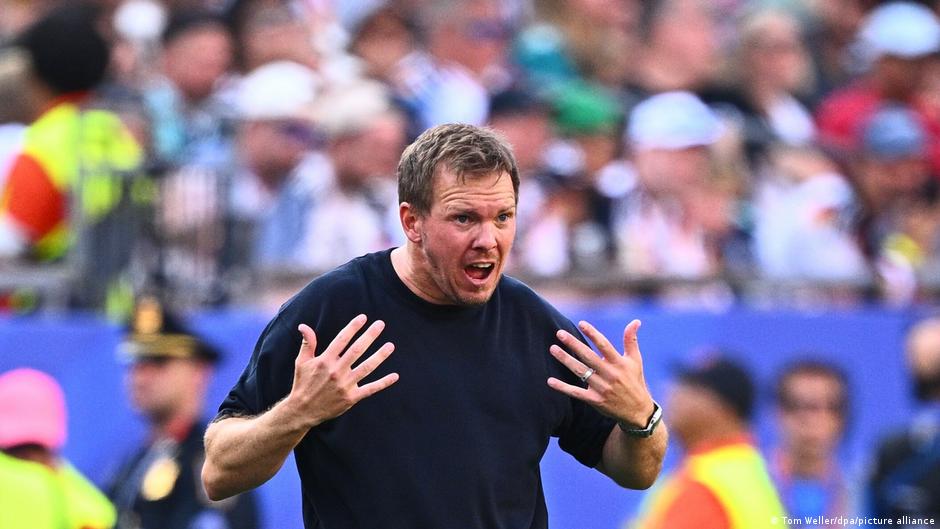
As was widely expected following Germany’s defeat to Paraguay at the 2026 World Cup, Julian Nagelsmann has stepped down as national team head coach, the German Football Association (DFB) confirmed on Friday.
The 38-year-old resigned from the job just three years after arriving and well before the end of his contract, which was due to expire after the 2028 European Championship. The renewal of his deal in January 2025 forced the DFB into difficult negotiations, and a secret three-hour meeting was reportedly held the day before the official announcement.
“This decision was not at all easy for me,” Nagelsmann said in a statement.
“My top priority has always been the team’s success. After such a bitter disappointment, the team deserves the chance for a fresh start without any burdens… Special thanks also to the fans. You pushed us on, you believed in us and even in difficult times you gave us energy. I am truly sorry and deeply saddened that we let you down and were unable to give you more nights of football excitement at this World Cup. You deserved much more than this!”
Nagelsmann’s assistants Benjamin Gluck and Benjamin Hübner are also gone. The DFB also said it is in talks with Jurgen Klopp for the vacant head coach position, indicating that the former Liverpool and Dortmund boss has already shown a desire to take on the role.
Nagelsmann won 23 of his 37 games in charge of Germany, while losing only eight times. Three of those defeats came against Spain, Portugal and France, but two defeats also came against Ecuador and then Paraguay in the 2026 World Cup.
His exit is another downturn in a coaching career that was once expected to reach the highest heights.
Young coach created history in Bundesliga
A decade ago, Julian Nagelsmann made his debut as Hoffenheim coach in a 1-1 draw with Werder Bremen in the Bundesliga. He was the face of Germany’s new, young coaching generation. He sided with a side battling relegation at the top of the table. They defeated Bayern Munich. Then came the Champions League. He told Süddeutsche Zeitung that: “30% coaching is strategy, 70% social ability.” He was considered a coach beyond his years, ahead of his time, and one of the best coaches ever.
He then moved to RB Leipzig, where he became the youngest coach to win a Champions League game, and then the youngest coach to make it to the semi-finals. A year later, he took RB Leipzig to the German Cup final but lost.
Despite his two years at Leipzig ending without a trophy, Bayern Munich reportedly paid €25 million for his services and offered him a five-year contract. They won the Bundesliga, but a crushing defeat to Villarreal in the Champions League damaged both the club and their reputation.
The following year, it all unraveled for Nagelsmann. His sacking of Bayern Munich goalkeeper coach Toni Tapalovic caused a stir, with Manuel Neuer saying the dismissal was “like ripping his heart out.” According to a report by The Athletic, Nagelsmann’s training was seen as too complex and he struggled to truly connect with the players.
In March 2023, Nagelsmann was sacked while on skiing leave during the international break. He had been in the job for only 20 months. After seven full seasons of coaching in the Bundesliga, he was out of work and had only one Bundesliga title to his name.
jobs in germany
Six months later, he was named head coach of Germany. He was a “desired candidate” whose passion for the game was “infectious” – such were the words of Rudi Völler, the sporting director at the time.
After a difficult start to his tenure, in which he suffered defeat to Turkey in Berlin and then a defeat to his mentor Ralf Rangnick in Vienna, Nagelsmann has prepared the team for Euro 2024 on home soil and has also been communicating strongly on topics outside football.
Despite a quarter-final loss to Spain, in which Germany were denied a crucial penalty, the performance at the tournament was considered a success. A connection between team and country was reestablished. Nagelsmann was considered a key factor in Germany’s success. His emotional speech after his exit, calling for people to come together, was poignant and the words of a man who was clearly aware of the influential nature of the national team. In short, 2024 was a big step in the right direction for the coach and the country.
In January 2025, Nagelsmann extended his contract until 2028, a decision that received much praise. Jürgen Klopp said that he “liked Julian’s work” and felt that Nagelsmann had made Germany favorites for the next tournament.
However, eyebrows were raised when Nagelsmann said immediately afterward that the goal was to win the World Cup. The atmosphere was sour after a disappointing performance in the last four of the Nations League, which was made worse when Germany’s World Cup qualifying campaign began with a defeat against Slovakia.
“I can no longer bear to hear this constant ‘quality, quality’. We have to play football with passion! In every game!” Nagelsmann was criticized at the time.
Germany got the job done, but as the World Cup year began, things began to unravel again as Nagelsmann’s communications became increasingly confusing. Oliver Baumann moved from number one to back-up following the surprise return of Manuel Neuer. Joshua Kimmich was a midfielder, then right back. Leon Goretzka was going to start, then didn’t. Deniz Undav was scoring in the Bundesliga, but was considered a back-up.
world cup crisis
And then came the World Cup. Beyond the opener against Curaçao, Nagelsmann’s team was more reactive than proactive. They were unable to hold on to their comeback winning streak in Toronto. They could not maintain the lead against Ecuador. They could not eliminate Paraguay. The players deserve criticism, but questions have also been asked about Nagelsmann’s decision-making, communication and sideline behavior.
Who knows what lies ahead for the one-time future king of German coaching. For someone who has long said he didn’t want to coach in his old age, there probably aren’t too many stops left before he hops off the football train. Certainly his reputation has taken a hit after this performance. A return to management in Germany seems unlikely. Given that the Premier League has one of the most volatile fire-and-hire approaches in world football, perhaps Nagelsmann will be seen on the sidelines of an English top-flight team again in six to 10 months’ time.
However, there is still confusion about how it all happened. For a coach with so many skills, many people would not have expected Julian Nagelsmann to have such a career.
Edited by: Chuck Penfold