Mark Root came prepared for his latest trip to Washington in late June.
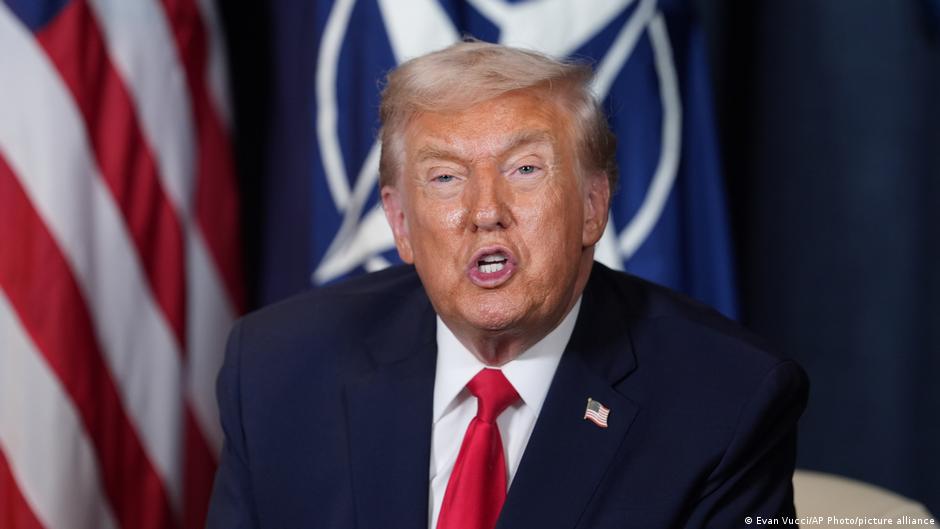
As Donald Trump complained about European allies and their reluctance to support the United States during its war against Iran, the NATO Secretary General responded with praise. That’s a lot. and pointed to a large display board decorated with gold headlines, one of which was titled: “The Trump Trillion.”
Rutte was in full pitch mode in front of the camera. “I want to show you what this president was able to achieve,” Rutte told the press, highlighting the additional $1.2 trillion (€1 trillion) in defense spending by European allies and Canada since 2017, when Trump first took office.
Just days before the crucial NATO summit began in Ankara on July 7, Rutte was doing what was to become one of his most important tasks: keeping Donald Trump on board. The summit will bring together the leaders of NATO’s 32 allies at a moment of growing uncertainty amid rising tensions in the Middle East and Russia’s ongoing war with Ukraine.
As the US reviews its military posture in Europe, many European governments are concerned about how committed Trump is to the security alliance.
Ankara summit aims to ‘make the case for NATO’
Rutte’s strategy to keep the alliance together is to flatter Trump, emphasize the benefits NATO brings to the US and highlight efforts by European allies to increase defense spending. The NATO chief wants to avoid public disputes in Ankara and demonstrate the allies’ unity.
Claudia Major, a trans-Atlantic security expert at the German Marshall Fund think tank, told DW that worried leaders will try to send the message that the alliance is still strong — and “try to appease Trump and make the case for NATO.”
This may explain why Rutte – who is looking for common ground – has put defense production at the center of this year’s summit.
He is expected to unveil what he calls a “defense industrial revolution,” which will include tens of billions of dollars in new contracts and procurement deals for Europeans seeking to boost arms production.
Rutte’s goal, Major said, is “to show that there is a market for American industry as well as make an economic case in favor of NATO that Trump will hopefully find attractive.”
America will keep a ‘close eye on allies’ in Europe
Whether this approach will work remains unclear. “If we’ve learned one thing about the American president over the last year and a half, it’s that he can be very disruptive and it’s hard to predict what he’s going to do,” Major said.
This unpredictability was on display at the NATO defense ministers meeting in Brussels on June 18, when Trump’s Secretary of Defense, Pete Hegseth, announced a review of US troop deployments and military posture in Europe.
Hegseth also issued a clear warning: “Our National Defense Strategy clearly states that we are going to encourage and enable our allies to step up and play their role,” he said. “So we will take a hard look at those allies who are not doing so, and who say no, or maybe, or wait and see when it is most important. This is a review that some countries will fail, and others will pass with flying colors.”
The harsh tone caused some irritation among the assembled ministers. The review itself was expected – European governments had long anticipated a gradual decline in the US role in Europe. Their concern is about how soon this will happen.
German Defense Minister Boris Pistorius warned against creating military shortages during the transition. “It’s about a roadmap. It’s about a synchronized way of doing it,” he said after the defense ministers’ meeting. “The most relevant challenge is to avoid dangerous capacity gaps.”
Europe needs its own plan to manage this infection, Major said. He said, “If the US decides they no longer want to play a significant role in Europe, the Europeans will have to step in – and they had better do so quickly given the threat from Russia and the overall geopolitical weakness around Europe.”
Following US pressure, European NATO allies and Canada increased defense spending by 20% in real terms in 2025 compared to the previous year.
Support for Ukraine tops the agenda
An important part of the Ankara summit will also be to secure further support for Ukraine, including promises of a potential new billion dollars of funding to strengthen the country’s defense and security.
According to news agency AFP, European members of NATO and Canada will pledge 70 billion euros ($80 billion) of military aid to Ukraine this year and next at the upcoming Ankara summit.
But tensions remain among European allies over burden sharing, with Rutte repeatedly calling for Ukraine aid to be distributed more evenly among NATO partners.
For Major, the central question of the NATO summit is not defense spending or procurement contracts, but political unity.
“If the summit reflects political division, if there is open conflict, if the U.S. president criticizes an ally for not spending enough, for not doing enough in the Iran war, then that is weakening political cohesion and with it the military deterrence and defense message,” he said.
But there is cautious optimism that the allies will stand together. At the G7 summit in France last month, Trump took a far more cooperative stance and joined other leaders in supporting additional pressure on Russia and President Vladimir Putin, including additional sanctions on oil exports and the banking sector.
German Chancellor Friedrich Merz took the result as a positive sign, saying it sent an important signal to Ukraine and “set a new tone in trans-Atlantic unity and determination.”
“Perhaps for the first time, a chance for peace may be open,” he said.
NATO unity faces a real test
NATO leaders are hoping for a similar outcome of unity in Ankara.
The summit declaration is expected to reaffirm the alliance’s mutual-defense clause, Article 5, which states that an attack on one ally is an attack on all. And they are hopeful of maintaining language describing Russia as a long-term threat to Euro-Atlantic security – both key priorities for European allies.
But resistance only works if that promise is credible. And that is why unity is the real test facing NATO in Ankara.
Edited by: Martin Kulber, Andreas Illmer