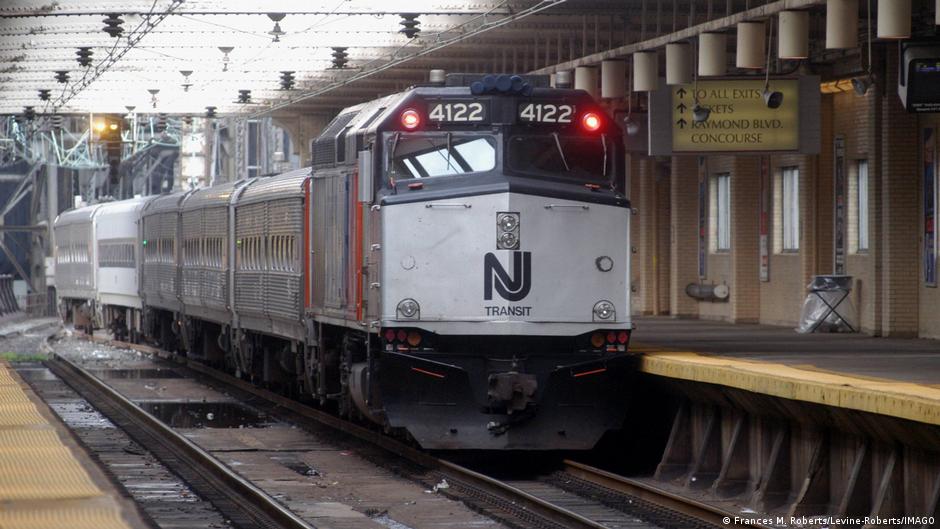
Historically neglected, train travel in America is having a moment. The number of passengers has set new records in the last two years. With aviation fuel and gas prices still running well above pre-Iran war levels, even more travelers this summer travel season may turn to passenger rail to avoid expensive airfares and trips to the gas pump.
But those unfamiliar with the country’s train network may be disappointed. Many cities do not have good rail connections, or the high-speed services common in European and East Asian countries.
And here’s a paradox, because America actually has more railroads than anywhere else in the world. So where is the separation?
freight vs passenger trains
The mid-to-late 19th century were a heyday for rail travel in America. Thousands of miles of railways were laid to connect the coasts and transport people and goods from one end of the country to the other. But it could not last.
By the mid-20th century, America prioritized federal funding for highway and airport development over railroads, making automobile and plane travel far more efficient than passenger rail lines.
So unlike many European countries, which have long viewed passenger trains as an important public good, the US prioritized the more profitable freight trains. That legacy lives on today, with much of the country’s track infrastructure now designed to carry heavy goods rather than passengers at high speeds.
The most popular route of the American passenger rail company Amtrak is an example of this. Known as the Northeast Corridor, it connects the cities between Boston and Washington, DC, taking about seven hours to travel the entire 457 miles (735 kilometers). By comparison, trains can cover the slightly longer route between the Italian cities of Naples and Milan in just under five hours.
Alan Zarembski, director of the University of Delaware’s Railroad Engineering and Safety Program, says one reason the Northeast Corridor’s rails can’t accommodate high-speed trains is because they are curved by the shape of the land. And changing it will be complicated.
“Straightening the track is a very expensive proposition,” he said. “I have to acquire land. The land is owned by someone, and often no one wants to sell it. … We’re talking about going through the most densely populated part of the United States.”
‘Train going nowhere’
While the Northeast Corridor is not currently capable of supporting high-speed rail, California had hoped to set a positive example.
In 2008, the state launched an initiative to connect Los Angeles and San Francisco with a bullet train. Sold as a massive upgrade to the 12-hour non-direct route between the two cities, the idea was to lay new track that would transport passengers between the cities in less than 3 hours. The state originally said the 800-mile line would be completed by 2020.
But the project has not left the planning stage, leading some to dub it California’s “train to nowhere.” So what went wrong?
The state initially appropriated $9.95 billion (€8.72 billion) for a project with a $33 billion budget, but they greatly underestimated the development cost which is now estimated to exceed $100 billion.
Zarembski believes that project leaders knew that their initial estimates were too low. “I think they downplayed it for political purposes,” he said. “They knew they would never get a higher price through the legislative process.”
The project has also faced opposition from communities who do not want the railway to pass through their neighborhoods.
As the state continues to seek investment, it is currently constructing a short section of the route, with plans to open in the early 2030s. As for the entire route, last year the California High-Speed Rail Authority outlined a plan that it said aimed to connect San Francisco to Northern California by 2038 — nearly two decades after its initial launch.
Benefits of good rail connection
Shifting to high-speed rail will not only benefit passengers, but also the climate. According to Amtrak, its electric trains produce 72% and 83% fewer emissions than planes and cars, respectively.
Yet transforming America into a country where passenger rail travel is faster and more efficient is an expensive business. And unlike prior US governments, which invested heavily in Amtrak, the Trump administration has sought to cut federal funding for passenger rail infrastructure since taking office – with a proposed cut of 82%. 2027 fiscal year budget.
Amtrak says it will need more than $100 billion of budget stimulus and over 15 years to complete all planned improvements in the Northeast Corridor alone. This would include updating signal systems, rebuilding old tunnels and bridges and adding a modern fleet – among other infrastructure improvements.
Alon Levy, a transportation and land use fellow at New York University’s Maron Institute, believes the necessary updates could be made at much lower expense.
Levy was the lead author of the report, which found that it would be possible to build high-speed rail on the Northeast Corridor for about $17 billion, in addition to funds already committed.
“The Northeast Corridor is one of the few lines where, for the most part, the standards of the line are quite high,” he said. Therefore, instead of a complete system overhaul, it would be wise to adopt common technical and operational standards in Europe and Asia and apply already proven rail technologies used abroad.
He believes the biggest issue for the US is often not a lack of money, but the failure to import innovations from other countries.
“It’s kind of the American mentality where if you’re not first at something, it’s really hard to learn how to be second or third,” he said. “If something is invented in Japan, it can reach Europe. It is very difficult for the US to reach it, even when they know they are behind.”
Edited by: Tamsin Walker