In December 2025, Italy awarded more than 1.1 gigawatts of solar capacity to 88 projects in the country’s first auction, which was specifically limited to projects built without Chinese-made equipment.
The winning bids averaged €66.38 ($75.80) per megawatt hour, 17% more than the price set in an unrestricted renewables auction held in 2025, according to data from GSE, Italy’s electricity services agency.
This was a deliberate premium paid for purchasing solar hardware from somewhere other than China. But with more than 90% of solar modules installed in the EU still imported from China, the auction showed how weak Europe’s alternatives really are.
China still produces more than 80% of the world’s solar components, dominating every step of the value chain from polysilicon to finished modules. That scale has provided the world with affordable panels, but it has made governments in Brussels and New Delhi uneasy about relying so heavily on a single supplier.
“China is present in almost every global solar supply chain,” Ajay Srivastava, founder of the Global Trade Research Initiative, told DW. Even panels assembled in India or Vietnam typically rely on Chinese-made cells, wafers or polysilicon further down the chain, he said.
India’s manufacturing promotion
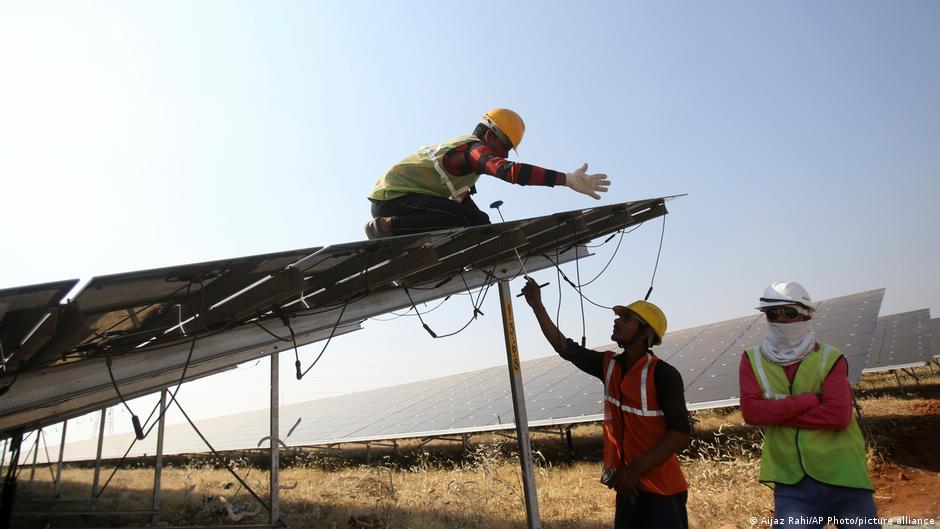
India’s transformation from buyer to builder has been rapid, at least on paper. The country’s solar photovoltaic (PV) module manufacturing capacity is set to reach 172 gigawatts (GW) by early 2026, while cell capacity is set to nearly triple to 30 GW.
This change is largely policy-driven.
Sanjay Varghese, a senior executive at Indian firm Renew, credited the government’s “Make in India” push – removing tariff and non-tariff barriers, such as the Approved List of Models and Manufacturers (ALMM), supported by a nearly $2.5 billion production-linked incentive (PLI) scheme – that reshaped the sector almost overnight.
“Five years ago, all the solar modules being installed in India were being imported from China,” Varghese said. “But today, all modules and about 50% of the cells consumed in India are made in India.”
Varghese expects the entire value chain from modules, cells, wafers, ingots and polysilicon to metallurgical-grade silicon to be domesticated within five to seven years.
Dries Eke, CEO of SolarPower Europe, said India’s capacity already far exceeds its demand. “This clearly means you will have a country looking for export opportunities,” Eke said.
where the limits are
But analysts also cautioned against overstating India’s preparedness to replace China.
Jochen Rentsch, head of technology transfer at the Fraunhofer Institute for Solar Energy Systems, pointed to wafers as the key hurdle: About 99% of the world’s photovoltaic wafers are still made in China. He also warned that Chinese manufacturers could price wafers below production costs, making it “almost impossible” for new entrants to compete on economics alone.
While India has become largely self-sufficient in cells and modules, it is dependent on China for wafers, polysilicon and manufacturing equipment, Rentsch said, suggesting that the shift toward Indian panels would shift only part of the process to Europe rather than eliminating its exposure to China.
Varghese acknowledged similar gaps from the industry side, noting that India is still dependent on Chinese companies for the equipment and machinery needed to manufacture solar products, and China continues to lead the world in solar technology development.
Europe’s policy gap
However, Europe’s plight is different. Germany alone aims to get 80% of its electricity from renewable energy by 2030, a goal that requires vast amounts of imported clean-energy hardware, much of it still tied to Chinese supply chains.
According to BSW-Solar, the German solar association, domestic module production in Germany has shrunk to a small, niche-market operation, although the country retains strong positions in inverters, mounting systems, battery storage and upstream manufacturing equipment.
Eke argued that Europe needs its own version of India’s PLI scheme, an output-based subsidy, similar in spirit to the US Inflation Reduction Act’s tax credits, to make local manufacturing commercially viable.
The EU’s upcoming Industrial Accelerator Act, which aims to build on the Net Zero Industry Act, 2024, has disappointed advocates like AK by broadly defining “Made in Europe” to include free-trade partners rather than requiring literal European production.
To make matters worse, US tariffs on Indian goods have reduced export prospects elsewhere, forcing Indian manufacturers to focus more on Europe. But Varghese said anti-dumping and countervailing duties on Indian-origin cells and modules in the US now exceed 250%, effectively closing that market for now.
But India’s geographical location provides some advantages. Rahul Sharan, deputy director and shipping expert at Drewry, an independent maritime research consultancy, said India’s west coast ports connect efficiently to Europe via the Suez Canal, potentially reducing delivery times compared to its East Asian rivals.
Still, he cautioned that logistics “alone is unlikely to eliminate the structural cost advantages that China has built up through scale and integration.” Sharan also identified the Strait of Malacca – through which more than 60% of global maritime trade passes – as a persistent chokepoint whose disruption, whether from South China Sea tensions or US-China rivalry, could spread through solar supply chains beyond Asia.
there’s a long road ahead
While experts argue that, at the moment, India remains the most credible alternative to emerging China in the field of solar manufacturing, it is not yet an alternative. Srivastava suggested that it takes 10 to 20 years to build real manufacturing capacity and that incentive schemes like India’s PLI often encourage assembly rather than deep manufacturing.
He believes the only realistic path forward is a coordinated “China-plus-one” strategy, with the US, Europe, India and others investing in parallel supply chains, even if the cost of production is 10 to 15% higher initially. “At present, however, that political and industrial leadership is missing,” Srivastava said.
This article is part of the India-Germany Climate and Energy Journalism Program organized by Clean Energy Wire, supported by the Heinrich Böll Stiftung.
Edited by: Carl Sexton