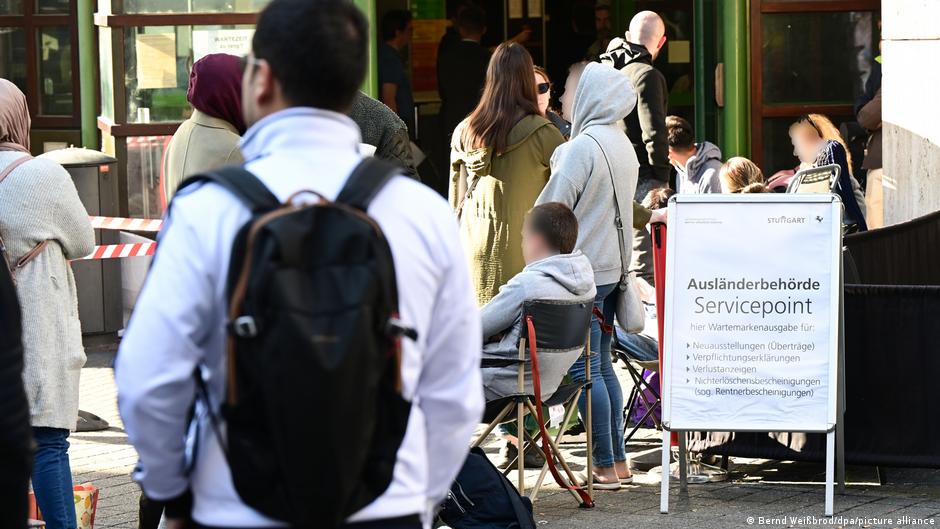
“Anyone who wants to successfully shape immigration must also understand emigration,” Laura Gossner of the Institute for Employment Research (IAB) said at a press conference in Berlin.
The organization conducted an online survey of people aged 18 to 65 who had immigrated to Germany before April 2025, asking them why they left the country again and what factors influenced their decision.
The researchers found that emigration is not driven by any one factor. Family-related reasons in particular play a major role. Experiences of discrimination were also cited.
Many contributing factors such as bureaucracy, housing, and language acquisition can be influenced by public policy.
Who is most likely to leave Germany again?
“On average, migrants are younger. They have spent less time in Germany and their partners and children are more likely to live abroad. They are also less likely to be proficient in German, but more likely to have a good command of English,” said IAB expert Theresa Koch.
While 60% of migrants return to their home countries, 40% move to other destinations. The most popular destinations are Spain, Switzerland, Italy and Croatia.
“We are competing with other European countries for skilled workers,” said Yulia Kosyakova, head of the research department on migration, integration and international labor market research. Employment Research Institute.
Bureaucracy is one of the main drivers of emigration
Expats criticize what is well-known about Germany: long processing times for naturalization applications, residence permits, visas and recognition of foreign qualifications. They often face long waits for a response from authorities. High administrative fees are another common source of frustration. Another point of criticism is the lack of support for career development, whether from job centres, local authorities or employers.
Laura Gossner says all this makes long-term planning, access to employment and a sense of belonging in Germany more difficult. IAB experts explain that administrative procedures influence “how immigrants assess their future in Germany. When procedures are perceived as lengthy, confusing or difficult to access, this can affect people’s chances of staying.” “We found that immigrants who view such processes more negatively are, on average, less likely to feel welcomed in Germany.”
Language remains the key to success in the German labor market
Tillman Frank is president of the Federal Association for International Skilled Labor Recruitment (Federal Association of International Skilled Recruitment e.V.) is also the managing director of TalentOrange GmbH, a company that has recruited and supported thousands of nurses, childcare workers and physiotherapists for positions in Germany. Frank tells DW that he knows why many people decide to pack their bags again after a short time in the country: In Germany, especially in the labor market, the key to finding your way is language, he explains.
Frank says, “It becomes problematic when the path to Germany is flawed from the beginning – when language acquisition is not adequately supported. If these elements are not present, the chances of these people returning home are relatively high. However, for those who are adequately prepared for life in Germany, retention rates are much higher.”
There is still demand for elderly care workers – but is the training appropriate?
According to Frank, people from Kenya, India and Vietnam are currently making particularly strong efforts to establish themselves in Germany. Kenya’s Ministry of Labor actively encourages young unemployed people to seek opportunities abroad. In India and Vietnam, many parents find vocational training opportunities in Germany highly attractive for their children. Demand for skilled workers from abroad remains strong, particularly in elder care.
Tilman Frank is therefore calling on the German government to support German-language education in migrants’ countries of origin. “Attempting to come to Germany without knowledge of the German language is not sustainable in the long run. International degree programs taught in English are a good example – people hope that this will enable them to work in Germany. But that does not happen.”
One reason for emigration may also be that immigrants are not employed in roles that match their qualifications: “For example, people trained in acute hospital care in their home countries may work in nursing homes providing basic care in Germany, without them being explicitly informed in advance,” explains Frank.
A New Approach: ‘Work and Live’ Agencies
Frank says policymakers now also recognize that international skilled workers should not only come to Germany, but also stay. His conclusion is that Germany offers a mixture of strengths and shortcomings.
“The Federal Employment Agency has introduced a centralized system that is faster and more reliable. The state of Hesse is setting up a central immigration authority, and there are also plans to create a federal ‘Work and Stay’ agency.”
“From an operational point of view, however, staff shortages in public authorities are making many aspects of the system more difficult. We are making progress with digitalization, but only slowly and through piecemeal initiatives by individual states and municipalities. There is still a lack of a comprehensive, nationwide solution.”
This article has been translated from German.